
Plumbing Apprenticeship Application: Steps, Forms & Online
This guide walks you through exactly what you need to apply, including where to find official application forms, how to complete online registration portals, and which documents you should gather before you start. At PlumbingJobs.com, we help connect aspiring plumbers with apprenticeship opportunities and employers across the country, so we understand what it takes to get your foot in the door.
By the time you finish reading, you’ll have a clear action plan to complete your application correctly the first time, and take the first real step toward building a career in one of America’s most essential trades.
Start with the right application type
Before you fill out any forms, you need to understand which type of plumbing apprenticeship application you’re pursuing. Your choice affects everything from the application portal you use to the documents you submit and the timeline you follow. Most apprenticeships fall into two main categories, and each path requires different paperwork and commitments.
Choosing the wrong application type can delay your start date by months or even disqualify you from certain programs.
Union apprenticeships
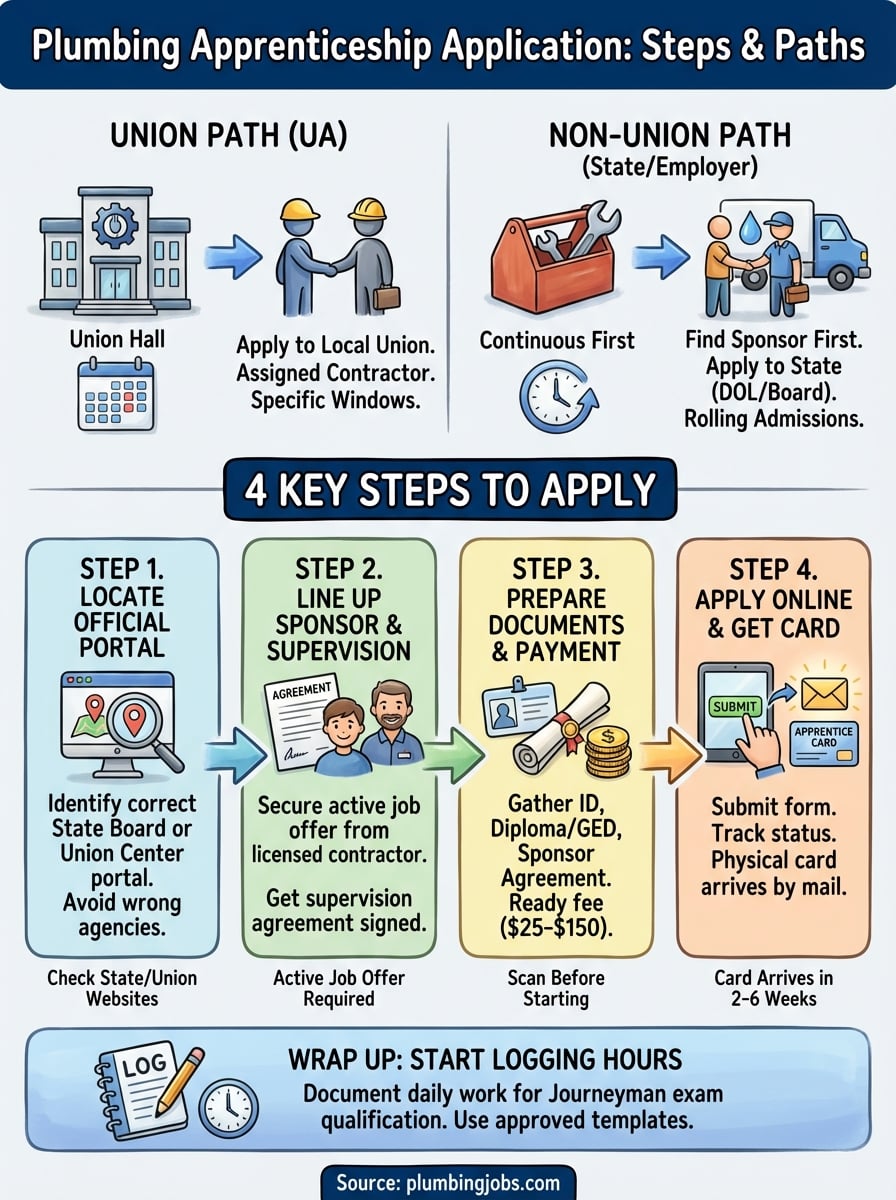
Union programs, typically run through the United Association (UA), require you to apply directly through your local union hall. You’ll find these listed as UA Local chapters, and each local handles its own application process. Union apprenticeships often require you to take an entrance exam, participate in an in-person interview, and wait for an available slot in their training class. These programs usually have specific application windows that open only once or twice per year.
Your application packet for union programs typically includes a birth certificate, high school transcript or GED, and sometimes a drug screening result. You don’t need a sponsor upfront because the union assigns you to a contractor once you’re accepted into the program.
Non-union programs
Non-union apprenticeships operate through individual employers, trade schools, or state agencies like your Department of Labor or Construction Industries Division. These programs often have rolling admissions, meaning you can apply whenever you secure a sponsoring employer. You submit your application to the state licensing board once you have proof of employment and a registered training agreement signed by your employer.
The application itself is usually simpler than union programs and doesn’t require entrance exams. However, you need to find your own sponsor first, which means applying for apprentice-level plumbing jobs and securing a position before you can register with the state.
Step 1. Locate the official portal for your area
Your plumbing apprenticeship application starts by finding the correct portal, and this varies dramatically depending on where you live and which program type you’re pursuing. Every state maintains its own licensing system, and getting this step wrong means submitting paperwork to the wrong agency, which wastes weeks of processing time. You need to identify whether your state uses a centralized online portal or requires paper applications mailed to a regional office.
Finding the right portal before you start gathering documents saves you from refiling and paying duplicate fees.
State licensing board websites
Start by searching “[Your State] plumber licensing board” or “[Your State] apprentice registration” in your browser. Most states house their plumbing apprentice registration within the Department of Labor & Industries, Construction Industries Division, or a dedicated Plumbing Board. Look for pages specifically labeled “Apply for Apprentice License” or “Register as an Apprentice.”
California uses DIR’s online portal at dir.ca.gov, while Texas requires you to work through the Texas State Board of Plumbing Examiners. Washington State handles everything through L&I’s online services portal. Each state’s portal has different login requirements, so create your account before you start filling out forms.
Union apprenticeship centers
Union applicants should visit ua.org and use their local union finder tool to identify your nearest UA training center. Contact them directly by phone to request application instructions, because many union locals don’t accept online applications and require you to pick up a physical packet during specific hours.
Step 2. Line up a sponsor and jobsite supervision
Most states require you to secure a sponsoring employer before you can submit your plumbing apprenticeship application, which means you need an active job offer from a licensed plumbing contractor. Your sponsor commits to providing on-the-job training under the supervision of a licensed journeyman or master plumber for the duration of your apprenticeship. Without this sponsor agreement, state licensing boards won’t process your registration paperwork.
Applying for apprentice jobs before securing your sponsor gives you the employment proof needed to complete your state registration.
Finding employers who sponsor apprentices
Search for apprentice plumber positions on PlumbingJobs.com where contractors actively hiring apprentices list their openings. Filter by your state and look for job postings that specifically mention “will sponsor apprenticeship” or “apprentice training provided.” You can also contact local plumbing contractors directly by phone and ask if they’re currently accepting apprentices. Many smaller shops don’t advertise but will consider candidates who reach out directly.
Getting the supervision agreement signed
Once you accept a position, request your employer complete the supervision or training agreement form required by your state licensing board. This document typically asks for the sponsor’s license number, business details, and a signature confirming they’ll provide at least the minimum required hours of supervised training (usually 2,000 hours per year). Your employer submits this form alongside your application or provides you with a signed copy to include in your packet.
Step 3. Prepare your info, documents, and payment
Your plumbing apprenticeship application requires specific personal information, supporting documents, and processing fees that vary by state and program type. Gathering everything before you start the online form prevents you from losing your progress halfway through or discovering you’re missing a critical document. Most applications expire after 30 days of inactivity, so having your materials ready means you can complete the entire process in one sitting.
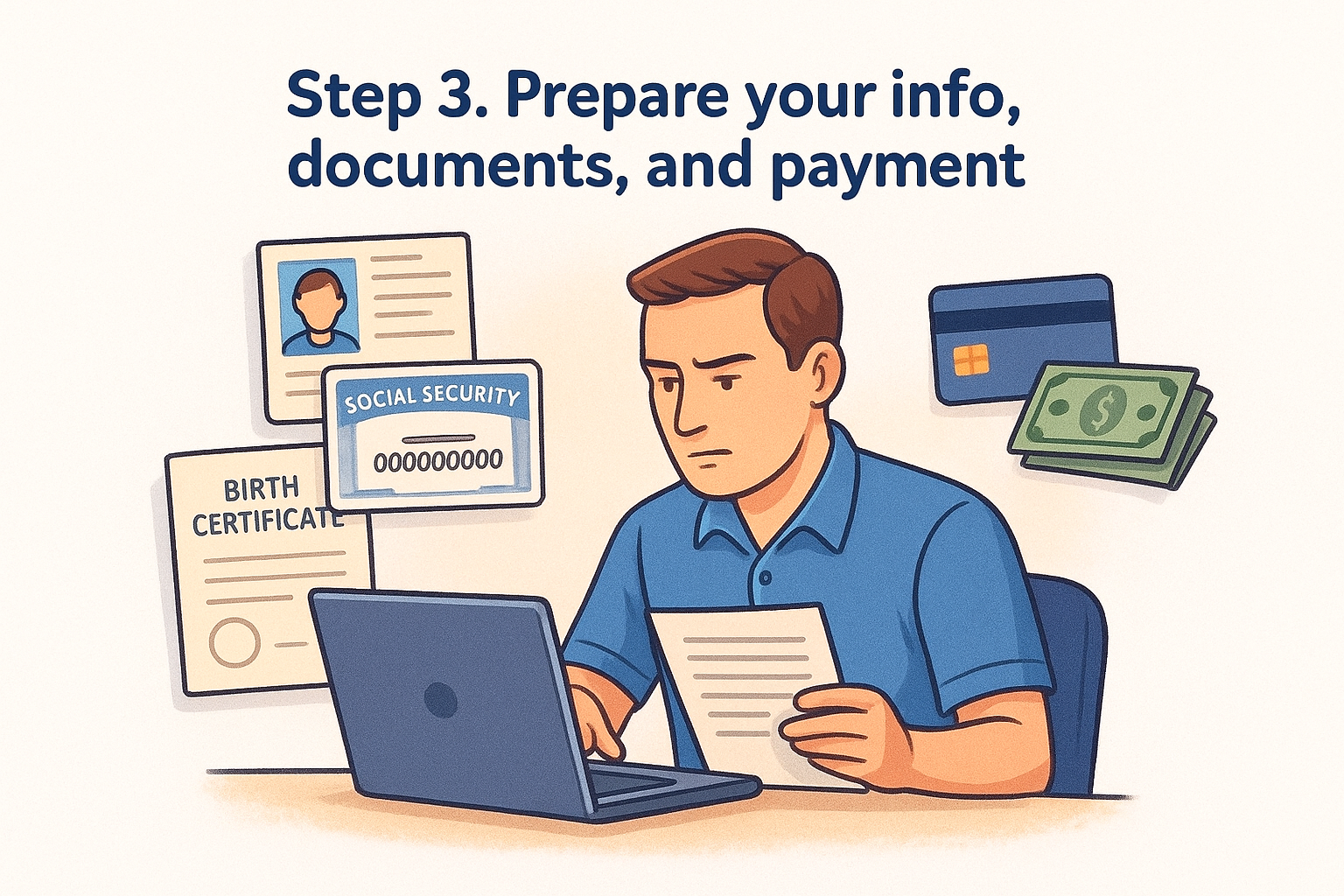
Missing even one required document can delay your approval by weeks while you request copies and resubmit.
Required documents checklist
You’ll need proof of identity, educational background, and employment authorization for your application. Scan or photograph these items before you start:
- Government-issued photo ID (driver’s license or state ID)
- Social Security card or proof of SSN
- High school diploma or GED certificate (official transcript for union programs)
- Signed sponsor agreement from your employing contractor
- Proof of age (birth certificate or passport)
Application fees and payment methods
States charge between $25 and $150 for initial apprentice registration, and most portals accept credit cards, debit cards, or electronic checks. California charges $75, Texas requires $50, and Washington State sets fees at $60. You pay this fee during online submission, and your application won’t process until payment clears.
Step 4. Apply online and get your apprentice card
Once you have your documents ready and your sponsor secured, you submit your plumbing apprenticeship application through your state’s online portal or mail your completed packet to the licensing board. Online portals walk you through each required field step by step, and you upload scanned documents directly into the system. Most states process online applications faster than mailed forms, with approval times ranging from 2 to 6 weeks depending on your state’s workload and whether your submission passes initial review.
Complete your application in one session to avoid losing entered data when your session times out.
Complete the online form fields
Your application form asks for personal information, educational history, and sponsor details in specific fields. Enter your legal name exactly as it appears on your ID, provide your Social Security number, and list your current mailing address where the board will send your physical apprentice card. Input your sponsor’s contractor license number and business name exactly as registered with the state, because mismatches trigger verification delays.
Track your application status
After submission, you receive a confirmation number or application ID that you use to check processing status online. Most state portals display status updates like “Received,” “Under Review,” or “Approved” within their applicant login dashboards. Your physical apprentice card arrives by mail within 10 business days of approval, and you cannot work legally until you receive it.
Wrap up and start logging hours
Your plumbing apprenticeship application is complete once you receive your physical card in the mail. Start working under your sponsor immediately and document every hour you spend on jobsites, because accurate hour logs determine when you qualify for your journeyman exam. Most states require between 4,000 and 8,000 total hours, and you must submit these records when you apply for license advancement.
Keep a daily logbook that tracks your date, hours worked, type of work performed, and supervisor’s signature. Your state licensing board provides approved hour log templates through the same portal where you submitted your application. Review these templates and establish a weekly routine for recording your progress.
Want plumbing jobs delivered to your inbox?
Want plumbing jobs delivered to your inbox?
Partner Site

