
Resume Templates for Plumbers: Examples and Writing Guide
Your plumbing skills get the job done on-site, but a weak resume can stop you from ever getting there. Whether you’re an apprentice applying for your first position or a master plumber ready for a management role, having strong resume templates for plumbers makes the difference between landing interviews and hearing nothing back. At PlumbingJobs.com, we connect plumbing professionals with employers across the United States, and we’ve seen firsthand what hiring managers actually look for in applications.
This guide gives you practical, ready-to-use resume templates designed specifically for the plumbing trade. You’ll find examples for different experience levels, a breakdown of essential sections every plumber resume needs, and tips on showcasing your certifications, licenses, and technical expertise. By the end, you’ll have everything required to build a resume that gets you noticed and helps you land your next plumbing job.
What employers look for in plumber resumes
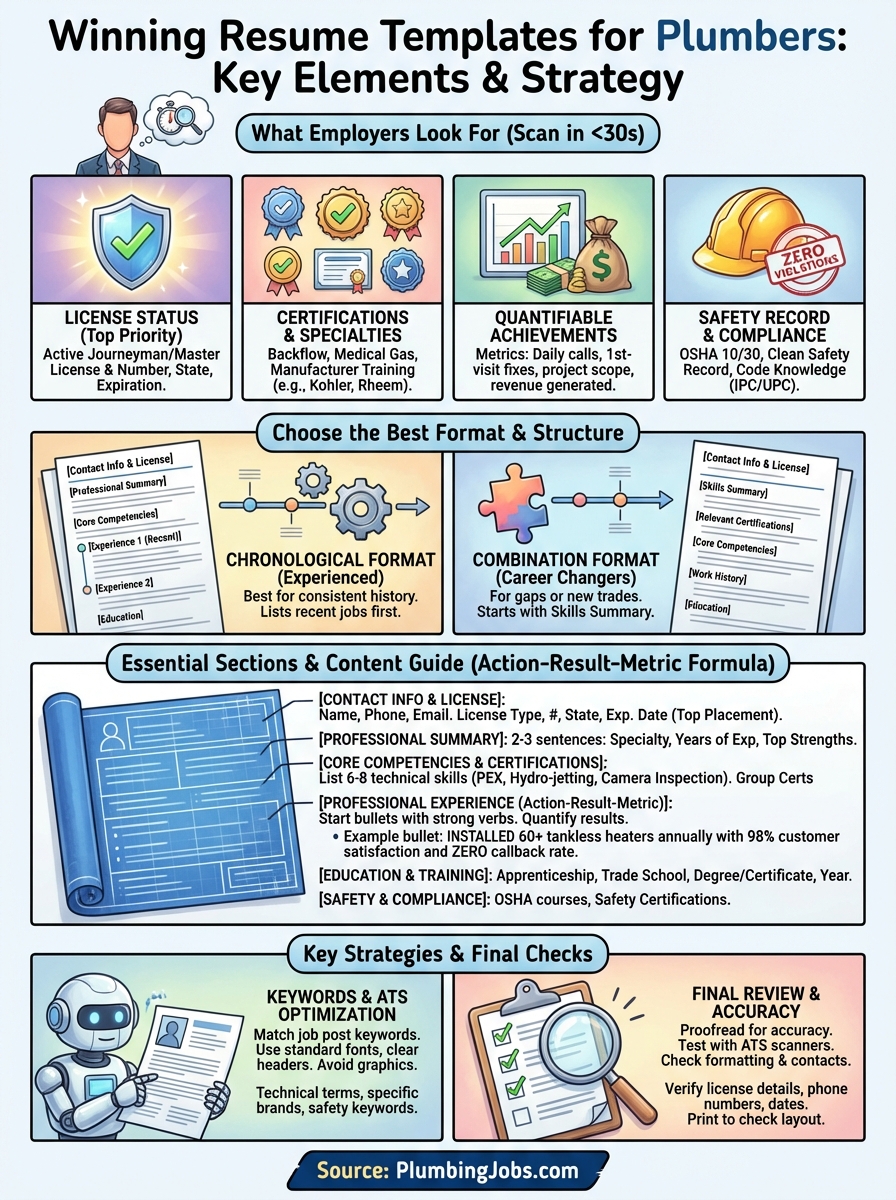
Hiring managers in the plumbing industry spend less than 30 seconds scanning your resume before deciding whether to call you in. They don’t read every word. Instead, they look for specific proof points that show you can do the job safely, efficiently, and without constant supervision. Understanding what catches their attention helps you build resume templates for plumbers that actually work.
Technical certifications and licensing
Your plumbing license status ranks as the first item employers verify. They need to know if you hold a valid journeyman or master plumber license in their state before considering anything else on your resume. List your license number, issuing state, and expiration date prominently near the top of your document.
Employers also scan for specialized certifications that match their business needs. Backflow prevention certification, gas line installation credentials, and medical gas piping endorsements all signal you can handle high-value contracts they might otherwise need to subcontract. Include any manufacturer-specific training from brands like Kohler, Delta, or Rheem that demonstrates your ability to service warranty work.
Plumbing contractors lose money when they hire someone only to discover they can’t legally perform the work their license covers.
Quantifiable work achievements
Generic statements like “responsible for plumbing repairs” tell employers nothing useful. They want numbers that prove your productivity and quality. Show how many service calls you completed daily, what percentage of jobs you finished on the first visit, or how much revenue you generated through upsells and add-on services.
Project-based plumbers should highlight scope and complexity instead. Include details like “installed 47 bathroom fixtures across a 220-unit apartment complex” or “roughed in plumbing systems for three commercial buildings totaling 85,000 square feet.” These specifics help hiring managers assess whether your experience matches their typical project scale.
Customer satisfaction metrics matter for service plumber roles. If you maintained a 4.8-star review average or received fewer than three callbacks per 100 jobs, that information belongs on your resume. Contractors bidding on residential work need plumbers who protect their reputation with homeowners.
Safety record and compliance knowledge
Employers face serious liability when hiring plumbers with poor safety habits. Your resume should demonstrate zero OSHA violations, completion of 10-hour or 30-hour OSHA construction safety courses, and any company safety awards you’ve earned. These details reduce perceived risk for employers.
Knowledge of current plumbing codes carries real value. Mention your familiarity with the International Plumbing Code (IPC), Uniform Plumbing Code (UPC), or specific state amendments that govern work in your area. Residential remodelers especially need plumbers who can navigate permit processes and inspection requirements without hand-holding.
Job-specific experience over generic descriptions
Plumbing covers dozens of specialties, and employers hire for specific operational needs. A commercial plumber who installs high-rise water distribution systems won’t impress a residential service company looking for someone to clear drain clogs and replace water heaters. Your resume must match the exact type of plumbing work the employer performs.
Use industry terminology that proves you know the trade. Reference PEX versus copper repiping, tankless water heater installations, hydro-jetting services, or camera inspections when those skills apply to the position. Vague language suggests you lack hands-on experience with the methods and materials the employer uses daily.
Choose the best resume format for plumbing work
The format you choose controls how employers process your qualifications. Your work history, certifications, and technical skills need to appear in an order that makes immediate sense to hiring managers who understand the plumbing trade. Most resume templates for plumbers fail because they follow generic office job formats that bury your most valuable credentials.
Chronological format for experienced plumbers
The reverse chronological resume puts your most recent plumbing job first, then works backward through your employment history. This format works best when you have consistent plumbing experience without major gaps and you’re applying for similar work to what you’ve done before. Hiring managers in the plumbing industry prefer this layout because they can quickly verify your progression from apprentice to journeyman to master plumber.

Start with your current or most recent position, including the company name, location, your job title, and employment dates. List 3-5 bullet points describing your responsibilities and measurable achievements. Move down to your previous job and repeat the same structure. This format proves you’ve built your skills over time and haven’t jumped randomly between unrelated trades.
Employers trust plumbers who show steady advancement in the same specialty rather than scattered experience across multiple fields.
Combination format for career changers
You need a hybrid or combination resume if you’re transitioning into plumbing from another construction trade or returning to the field after time away. This format starts with a skills summary section that highlights your relevant technical abilities, then follows with a chronological work history. The skills section gives you space to emphasize transferable expertise like pipefitting, welding, or HVAC experience that applies directly to plumbing work.
Place your most relevant certifications and licenses immediately below your contact information, before your skills summary. Follow with 5-7 core competencies like “commercial rough-in,” “service and repair,” or “code compliance.” Your employment history comes last but still includes specific accomplishments from each position.
What to avoid in plumbing resumes
Never use a functional resume that groups skills without showing where or when you learned them. Plumbing contractors assume you’re hiding employment gaps or lack real experience when you skip job titles and dates. They need to see exactly which companies vouched for your work and how long you stayed with each employer.
Skip creative formats with graphics, color blocks, or unusual fonts. Applicant tracking systems (ATS) used by larger plumbing companies can’t parse these designs correctly, which means your resume never reaches a human reviewer. Stick with standard fonts like Arial or Calibri, clear section headers, and simple bullet points that both software and hiring managers can read easily.
Plumber resume template you can copy and fill in
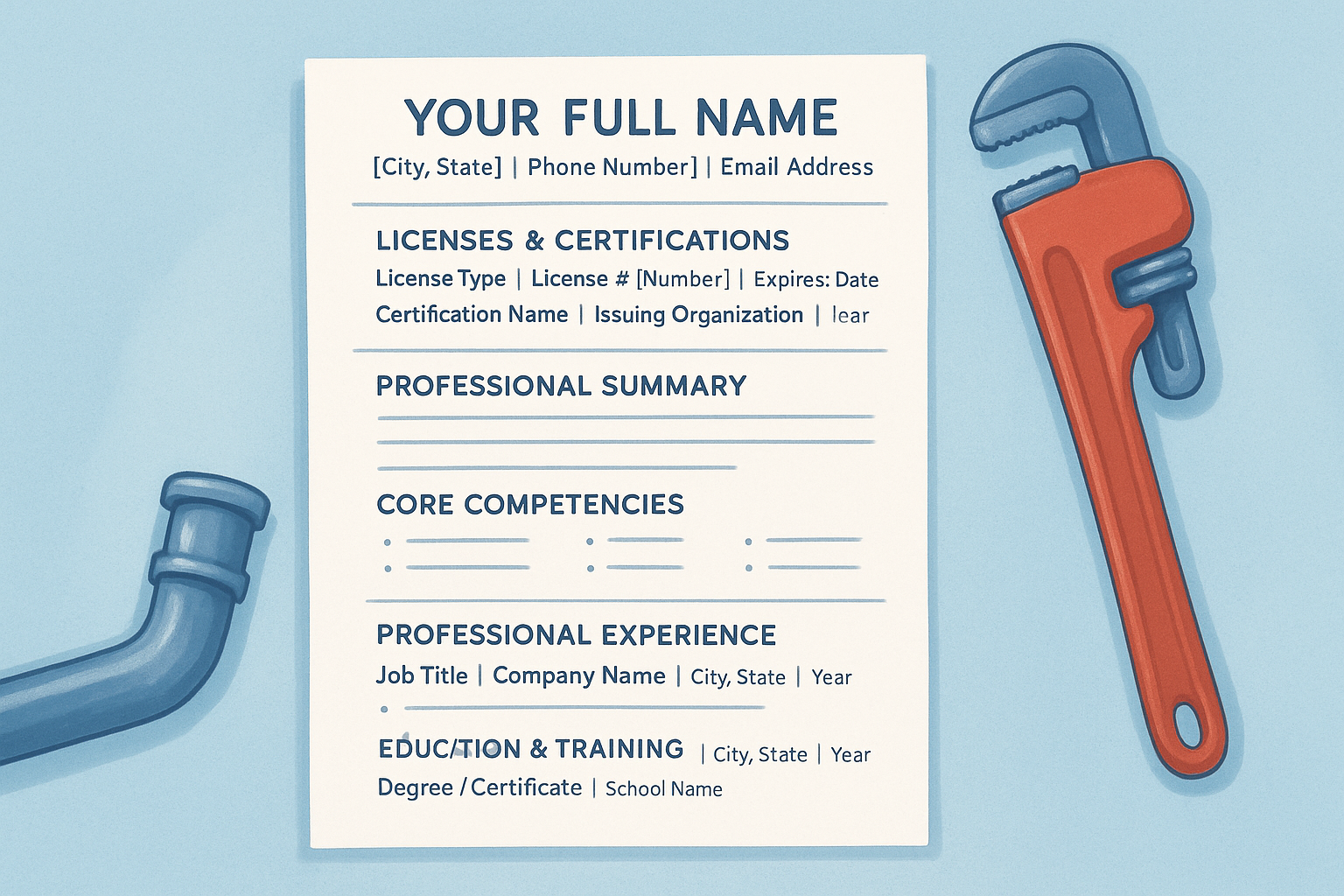
You need a starting point that includes all the sections employers expect without making you guess at structure. The resume template below follows industry standards for plumbing positions and works for both applicant tracking systems and human reviewers. Copy this template into your word processor or Google Docs, then replace the bracketed placeholders with your actual information.
Basic template structure
This template prioritizes your licensing credentials and technical skills at the top where hiring managers look first. The format keeps information scannable while providing enough detail to prove your qualifications.
[YOUR FULL NAME]
[City, State] | [Phone Number] | [Email Address]

LICENSES & CERTIFICATIONS
[License Type] | License #[Number] | [State] | Expires: [Date]
[Certification Name] | [Issuing Organization] | [Year]

PROFESSIONAL SUMMARY
[2-3 sentences describing your plumbing specialty, years of experience,
and top technical strengths relevant to the job you're applying for]

CORE COMPETENCIES
• [Skill 1]  • [Skill 2]  • [Skill 3]
• [Skill 4]  • [Skill 5]  • [Skill 6]

PROFESSIONAL EXPERIENCE

[Job Title] | [Company Name] | [City, State] | [Month/Year - Month/Year]
• [Action verb] + [what you did] + [measurable result]
• [Action verb] + [what you did] + [measurable result]
• [Action verb] + [what you did] + [measurable result]

[Previous Job Title] | [Previous Company] | [City, State] | [Month/Year - Month/Year]
• [Action verb] + [what you did] + [measurable result]
• [Action verb] + [what you did] + [measurable result]

EDUCATION & TRAINING
[Degree/Certificate] | [School Name] | [City, State] | [Year]
[Apprenticeship Program] | [Hours Completed] | [Year]

SAFETY & COMPLIANCE
• [Safety certification or training]
• [OSHA course completion]
Filling in your specific details
Replace each bracketed section with your actual credentials and work history rather than generic descriptions. Under Professional Summary, write something like “Licensed Master Plumber with 8 years specializing in commercial new construction and medical gas systems” instead of vague statements about being hardworking or reliable.
Your Core Competencies section should list 6-8 specific technical abilities that match the job posting. Examples include “PEX and copper repiping,” “backflow prevention testing,” “water heater installation,” or “drain camera inspections.” These keywords help your resume pass through applicant tracking systems.
Most resume templates for plumbers fail because they use office job language instead of trade-specific terminology that proves hands-on experience.
For work experience bullets, start each line with action verbs like “installed,” “diagnosed,” “repaired,” “inspected,” or “maintained.” Follow with specific details: “Installed 35+ tankless water heaters in residential properties with zero callbacks” beats “responsible for water heater installations” because it quantifies your work and demonstrates quality.
Plumber resume examples by experience level
Your resume needs to reflect where you stand in your plumbing career. An apprentice resume highlights training and eagerness to learn, while a master plumber resume showcases leadership, complex projects, and business impact. Using resume templates for plumbers that match your experience level helps you emphasize the right qualifications without overselling or underselling your abilities.
Entry-level apprentice plumber example
You need to focus on your training, certifications, and willingness to take direction when you’re just starting out. Apprentice positions don’t require years of independent experience, but employers want proof you understand basic plumbing principles and follow safety protocols.
PROFESSIONAL SUMMARY
First-year plumbing apprentice completing 8,000-hour registered
program with focus on residential service and repair. EPA 608
certified with strong foundation in copper and PEX systems.

RELEVANT EXPERIENCE
Plumbing Apprentice | ABC Plumbing Services | Phoenix, AZ | Jan 2025 - Present
• Assist journeyman plumbers on 6-8 residential service calls daily
• Successfully replaced 40+ water heaters with zero installation defects
• Maintain and organize truck inventory including $15,000 in parts and tools

Apprentice Training | Phoenix Technical College | Phoenix, AZ | Aug 2024 - Dec 2024
• Completed 300 classroom hours covering IPC code, blueprint reading, and math
• Practiced copper soldering, PEX crimping, and drain cleaning techniques
Journeyman plumber example
Focus your resume on independent work capability and specialized skills you’ve developed. Employers hiring journeymen expect you to handle service calls without supervision and solve problems efficiently.
PROFESSIONAL SUMMARY
Licensed Journeyman Plumber with 5 years in residential service,
repair, and remodeling. Average 95% first-call resolution rate with
expertise in water heater installations, repiping, and fixture upgrades.

PROFESSIONAL EXPERIENCE
Journeyman Plumber | Premier Home Services | Dallas, TX | Mar 2022 - Present
• Complete 25-30 service calls weekly averaging $850 per ticket
• Diagnosed and repaired complex issues reducing callback rate to under 2%
• Mentored 3 apprentices through state licensing requirements
Journeyman plumbers who quantify their productivity and quality metrics stand out from candidates who only list general duties.
Master plumber or supervisor example
Your resume should emphasize project management, code expertise, and business impact rather than basic installation skills. Supervisory roles require proof you can oversee crews, handle inspections, and manage budgets.
PROFESSIONAL SUMMARY
Licensed Master Plumber with 12 years managing commercial new construction
and multi-family projects. Directly supervised teams of 8-15 plumbers while
maintaining 100% inspection pass rate across $2M+ annual project volume.

PROFESSIONAL EXPERIENCE
Master Plumber / Project Manager | Continental Mechanical | Austin, TX | 2019 - Present
• Managed plumbing scope for 4 commercial buildings totaling 180,000 square feet
• Reduced material waste by 18% through improved estimating and inventory control
• Coordinated with GCs and inspectors ensuring zero schedule delays due to plumbing
Skills and keywords to include on a plumber resume
Your skills section needs to pass applicant tracking systems (ATS) while proving to human reviewers that you possess the exact abilities they need. Most resume templates for plumbers fail here because they list generic terms like “team player” or “attention to detail” instead of trade-specific technical competencies that match actual job requirements. Employers search for keywords that align with their daily operations, equipment brands, and service offerings.
Technical skills that match job descriptions
Read each job posting carefully and identify the specific methods, materials, and systems the employer mentions. If they need someone experienced with PEX installations, include “PEX piping installation and repair” rather than just “piping.” Your resume should mirror their language because ATS software scores candidates based on keyword matches before any human sees your application.
Include these high-value technical skills when they apply to your experience:
- Water heater installation (tankless, electric, gas)
- Drain cleaning and hydro-jetting
- Backflow prevention testing and certification
- Medical gas piping systems
- Fixture installation and repair
- Copper and PEX repiping
- Sewer camera inspection
- Water treatment systems
- Gas line installation and repair
- Commercial plumbing systems
Safety certifications and compliance keywords
Your safety training directly reduces liability for employers, which makes these credentials worth highlighting prominently. List your OSHA 10 or OSHA 30 completion, confined space entry training, and any state-required safety certifications. Compliance keywords like “IPC code,” “UPC standards,” and “permit acquisition” prove you won’t cause inspection failures or project delays.
Employers skip resumes that lack proof of safety training because one workplace accident costs more than the salary they save hiring cheaper labor.
Soft skills that prove reliability
Focus on measurable interpersonal abilities rather than vague personality claims. Instead of writing “excellent communication skills,” specify “explained repair options to 30+ homeowners daily resulting in 65% service agreement acceptance rate.” Customer service matters for residential plumbers, while project coordination skills apply to commercial roles. Time management becomes relevant when you mention completing service calls within scheduled windows or finishing projects ahead of deadline.
Write better work experience bullets for plumbing jobs
Your work experience section either proves your value or wastes space with meaningless job descriptions. Weak bullets like “responsible for plumbing installations” tell employers nothing useful because every plumber handles installations. You need to show specific results, quantities, and complexity levels that demonstrate how you performed in real situations. The difference between generic statements and strong accomplishment bullets directly impacts whether you get called for interviews.
Use the action-result-metric formula
Structure each bullet point using a clear formula that hiring managers scan quickly. Start with a strong action verb, describe what you did with specific technical details, then add a measurable outcome that proves quality or productivity. This approach works across all resume templates for plumbers because it forces you to quantify your contributions rather than list vague duties.
Follow this pattern for maximum impact:
[Action verb] + [specific plumbing task/system] + [measurable result/impact]
Strong examples that follow the formula:
- Installed 60+ tankless water heaters annually with 98% customer satisfaction rating and zero callback rate
- Diagnosed and repaired complex commercial HVAC hydronic systems reducing downtime by 35% across 12 facilities
- Completed rough-in plumbing for 8-unit apartment building 3 days ahead of schedule under budget
- Performed backflow testing on 200+ commercial properties maintaining 100% state compliance record
Weak examples that waste space:
- Responsible for installing water heaters
- Worked on commercial projects
- Fixed plumbing problems for customers
- Handled various plumbing tasks
The numbers in your work experience bullets prove your productivity and quality better than any adjective you could write about yourself.
Focus on outcomes that matter to employers
Think about what keeps plumbing business owners awake at night and address those concerns in your bullets. They worry about callbacks eating profit margins, customers leaving bad reviews, failing inspections, and wasting materials. Your bullets should demonstrate how you prevented these problems or solved them when they occurred.
Revenue-focused bullets work well for service plumber positions. Instead of “performed drain cleaning,” write “completed 25-30 drain cleaning calls weekly averaging $285 per job with 70% conversion rate on camera inspection upsells.” Commercial plumbers should emphasize project scale and coordination: “coordinated plumbing installation across 4 concurrent job sites managing $450K in material procurement and scheduling for 6-person crew.”
Quality metrics prove you do the job right the first time. Mention your inspection pass rates, customer satisfaction scores, or warranty claim percentages when you have strong numbers. Even stating “maintained tool inventory valued at $18,000 with zero loss or damage over 3 years” shows responsibility that matters to employers who provide expensive equipment.
List licenses, certifications, and safety training correctly
Your plumbing license status determines whether employers can legally hire you, which means this information belongs near the top of your resume where it gets immediate attention. Placing credentials at the bottom forces hiring managers to hunt through your entire document before they can verify your qualifications. Most professional resume templates for plumbers position licensing and certifications immediately below your contact information in a dedicated section that stands out from your work history. This placement ensures applicant tracking systems capture the keywords while human reviewers see your most important credentials first.
Format your license information clearly
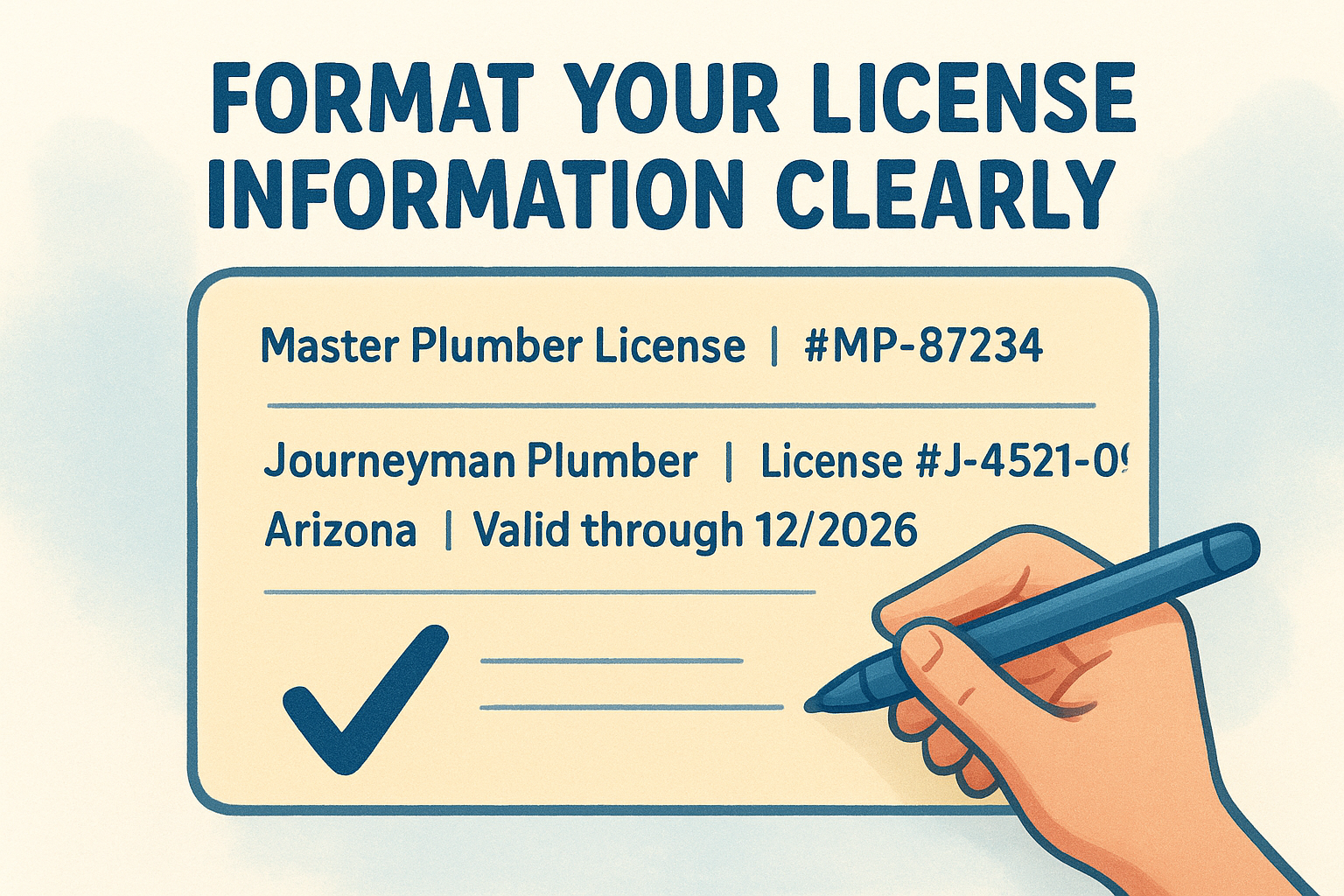
List your plumbing license using a consistent structure that includes every detail state boards and employers need to verify. Your license entry should contain the license type, license number, issuing state, and expiration date all on one line for easy scanning. Avoid abbreviations that might confuse ATS software or out-of-state employers unfamiliar with your region’s licensing terminology.
Correct formatting examples:
Master Plumber License | #MP-87234 | Texas | Expires: 06/2027
Journeyman Plumber | License #J-4521-09 | Arizona | Valid through 12/2026
Incorrect formatting to avoid:
Licensed Master Plumber (expires soon)
TX Plumber
Journeyman (current)
Your active license needs to appear first when you hold multiple credentials. Follow with any reciprocal state licenses or specialized endorsements like medical gas installer permits. Include your apprentice registration number only if you’re still completing hours and applying for apprentice positions.
Employers discard resumes that list expired licenses or omit license numbers because they need to verify credentials before scheduling interviews.
Group certifications by category
Separate your technical certifications from safety training so employers can quickly find what matters most for their operation. Create distinct subsections under your credentials area labeled “Professional Certifications” and “Safety & Compliance Training” to organize multiple credentials logically.
Professional certifications structure:
PROFESSIONAL CERTIFICATIONS
Backflow Prevention Tester | ASSE 5110 | Renewed 2025
EPA Section 608 Universal Certification | Type I-IV | 2023
Medical Gas Installer | ASSE 6010 | Valid through 2027
Safety training structure:
SAFETY & COMPLIANCE
OSHA 30-Hour Construction Safety | 2024
Confined Space Entry Certification | 2025
First Aid/CPR | American Red Cross | Current
Manufacturer certifications from brands like Kohler, Navien, or Rheem demonstrate specialized product knowledge that wins you service contracts. List these under your professional certifications with the manufacturer name, product line, and year completed so employers know you can handle warranty work on equipment they install.
Final checks for ATS, readability, and accuracy
Your resume looks complete, but one final review before submitting separates applications that land interviews from those that disappear into rejection folders. Even the best resume templates for plumbers fail when small formatting errors confuse applicant tracking systems or typos damage your credibility. You need to run through three critical checks that catch problems employers use to disqualify candidates automatically.
Test your resume through ATS scanners
Copy your resume text and paste it into a plain text editor like Notepad to see exactly what ATS software reads. Your carefully formatted document might look perfect in Word, but tracking systems often strip formatting and jumble information if you used text boxes, tables, or columns. Everything should appear in logical order from top to bottom without random characters, missing sections, or scrambled contact details.
Run your resume through free ATS testing tools to identify keyword gaps and formatting issues before employers see it. Upload your file and compare it against the job description you’re targeting. The scanner highlights missing skills, weak keyword density, and sections the software can’t parse correctly. Fix any problems the tool identifies, then test again to confirm your changes worked.
Most plumbing job applicants lose opportunities not because they lack qualifications but because ATS software can’t read their resume format correctly.
Check formatting and readability
Print your resume or view it at 100% zoom on your screen to catch visual problems that hurt readability. Look for inconsistent spacing, alignment issues, font size variations, or orphaned bullets that confuse the eye. Your document should look clean and professional with clear section breaks and uniform formatting throughout.
Verify these formatting elements:
- Consistent date formats (MM/YYYY or Month Year)
- Aligned bullet points with proper indentation
- No widows or orphans (single lines at page breaks)
- Standard fonts (Arial, Calibri) in 10-12 point size
- Adequate white space between sections
- File saved as .PDF to preserve formatting
Verify all information for accuracy
Double-check every license number, phone digit, and employment date because even small errors give employers reasons to question your attention to detail. Call the phone number listed on your resume to confirm it rings correctly. Click any email addresses to verify they’re typed without typos. Search your own name online to ensure the information matches across your resume and professional profiles.
Confirm your license status through your state licensing board website and verify the expiration date you listed matches their records exactly. Employers check these details during background verification, and discrepancies between your resume and official records create red flags that cost you job offers. Review certification dates, OSHA completion years, and previous employer names for accuracy before sending your application.
Wrap up and apply with confidence
You now have everything needed to build a strong plumber resume that passes applicant tracking systems and convinces hiring managers to call you in. The resume templates for plumbers in this guide give you a proven structure, while the examples show exactly how to present your licenses, skills, and work history effectively. Your next step is simple: customize the template with your actual credentials, quantify your accomplishments with specific numbers, and proofread everything twice before submitting.
Strong resumes open doors, but they only work when you apply to the right opportunities. Browse hundreds of plumbing positions across all 50 states and find roles that match your experience level and specialty at PlumbingJobs.com. Visit our blog for more career resources including interview tips, salary negotiation strategies, and licensing requirements by state that help you advance in the plumbing trade.
Want plumbing jobs delivered to your inbox?
Want plumbing jobs delivered to your inbox?
Partner Site

