
Master Plumber License Requirements: State-By-State Guide
Earning a master plumber license marks the highest achievement in the plumbing trade, and it opens doors to better-paying positions, the ability to pull permits, and the option to start your own business. But master plumber license requirements vary significantly from state to state, making it difficult to know exactly what you need to qualify.
Whether you’re a journeyman ready to take the next step or mapping out your career path from the start, understanding these requirements is essential. At PlumbingJobs.com, we see listings every day that require master-level credentials, and we know firsthand how frustrating it can be to navigate the patchwork of state regulations without a clear resource.
This guide breaks down the licensing requirements across all 50 states, covering experience hours, examination processes, and application procedures. By the end, you’ll know exactly what it takes to earn your master plumber license and qualify for the positions that demand top-tier expertise.
What a master plumber license means
A master plumber license represents the highest professional certification in the plumbing industry and grants you the legal authority to perform all plumbing work without supervision, pull permits for projects, and supervise other licensed plumbers. This credential proves you have met stringent experience requirements, passed comprehensive examinations, and understand both the technical and regulatory aspects of plumbing systems. Unlike journeyman licenses that allow you to work under supervision, a master license gives you complete independence in your trade.
Professional scope and legal authority
Your master plumber license grants you exclusive rights that no lower-tier license provides. You can pull permits directly from municipal building departments, which means you control the entire project timeline without waiting for a supervising plumber to approve your work. Most jurisdictions require a master plumber to sign off on all commercial plumbing installations, major residential renovations, and any work that involves modifying main water or sewer lines.
The license also allows you to supervise and employ apprentices and journeymen under your credentials. When you hire other plumbers, they work under your license number, and you assume responsibility for their workmanship. This supervision authority extends to reviewing installation plans, ensuring code compliance on job sites, and signing final inspection documents that allow buildings to receive certificates of occupancy.
State laws typically prohibit unlicensed individuals from performing plumbing work for compensation, making your master license a legal requirement for running a plumbing business.
Career and business advantages
Earning your master plumber license immediately increases your earning potential by an average of $15,000 to $25,000 annually compared to journeyman wages. Employers value master plumbers because they eliminate the need for oversight on complex projects, reduce liability risks, and can manage entire departments or field teams. Many organizations reserve supervisory roles, project management positions, and specialized technical positions exclusively for master-licensed candidates.
The business advantages are equally significant. You can legally establish your own plumbing contracting company, bid on commercial projects, and build a client base without partnering with another licensed plumber. Your master license number appears on all permits and contracts, establishing you as the responsible party. This independence allows you to set your own rates, choose your projects, and scale your business by hiring additional staff who work under your supervision.
Accountability and liability differences
With a master plumber license comes heightened professional responsibility for every project you touch. State licensing boards hold you accountable not only for your own work but also for any installations completed by plumbers working under your license. You face potential disciplinary action, including license suspension or revocation, if work performed under your authority violates building codes or causes property damage.
Your liability insurance requirements also change once you hold a master license. Most states mandate higher coverage limits for master plumbers, typically ranging from $500,000 to $2 million in general liability insurance, because you assume responsibility for larger projects and supervise other workers. Understanding these master plumber license requirements helps you prepare for both the privileges and obligations that come with this advanced credential. Insurance carriers assess risk differently for master license holders, factoring in your supervisory role and the scope of work you’re authorized to approve.
Step 1. Find your licensing authority
Identifying the correct licensing authority is your first critical step because applying to the wrong jurisdiction wastes time, money, and delays your career advancement. Unlike many professions with clear federal oversight, plumbing licenses operate under state, county, or municipal control, and each jurisdiction sets its own master plumber license requirements. You might discover that your state issues licenses through a centralized board, or you may need to contact your local city or county government directly.
State licensing boards vs. local jurisdictions
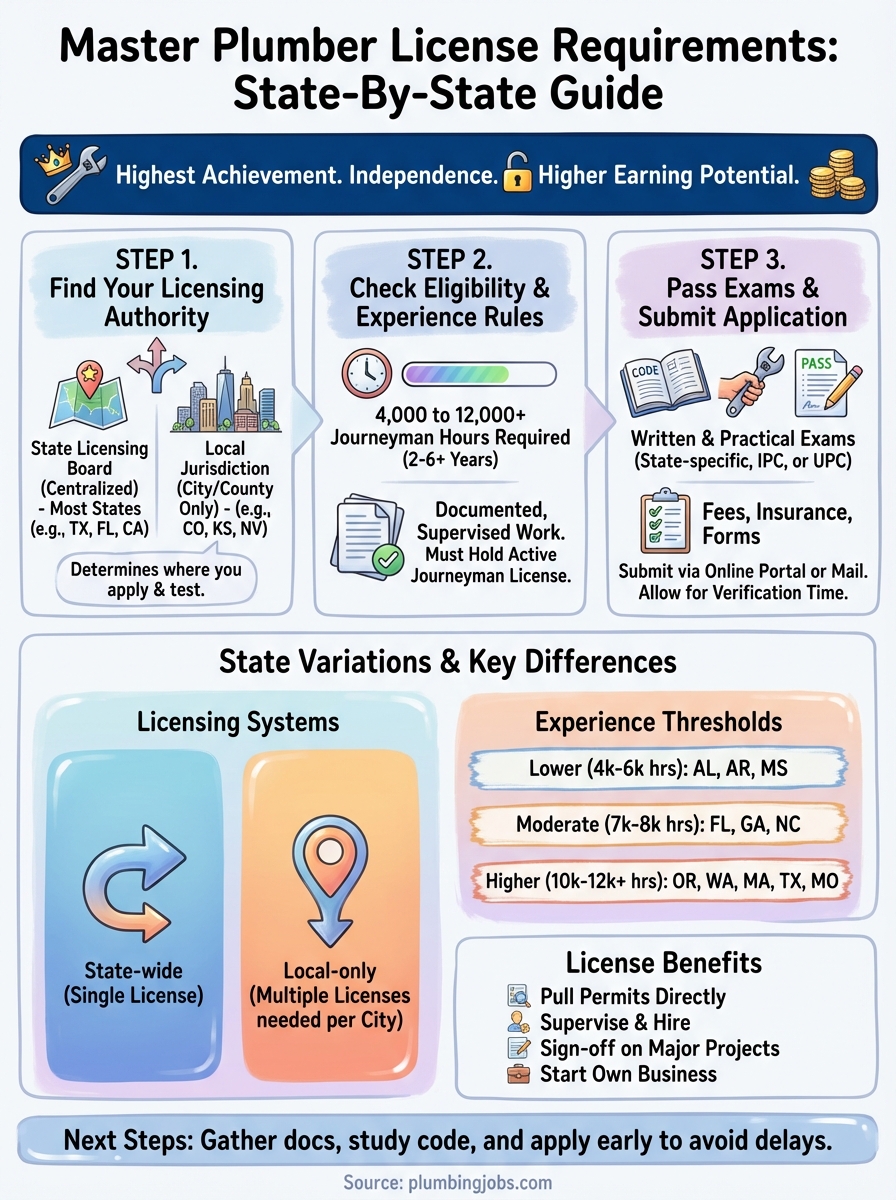
Most states operate through a state plumbing board that issues licenses valid anywhere within state boundaries. States like Texas, Florida, and California maintain centralized licensing systems where you apply once and can work throughout the entire state under that credential. Your application goes directly to the state board, and they handle all examinations, experience verification, and renewals through a single administrative body.
However, several states use local licensing systems where cities or counties control the entire process independently. In these jurisdictions, you hold a license specific to that municipality, and working in a neighboring city requires obtaining a separate license. States with local-only licensing include Colorado, Kansas, and Nevada, where each major city operates its own plumbing board with unique requirements.
Understanding whether your state uses centralized or local licensing determines where you submit applications and which examination you need to pass.
How to locate your specific authority
Start by searching “[Your State] plumbing board” or “[Your State] plumbing license” to identify the governing body. State licensing boards typically operate under names like “State Board of Plumbing Examiners,” “Department of Labor and Industries,” or “Division of Professional Licensing.” You can find contact information, application forms, and requirement details on their official websites.
If your state uses local licensing, contact your city or county building department directly. Building departments maintain lists of licensing requirements and can direct you to the specific board that processes applications. Call the permit counter and ask which authority issues master plumber licenses for your area, as this information often appears unclear on government websites.
For states with mixed systems, verify whether your work location falls under state or local jurisdiction. Some states license plumbers at the state level but allow larger cities to impose additional local requirements or issue their own separate licenses. Confirming your correct authority before gathering documentation saves you from resubmitting applications or taking the wrong examination.
Step 2. Check eligibility and experience rules
Every state sets minimum experience thresholds that you must meet before applying for your master plumber license, and these requirements typically measure your work history in documented hours rather than years. Most jurisdictions require between 4,000 and 12,000 hours of plumbing experience as a licensed journeyman before you qualify to sit for the master examination. Understanding these master plumber license requirements early helps you track your hours correctly and avoid application rejections.
Minimum experience hour requirements
States calculate experience requirements using actual hours worked on plumbing projects rather than calendar years of employment. A typical full-time plumbing schedule equals approximately 2,000 hours annually, which means a 4,000-hour requirement translates to two years of continuous work. Your state may require anywhere from two to six years of journeyman-level experience, and some jurisdictions add extra hours if you took extended breaks from the trade or worked part-time.
Common experience requirements across states:
| Experience Level | States | Typical Hours |
|---|---|---|
| Lower requirements | Alabama, Arkansas, Mississippi | 4,000-6,000 hours |
| Moderate requirements | Florida, Georgia, North Carolina | 7,000-8,000 hours |
| Higher requirements | Oregon, Washington, Massachusetts | 10,000-12,000 hours |
Document every hour you work from the day you earn your journeyman license, including overtime, because some states count overtime hours differently or cap how much credit you receive per week.
Journeyman prerequisite and supervised work
Nearly every state requires you to hold an active journeyman license before qualifying for master status, which means you cannot jump directly from apprentice to master even if you accumulate enough hours. Your journeyman license must remain in good standing without suspensions, violations, or disciplinary actions during your entire experience period. States verify this through licensing board databases and reject applications if they find lapses in your journeyman status.
Some jurisdictions require that a portion of your hours involve specific work types like commercial installations, gas piping, or medical gas systems to demonstrate comprehensive experience.
The definition of acceptable experience varies significantly. Most boards only count hours where you performed plumbing work directly, excluding administrative tasks, sales activities, or non-plumbing construction duties. Work completed under another master plumber’s direct oversight typically qualifies, but states define “direct oversight” differently.
Documentation you need to collect
Gather these specific documents before starting your application:
- Employer verification forms signed by the master plumber who supervised your work, including their license number and contact information
- Pay stubs or W-2 forms showing continuous employment during your claimed experience period
- Project descriptions detailing the types of plumbing systems you installed, repaired, or designed
- Current journeyman license certificate proving your credentials remained active throughout your experience
- Liability insurance certificates if you worked as an independent contractor under another master’s license
Request verification forms from previous employers immediately, because companies close or supervisors retire, making it difficult to obtain signatures years later.
Step 3. Pass exams and submit your application
Passing the master plumber examination represents the final technical hurdle in earning your license, and the test evaluates your knowledge of plumbing codes, system design, hydraulics, and business practices. Most states require you to pass both a written examination and a practical skills test, though some jurisdictions use only written exams or accept national certifications as substitutes. Understanding the examination format and application process prevents delays and helps you prepare correctly for your specific jurisdiction.
Examination types and preparation strategies
Your state likely uses one of three testing formats: state-specific exams created by the licensing board, standardized tests like the ICC Master Plumber exam, or a combination requiring both. States with their own exams typically test on local plumbing codes and jurisdiction-specific regulations, while standardized tests focus on International Plumbing Code (IPC) or Uniform Plumbing Code (UPC) principles. Check which code your state follows because studying the wrong code manual wastes preparation time.
Registration for examinations occurs through testing centers or licensing boards, and you typically schedule your test date after submitting your application and paying examination fees ranging from $100 to $400. Most exams allow four hours for completion and include 80 to 100 multiple-choice questions covering topics like fixture units, pipe sizing, venting requirements, backflow prevention, and gas piping calculations.
Schedule your examination date at least 60 days after submitting your application to allow time for experience verification and eligibility approval.
Preparation materials you should obtain include the current plumbing code book adopted by your state, practice exams from the testing organization, and reference guides covering hydraulics and system design calculations. Many jurisdictions allow you to bring code books into the examination room, but you cannot use highlighted or tabbed sections.
Application submission process
Complete your application using this checklist to ensure nothing gets rejected:
Required application components:
- Completed application form with all sections filled accurately
- Application fee payment (typically $200-$500)
- Verified experience documentation from supervising master plumbers
- Current journeyman license copy
- Proof of liability insurance meeting state minimum requirements
- Background check authorization and fingerprint cards (varies by state)
- Passport-quality photograph for license issuance
Submit applications through online portals or mail depending on your licensing authority’s system. Online submissions receive faster processing times, typically 2-4 weeks, while mailed applications take 4-8 weeks for initial review. Include all supporting documents in a single submission because requesting additional materials later restarts the review timeline.
Track your application status by calling the licensing board weekly or checking online portals. Most boards verify your submitted experience hours by contacting your previous employers directly, which can extend processing if those contacts do not respond promptly. Understanding these master plumber license requirements and following the application procedures carefully increases your approval chances and reduces frustrating delays.
Step 4. State requirements A to E
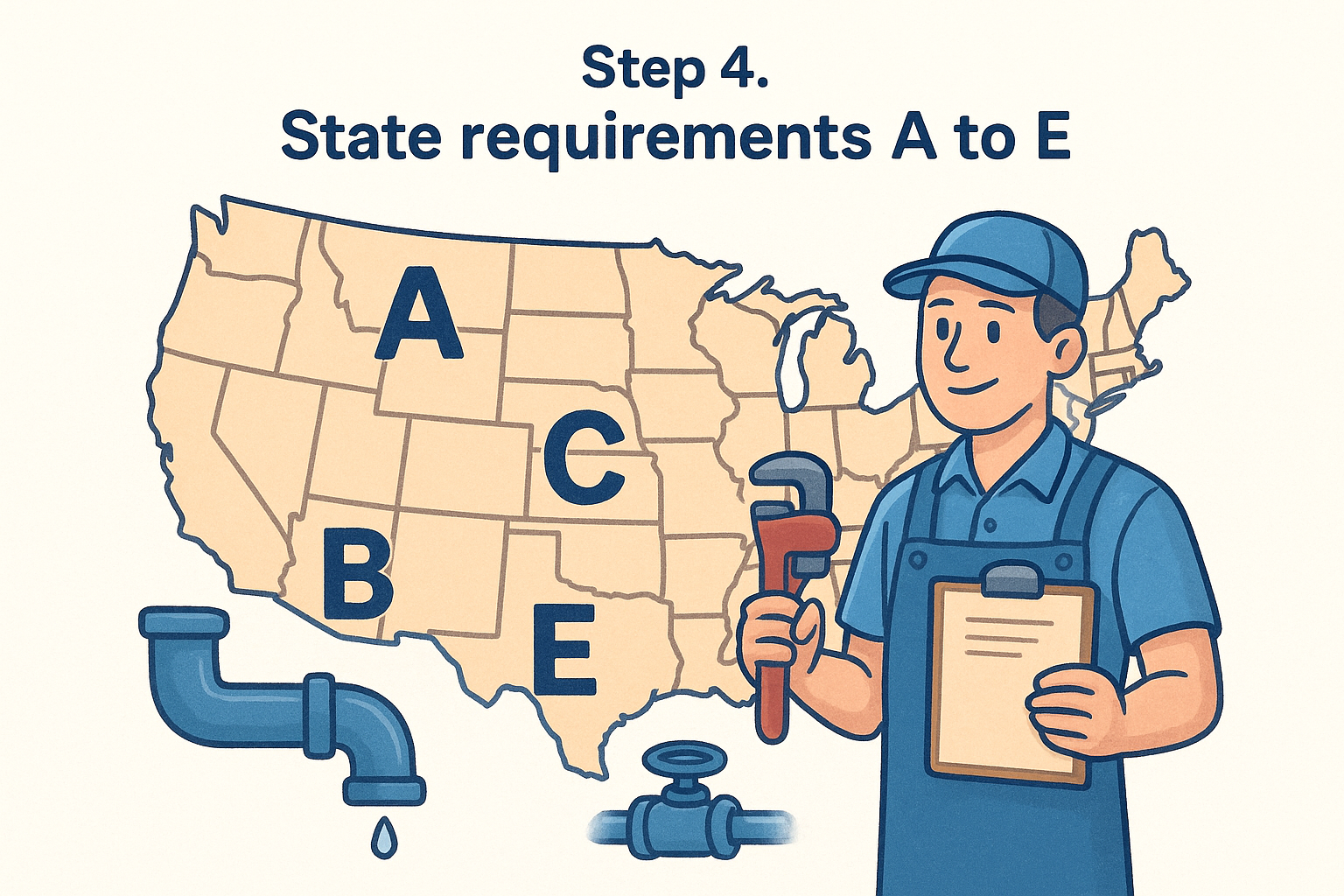
Understanding master plumber license requirements for states alphabetically from A to E helps you navigate some of the most varied licensing systems in the country. These states include centralized licensing boards and local-only jurisdictions, and their experience requirements range from 4,000 to 10,000 hours. You need to check whether your target state issues licenses at the state level or delegates authority to individual cities and counties.
States with centralized licensing boards
Alabama requires 4,000 hours of journeyman experience and passing a state examination through the Alabama Plumbing and Gas Fitters Examining Board. You must submit verification forms from employers and pay a $150 application fee. Alaska demands 8,000 hours of experience plus passing both written and practical exams administered by the Department of Commerce. Your application costs $200, and you need proof of workers’ compensation insurance before approval.
Arizona operates through the Registrar of Contractors, requiring 4 years of journeyman experience and passing a business management exam in addition to the technical test. Application fees total approximately $330. Arkansas sets its threshold at 6,000 hours and uses the ICC Master Plumber examination, which you can schedule after the State Board of Plumbing Examiners approves your application showing verified experience.
California maintains one of the strictest processes, requiring 5 years of journeyman work and passing a state-specific exam covering California Plumbing Code. You apply through the Contractors State License Board and pay $450 in combined fees. Connecticut requires 10,000 hours of experience, the highest in this group, plus passing examinations on state plumbing codes and business practices through the Department of Consumer Protection.
States with higher hour requirements typically count only work performed under direct supervision of a master plumber, so track which projects qualify before claiming credit.
Delaware issues licenses through individual counties rather than a state board, though requirements remain consistent at 8,000 hours statewide. Apply directly to your county licensing office with experience verification and examination scores.
Colorado’s local licensing structure
Colorado does not issue state licenses, requiring you to apply directly to the city or county where you plan to work. Denver requires 8,000 hours and city-specific examinations, while Colorado Springs demands 6,000 hours. Each jurisdiction sets independent master plumber license requirements, meaning you hold separate licenses for each municipality where you operate your business or accept employment.
Step 5. State requirements F to L
Navigating master plumber license requirements for states F through L reveals significant variation in both experience hours and examination formats. These ten states include centralized licensing systems in most jurisdictions, with Kansas standing as the notable exception that delegates authority to local municipalities. Your preparation strategy depends entirely on understanding whether your state requires state examinations or accepts national certifications like the ICC Master Plumber test.
States with centralized licensing authority
Florida requires 10,000 hours of verifiable journeyman experience and passing a state-specific examination through the Department of Business and Professional Regulation. You pay $188 in combined application and examination fees, and your license remains valid statewide without additional local permits. Georgia sets its requirement at 7,000 hours plus passing both the business and law exam and the trade exam administered by the State Board of Plumbing. Application fees total approximately $200, and you must provide proof of liability insurance before license issuance.
Hawaii demands 8,000 hours of experience and requires passing examinations covering the Uniform Plumbing Code, which differs from the International Plumbing Code used by many mainland states. Your application goes to the Department of Commerce and Consumer Affairs with a $190 fee. Idaho uses the Division of Building Safety and requires 8,000 hours plus passing the ICC Master Plumber examination, with total fees around $150.
Illinois requires 12,000 hours of documented experience, one of the highest thresholds nationally, and uses state examinations covering the Illinois Plumbing Code. Apply through the Department of Public Health with $250 in fees. Indiana sets its requirement at 8,000 hours and accepts the ICC exam after the Professional Licensing Agency verifies your experience documentation.
States requiring 10,000 or more hours typically take 60-90 days to verify your employment history because they contact multiple previous employers directly.
Iowa requires 8,000 hours and state examinations through the Plumbing and Mechanical Systems Board, with $260 in application costs. Kentucky demands 6,000 hours plus passing state exams covering Kentucky Plumbing Code, applying through the Division of Plumbing. Louisiana requires 7,000 hours and state-specific testing through the State Plumbing Board with $275 in fees.
Kansas local licensing system
Kansas does not issue state licenses, requiring you to apply directly to the city or county where you work. Wichita requires 8,000 hours and city examinations, while Kansas City demands 6,000 hours. Each jurisdiction operates independently, meaning you need separate licenses for each municipality where you accept plumbing projects or employment.
Step 6. State requirements M to R
States M through R contain widely varying master plumber license requirements, ranging from Maryland’s 5,000-hour minimum to Massachusetts’ demanding 12,000-hour threshold. These thirteen states primarily use centralized licensing systems except Nevada, which operates entirely through city and county authorities. Your application timeline depends on whether your state verifies experience internally or requires third-party documentation from every employer you list.
States with centralized licensing boards
Maine requires 8,000 hours of journeyman experience and passing examinations through the Office of Professional and Occupational Regulation, with $270 in combined fees. Maryland sets the lowest requirement in this group at 5,000 hours plus passing the ICC Master Plumber exam, applying through the Board of Master Plumbers with $230 in costs. Massachusetts demands 12,000 hours, matching Illinois for the highest national threshold, and requires state examinations covering Massachusetts Plumbing Code through the Board of State Examiners of Plumbers and Gas Fitters.
Michigan requires 9,000 hours and state-specific testing through the Department of Licensing and Regulatory Affairs with $250 in fees. Minnesota sets its requirement at 8,000 hours plus passing examinations on Minnesota Plumbing Code, applying through the Department of Labor and Industry. Mississippi requires 6,000 hours and state examinations through the State Board of Plumbing with $175 in costs.
Missouri demands 12,000 hours and state testing through the Administrative Hearing Commission, with $300 in application fees. Montana requires 8,000 hours plus ICC examination acceptance through the Department of Labor and Industry. Nebraska sets its threshold at 6,000 hours with state examinations covering local codes.
States requiring verification from every employer you list can extend application processing to 90 days or longer if previous companies fail to respond promptly.
New Hampshire requires 8,000 hours and state examinations through the Plumbers Board with $265 in fees. New Jersey demands 9,000 hours plus state testing through the Board of Master Plumbers. New Mexico requires 6,000 hours and accepts ICC examinations after the Construction Industries Division verifies your experience. New York sets its requirement at 7,500 hours with state examinations through the Department of Buildings in New York City or county boards elsewhere.
North Carolina requires 8,000 hours and state-specific testing through the State Board of Examiners of Plumbing with $230 in costs. North Dakota demands 8,000 hours plus state examinations. Ohio requires 10,000 hours and testing through the Board of Building Standards. Oklahoma sets its threshold at 7,000 hours with state examinations. Oregon requires 8,000 hours and state testing through the Building Codes Division. Pennsylvania demands 8,000 hours plus state examinations. Rhode Island requires 7,000 hours and testing through the Contractors Registration and Licensing Board.
Nevada’s local licensing structure
Nevada does not issue state licenses, requiring you to apply directly to the city or county where you work. Las Vegas requires 8,000 hours and city examinations through the Clark County Building Department, while Reno demands 6,000 hours through Washoe County. Each jurisdiction maintains separate master plumber license requirements, meaning you hold individual licenses for each municipality where you accept projects.
Step 7. State requirements S to Z
States beginning with S through Z complete the alphabetical review of centralized licensing jurisdictions, and these eleven states show considerable variation in both experience thresholds and examination acceptance policies. South Carolina through Wyoming include some of the most straightforward application processes nationally, with several states accepting ICC examinations instead of creating state-specific tests. Your timeline from application to license issuance typically ranges from 30 to 90 days depending on how quickly each board verifies your documented experience hours.
States with centralized licensing boards
South Carolina requires 6,000 hours of journeyman experience and passing state examinations through the Department of Labor, Licensing and Regulation with $220 in fees. South Dakota sets its threshold at 8,000 hours plus state testing through the State Plumbing Commission. Tennessee demands 7,000 hours and accepts ICC examinations after the Board for Licensing Contractors verifies your experience, with $300 in application costs.
Texas requires 12,000 hours, matching the highest national requirements, plus passing state examinations through the Texas State Board of Plumbing Examiners. Application fees total approximately $275, and you must provide proof of liability insurance meeting state minimums. Utah sets its requirement at 8,000 hours and accepts ICC examinations through the Division of Occupational and Professional Licensing with $240 in costs.
Vermont requires 8,000 hours and state testing through the Office of Professional Regulation. Virginia demands 8,000 hours plus passing state examinations covering Virginia Plumbing Code through the Board for Contractors. Washington requires 8,000 hours and state-specific testing through the Department of Labor and Industries with $305 in fees.
Texas and Missouri share the distinction of requiring 12,000 documented hours, the highest threshold nationally, which translates to six full years of continuous journeyman work.
West Virginia sets its requirement at 7,000 hours plus state examinations through the Division of Labor. Wisconsin requires 6,000 hours and accepts both state examinations and ICC testing through the Department of Safety and Professional Services. Wyoming demands 8,000 hours plus state testing through the Department of Fire Prevention and Electrical Safety with $200 in application fees.
These final eleven states demonstrate that master plumber license requirements vary primarily in experience hours rather than examination difficulty, with most boards using similar verification processes for employment documentation and similar fee structures ranging from $200 to $300 total.
Step 8. States with local licensing only
Three states operate entirely without centralized licensing boards and require you to apply directly to individual cities or counties where you plan to work. Colorado, Kansas, and Nevada use local jurisdiction systems, meaning each municipality sets its own master plumber license requirements, examination standards, and fee structures. This decentralized approach requires you to research requirements for every city where you might accept employment or bid on projects, and you cannot assume that neighboring jurisdictions follow identical rules.

Understanding local jurisdiction systems
Local licensing creates separate credential requirements for each municipality where you work, and your Denver license holds no validity in Colorado Springs despite both cities sitting in the same state. You apply to city or county building departments rather than state boards, and each jurisdiction maintains its own examination schedule, application forms, and experience verification processes. Most local boards require you to submit documentation proving you completed the minimum hours within their specific geographic boundaries or under supervision of a master plumber already licensed in that jurisdiction.
The application timeline varies significantly between cities because smaller municipalities process applications manually while larger cities use online portals with faster review periods. Expect 30 to 90 days for initial approval in major cities like Las Vegas or Denver, but budget 90 to 120 days for smaller counties with limited administrative staff.
Applying to multiple jurisdictions simultaneously helps you maintain continuous work opportunities while waiting for individual license approvals.
Application strategy for multiple cities
Start by identifying every city where you plan to work and request their specific application packets. Contact the building department permit counter directly because many local jurisdictions do not publish complete requirements on their websites. Ask these specific questions when you call:
Required information checklist:
- Minimum experience hours required
- Which plumbing code they follow (IPC or UPC)
- Whether they accept examinations from other jurisdictions
- Application fees and renewal costs
- Insurance requirements and bond amounts
- Timeline for application processing
Submit applications to your primary work location first, then add neighboring jurisdictions as your business expands. Some cities accept examination scores from larger nearby municipalities, which reduces the number of separate tests you need to pass. Track each application separately using a spreadsheet that includes submission dates, required documents, and follow-up contact information for each jurisdiction’s licensing office.
Next steps
Now that you understand the master plumber license requirements for your state, start gathering your experience documentation immediately rather than waiting until you reach the minimum hours. Contact your current employer to set up a system for tracking hours monthly, and request signed verification forms from previous supervisors before you lose contact with them. Order your state’s plumbing code book and begin studying at least six months before your planned examination date.
Submit your application as soon as you meet the minimum hour threshold because processing times can extend your timeline by two to three months. If you’re already licensed and ready to advance your career, browse opportunities on PlumbingJobs.com where employers across all 50 states post positions specifically requiring master-level credentials. Your new license opens doors to supervisory roles, project management positions, and business ownership opportunities that justify the investment you made in meeting these requirements.
Want plumbing jobs delivered to your inbox?
Want plumbing jobs delivered to your inbox?
Partner Site

