
Plumber Salary By State: Average Pay (Hourly + Annual)
Where you work matters almost as much as how skilled you are. Plumber salary by state varies dramatically across the U.S., with some states paying nearly double what others offer for the same work. Whether you’re an apprentice mapping out your career or a journeyman considering relocation, knowing these numbers gives you real leverage.
At PlumbingJobs.com, we connect plumbers with opportunities nationwide, and we see firsthand how location shapes earning potential. A master plumber in Massachusetts and one in Mississippi might have identical skills, but their paychecks tell very different stories. Understanding these gaps helps you make smarter career moves.
This breakdown covers average hourly and annual wages for plumbers in all 50 states, ranked from highest to lowest paying. You’ll see exactly where the money is, which states are climbing, and what factors drive these differences.
1. PlumbingJobs.com pay data and job listings by state
Before diving into national averages, you can check real-world plumber salary by state data directly on PlumbingJobs.com. Every job listing includes posted pay ranges, giving you a live snapshot of what employers actually offer right now. This beats waiting on annual surveys because you see current demand and competitive rates in real time.
Compare salaries while you browse real jobs
When you open a job posting, you’ll find hourly or annual pay listed alongside location, shift requirements, and benefits. This lets you compare a residential service technician role in Arizona against a commercial plumber position in Oregon without switching tabs. Many listings also break down overtime rates, per diem allowances, and sign-on bonuses, so you capture the full compensation picture before applying.
Comparing posted pay across multiple listings in your target state gives you negotiating power that generic salary guides can’t match.
Filter by role, experience level, and location
PlumbingJobs.com lets you narrow results by state, city, and job title to match your exact career stage. If you hold a journeyman license and want to compare Arizona against New Mexico, you filter for journeyman roles in both states and review posted wages side by side. Apprentice listings often include training pay scales, while master plumber roles reveal leadership premiums and project-based bonuses.
Set state-based job alerts to track pay trends
You don’t need to check manually every week. Set up email alerts for specific states or metro areas, and PlumbingJobs.com sends new listings straight to your inbox. Over a few months, these alerts show you whether pay is rising, which companies compete hardest for talent, and when seasonal demand pushes rates higher. This tracking method reveals patterns that static salary charts miss entirely.
Use local listings to validate your target pay
National averages tell you what plumbers earn on paper, but local job postings confirm what employers in your city actually pay today. If you’re targeting $35 per hour, search for roles in your market and count how many postings meet or exceed that number. When most listings fall short, you know to adjust expectations, pursue additional certifications, or consider nearby metros with stronger demand.
2. National plumber pay baseline for 2026
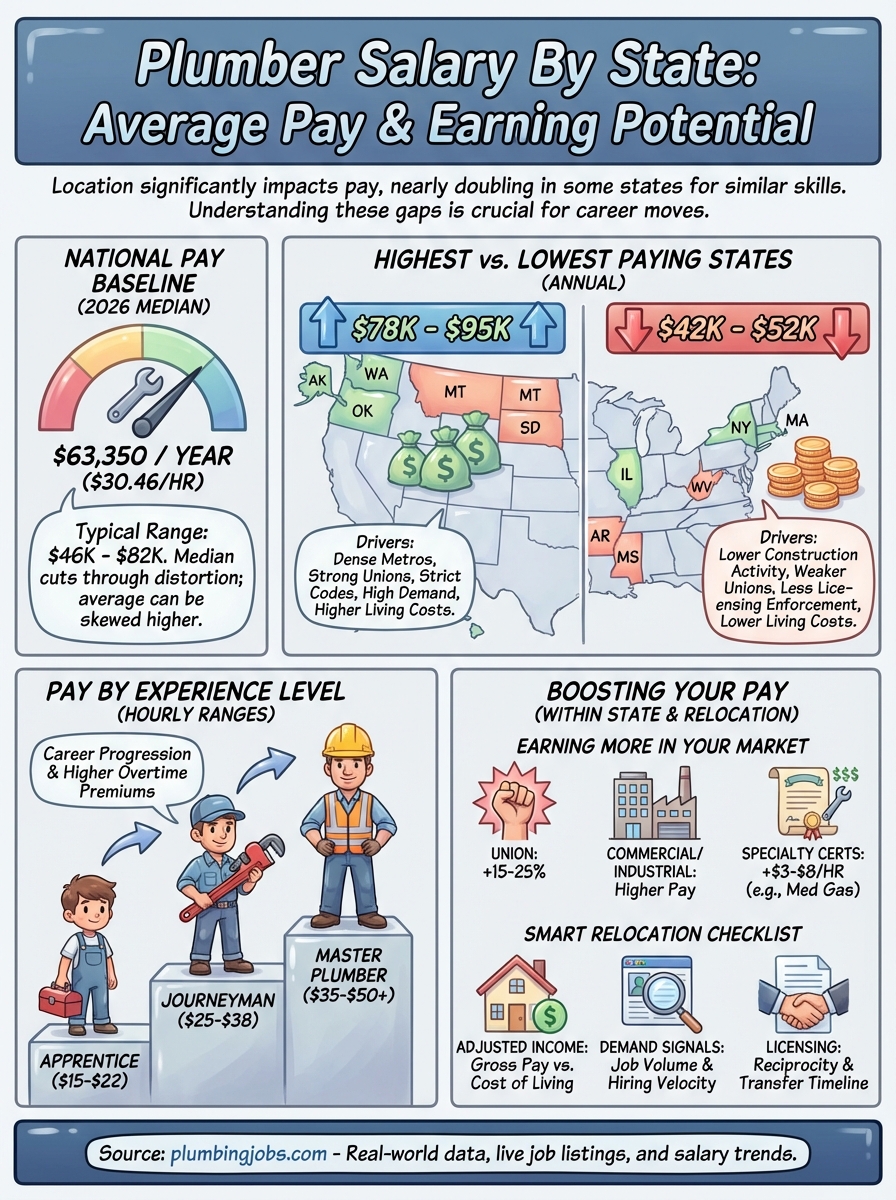
Understanding plumber salary by state starts with knowing the national baseline. As of 2026, the median annual wage for plumbers across the U.S. sits at approximately $63,350, which translates to about $30.46 per hour. This figure comes from federal labor data and represents the midpoint where half of all plumbers earn more and half earn less. Knowing this benchmark helps you evaluate whether a specific state’s pay is competitive or falls behind.
Average vs median pay and why it matters
You’ll see both average and median figures when researching plumber wages. The average (mean) adds all salaries together and divides by the number of workers, which can skew higher when a few master plumbers or specialty contractors earn exceptionally well. The median cuts through that distortion by showing the true middle of the pay distribution. For most plumbers, median pay offers a more accurate picture of what you can expect to earn in a typical role.
Typical hourly, annual, and overtime ranges
Most plumbers earn between $46,000 and $82,000 annually, depending on experience and location. Hourly rates typically range from $22 to $39, with overtime pushing total compensation higher during busy seasons. Many plumbers boost their annual take-home by 15 to 30 percent through weekend emergency calls, holiday premiums, and project-based bonuses. Overtime often pays time-and-a-half, which significantly changes your effective hourly rate.
What sources include and exclude in plumber pay
Federal wage data usually counts base pay, commissions, and guaranteed bonuses but excludes health benefits, retirement contributions, and irregular overtime. Some surveys include self-employed plumbers, while others focus only on W-2 employees, which shifts averages. You need to check whether a source tracks residential, commercial, or industrial sectors separately, because industrial plumbers often earn 20 percent more than residential service techs.
How to read percentiles to gauge your earning ceiling
Labor statistics break pay into percentiles that show where you land relative to all plumbers. The 10th percentile marks entry-level apprentice pay, while the 90th percentile reveals what top earners make without switching careers. If you’re at the 50th percentile (median), you earn more than half your peers. Tracking your percentile over time shows whether your skills and experience are translating into competitive raises.
Percentile data tells you not just what plumbers earn on average, but how much room you have to grow in your current market.
3. Highest-paying states for plumbers
When comparing plumber salary by state, a handful of locations consistently top the charts with annual wages that exceed $80,000. These states combine strong construction markets, high demand for skilled trades, and cost structures that support premium pay. Knowing which states lead the pack helps you target regions where your skills command the best compensation.
Top states by average annual pay
Alaska, Illinois, Massachusetts, New York, and Washington regularly post the highest average annual earnings for plumbers, often ranging from $78,000 to $95,000. Alaska’s remote job sites and harsh conditions justify premium wages, while Massachusetts and Illinois benefit from dense metro markets with strict building codes. Union density in these states also pushes baseline pay upward, particularly for commercial and industrial projects.
Top states by average hourly pay
Hourly rates follow a similar pattern, with Alaska, Massachusetts, and Hawaii leading at $38 to $46 per hour for experienced plumbers. Washington and Oregon also rank high, reflecting strong West Coast construction activity and aggressive minimum wage policies. These rates often exclude overtime, which can add another 20 to 40 percent to your annual take-home.
What drives higher pay in these states
High pay correlates with cost of living, union strength, and licensing barriers that limit the labor pool. States with mandatory apprenticeship programs produce fewer certified plumbers, which tightens supply and lifts wages. Energy sector demand in Alaska and commercial construction booms in New York create bidding wars for skilled labor.
When fewer plumbers compete for more jobs, your leverage to negotiate higher pay increases dramatically.
Notable metros that push state averages up
Specific metro areas like San Francisco, Boston, and Anchorage often pay 15 to 30 percent above their state averages. These cities face acute housing shortages and infrastructure overhauls that require thousands of licensed plumbers. Even if the state average looks modest, checking pay in the major metro can reveal opportunities that blow past the statewide benchmark.
4. Lowest-paying states for plumbers
On the opposite end of the spectrum, several states consistently report plumber salary by state figures that fall 20 to 40 percent below the national median. These regions often feature lower construction activity, smaller populations, and minimal union presence, which combine to suppress wages. Understanding these markets helps you set realistic expectations if you live there or decide whether relocation makes financial sense.
Lowest states by average annual pay
Mississippi, Arkansas, West Virginia, Montana, and South Dakota typically post the lowest average annual earnings for plumbers, ranging from $42,000 to $52,000. These states have smaller metro areas with less commercial development and fewer industrial facilities that pay premium wages. Rural demand exists, but competition from handymen and unlicensed workers often drives rates down.
Lowest states by average hourly pay
Hourly rates in these markets generally hover between $20 and $25, which puts full-time plumbers near or below the national median. States like Louisiana and Alabama also rank low on hourly pay despite occasional energy sector booms that boost a small subset of workers. Most residential service calls in these areas fall at the lower end of the scale.
Why pay runs lower in these markets
Lower cost of living explains part of the gap, but weak licensing enforcement and limited union coverage play bigger roles. When barriers to entry drop, more workers flood the market and undercut each other on price. Economic factors like slower population growth and aging infrastructure budgets also limit how much municipalities and homeowners can pay.
How plumbers raise earnings without moving
You can increase your income in low-pay states by pursuing specialty certifications like backflow prevention, medical gas, or fire suppression. Taking on-call emergency work, offering weekend service, and expanding into light commercial projects often doubles your effective hourly rate.
Certifications and service diversification let you compete in higher-margin niches that most local plumbers ignore.
5. Plumber pay by experience level
Experience matters more than location in many cases. Your plumber salary by state gains shift dramatically as you progress from apprentice to journeyman to master, with each license level unlocking higher base rates, better overtime premiums, and access to leadership roles. Understanding these pay tiers helps you map realistic earnings growth over your career.

Apprentice pay and what to expect early on
Apprentices typically earn 40 to 60 percent of journeyman wages, translating to $15 to $22 per hour depending on the state and program. Most apprenticeships last four to five years, with automatic raises every six to twelve months as you complete training hours and pass exams. Union apprenticeships often guarantee structured pay scales, while nonunion programs offer more variability but sometimes faster advancement.
Journeyman pay and common raise milestones
Journeymen command $25 to $38 per hour in most markets, with commercial and industrial roles paying at the higher end. You reach this level after passing your state’s journeyman exam and logging 8,000 to 10,000 hours of verified work experience. Common raise triggers include completing specialty certifications, taking on lead tech duties, or switching from residential to commercial projects.
Journeyman status is where most plumbers spend the bulk of their careers, so negotiating strong base pay at this stage sets your long-term earnings trajectory.
Master plumber pay and leadership premiums
Master plumbers earn $35 to $50 per hour, with some markets exceeding $55 for supervisory roles. This license requires additional years of experience and a separate state exam covering advanced codes, business management, and project oversight. Many masters supplement hourly wages with project bonuses, profit-sharing arrangements, or their own contracting businesses.
How experience changes hourly rates and overtime
Each experience tier also adjusts your overtime multiplier and call-out premiums. Apprentices rarely qualify for emergency on-call rotations, while journeymen and masters capture most time-and-a-half weekend shifts and double-time holiday work. Over a year, these premium hours can boost total compensation by 20 to 40 percent beyond base pay.
6. What changes plumber pay inside the same state
Two plumbers in the same city can earn vastly different amounts depending on who they work for and what type of projects they handle. Your plumber salary by state represents an average, but individual factors like union membership, sector choice, and specialty certifications create pay gaps of 30 to 50 percent even within the same metro area.
Union vs nonunion pay differences
Union plumbers typically earn 15 to 25 percent more than nonunion workers in the same market, with guaranteed health benefits and pension contributions on top of base pay. Union shops enforce strict pay scales tied to experience level, which protects you from wage compression. Nonunion employers offer more flexibility on scheduling and side work but rarely match union total compensation packages.
Residential vs commercial vs industrial work
Residential service plumbers often earn $22 to $32 per hour, while commercial plumbers handling new construction command $30 to $42 in the same state. Industrial plumbers working refineries, power plants, or hospitals push even higher, sometimes exceeding $45 per hour due to specialized code knowledge and shutdown work. Switching sectors is the fastest way to increase your pay without relocating.
Specialty roles that pay more
Certifications in medical gas, backflow prevention, fire suppression, and HVAC-plumbing hybrids add $3 to $8 per hour to your base rate. Elevator hydraulics, sprinkler system design, and hydrojetting also command premium wages because fewer plumbers hold those credentials. Employers pay extra for skills that reduce their need to subcontract specialized tasks.
Adding two specialty certifications often delivers bigger raises than waiting three years for standard experience bumps.
On-call, overtime, per diem, and shift premiums
Emergency on-call rotations pay $100 to $300 per week just for availability, plus time-and-a-half when you respond. Overtime beyond 40 hours typically pays 1.5x your hourly rate, with double-time on holidays. Per diem allowances for travel jobs add $50 to $150 daily, and night or weekend shifts often include 10 to 20 percent shift differentials.
7. How to choose a state using pay and real costs
A high plumber salary by state means nothing if your paycheck disappears into rent and groceries. Smart relocation decisions balance gross wages against actual purchasing power, plus job availability and licensing friction. You need a framework that cuts through headline numbers and reveals which markets truly improve your financial position.
Cost of living adjustments that change the ranking
A $75,000 salary in Massachusetts buys less than $60,000 in Tennessee once you account for housing, taxes, and everyday expenses. Use cost of living calculators to convert raw pay into real purchasing power, which often flips state rankings completely. High-tax states with expensive housing sometimes leave you with less disposable income than lower-paying markets with affordable rent and no state income tax.
Demand signals to check before you relocate
Check job board volume, average days to fill postings, and how many employers offer sign-on bonuses or relocation assistance. Rising construction permits and population growth predict future demand, while declining permits signal tightening markets. Strong demand gives you negotiating leverage and job security that raw pay figures never capture.
Licensing rules, reciprocity, and timeline to get working
Some states accept your current license through reciprocity agreements, letting you work immediately after passing a local code exam. Others require full re-apprenticeship or thousands of additional hours, which delays income for months or years. Research exact requirements and application timelines before committing to a move.
A simple checklist to compare two states side by side
List gross annual pay, subtract state and local taxes, then divide by cost of living index. Add licensing transfer time in weeks, count active job postings in your specialty, and note union density and average commute times. The state with the highest adjusted income and shortest ramp-up period wins your shortlist.
Adjusted income after taxes and living costs matters more than the salary number you see in national rankings.
What to do next
You now understand how plumber salary by state varies across the country and which factors drive those differences. Armed with this data, you can target high-paying markets, negotiate stronger offers, or justify a raise based on regional benchmarks. Knowledge only matters when you act on it.
Start by filtering jobs on PlumbingJobs.com by your target states to see current posted wages and compare them against the averages you read here. Set up email alerts for those locations so you track pay trends and catch new opportunities the moment they appear. Check the licensing requirements for your top two states and map out the timeline to get certified if you decide to relocate.
For deeper insights into licensing rules, certification paths, and career advancement strategies, explore our plumbing industry blog where we break down state-specific regulations and share proven tactics to boost your earning potential. Your next career move starts with better information.
Want plumbing jobs delivered to your inbox?
Want plumbing jobs delivered to your inbox?
Partner Site

