
Plumber Cover Letter Example: Templates For Any Experience
Your resume gets you noticed, but a strong plumber cover letter example can be what actually gets you hired. Most plumbing candidates skip the cover letter entirely, or slap together something generic, which means a well-written one immediately puts you ahead. Whether you’re an apprentice applying for your first gig or a master plumber ready for a leadership role, your cover letter is where you show employers the person behind the qualifications.
At plumbingjobs, we connect plumbing professionals with employers across all 50 states, and we see firsthand what hiring managers respond to. A tailored cover letter that speaks directly to the job posting outperforms a copy-paste template every time. That said, you still need a solid starting point, and that’s exactly what this guide delivers.
Below, you’ll find ready-to-use cover letter templates for every experience level, from zero experience to seasoned journeyman and beyond. Each one includes line-by-line guidance so you can adapt it to your specific situation and land more interviews with less guesswork.
What a plumber cover letter must do
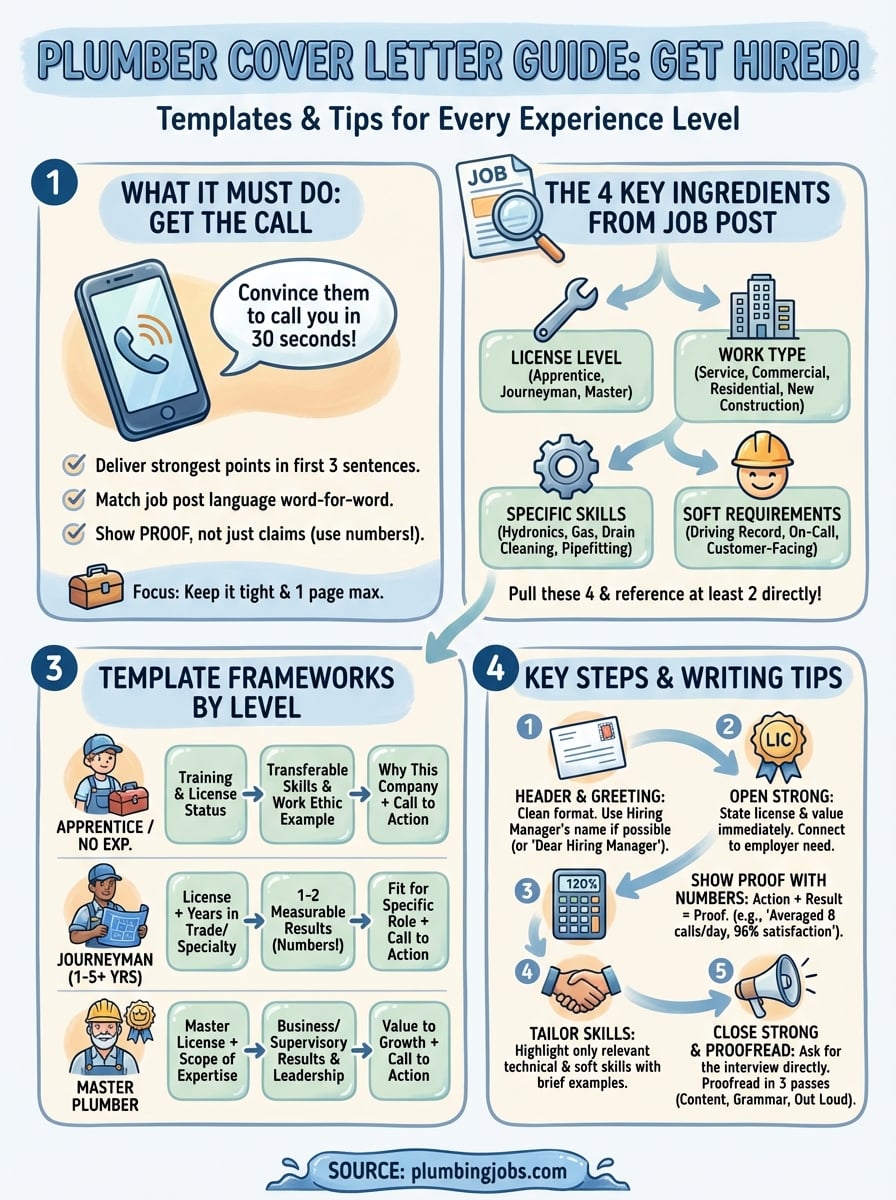
A plumber cover letter example isn’t just a formality you attach to your resume. It’s your first real conversation with a hiring manager, and it has one job: convince them to call you. Most cover letters fail because they say something like “I’m a hard worker who loves plumbing.” That tells an employer nothing. A strong cover letter, by contrast, gives the employer specific reasons to put your name at the top of the callback list.
Convince the employer in 30 seconds
Hiring managers at plumbing companies spend very little time on each application. They’re often scheduling jobs, managing crews, and fielding calls at the same time they’re reviewing candidates. That means your cover letter needs to deliver its strongest points in the first three sentences. If you bury your license level, your years of experience, or your biggest achievement at the bottom, most employers won’t reach it.
Your opening lines should immediately answer the question every employer has: “Why should I hire this person over the next one?”
Your job in those first lines is to state who you are and what you’re licensed to do, then connect that directly to the role. Skip the warm-up. Start with something concrete, like your license type, years in the trade, or a number that proves your output on the job.
Match the job posting word for word
Generic cover letters get ignored. The fastest way to make yours stand out is to mirror the language the employer used in their job post. If the posting says “commercial pipefitting,” use that phrase. If it lists “service call efficiency” as a priority, address that directly. Employers read dozens of applications, and a cover letter that reflects their own words signals that you actually read the post instead of sending a copy-paste letter.
Here’s what you should pull from any job posting before you write a single line:
- Required license level (apprentice, journeyman, master)
- Job type (service, commercial, residential, new construction)
- Specific skills mentioned (hydronics, gas lines, drain cleaning, backflow prevention)
- Soft requirements (clean driving record, on-call availability, customer-facing work)
Pull those four items and reference at least two of them directly in your letter. That simple step moves your application from generic to relevant without rewriting everything from scratch.
Show proof, not just claims
Every plumber applying for a job will say they’re reliable, skilled, and a team player. Those words mean nothing without evidence behind them. The cover letters that get callbacks are the ones that replace vague claims with concrete results. Instead of saying “I work efficiently,” say “I averaged 7 service calls per day on a residential route for three years.” Instead of “I have strong troubleshooting skills,” say “I diagnosed and repaired a slab leak that two other crews had missed.”
You don’t need to turn your cover letter into a resume recap. Pick one or two specific results that align directly with what the employer needs, and let those carry the weight. A number, a project size, a customer satisfaction metric, or a deadline you hit all tell a stronger story than any adjective you could choose.
Keep it tight and focused
A cover letter that runs longer than one page loses readers fast. Plumbing employers aren’t looking for an essay; they want to know if you can do the job and if you’re worth a phone call. Your letter should fit in three to four short paragraphs. Each paragraph should carry its own purpose: your introduction, your proof, your fit for this specific role, and your call to action.
Cutting your letter down is actually harder than writing it long. Read each sentence and ask yourself whether it adds a concrete reason to hire you or just fills space. If it fills space, cut it and let the stronger content breathe.
Step 1. Read the job post like a checklist
Before you write a single word of your plumber cover letter example, treat the job post as a list of instructions. Most job seekers skim postings to confirm the location and pay range, then start writing. That approach leaves out the exact details employers want to see reflected back at them. Read the post twice: once to understand the role, and once to extract what belongs in your letter.
The job post tells you exactly what to write. Your only job is to pay attention to it.
Find the four things that matter most
Every plumbing job post contains signals that tell you what the employer values. Some are obvious, like the required license level. Others are buried in bullet points or phrased as preferences. Your goal is to pull out the four key categories before you open a blank document.
Here’s what to look for in any posting:
- License requirement: Does the post specify apprentice, journeyman, or master? If they list a journeyman license as required, lead with yours.
- Work type: Look for terms like residential service, commercial construction, new construction, or service and repair. These describe the environment you’ll work in.
- Specific technical skills: Gas line installation, hydronics, backflow testing, drain cleaning, and pipefitting are common examples. Note which ones appear more than once.
- Soft or logistical requirements: On-call availability, a clean driving record, customer interaction, or the ability to lift a certain weight all signal what the employer screens for beyond technical skill.
Pull these four items before writing anything, and you’ll have a targeted framework your entire letter can follow.
Turn requirements into your letter’s content
Once you have your four items, match each one to something real from your own background. If the post lists gas line experience as a requirement, write one sentence that confirms you have it and puts a number behind it. If they need someone comfortable with customer-facing service calls, give one specific example of a time you handled that well.
You don’t need to hit all four items in equal depth. Focus on the two or three that appear most prominently in the post, because those are the priorities the employer will screen for first. The remaining items can be mentioned briefly or left to your resume. This method keeps your letter short, direct, and clearly written for this specific job rather than a generic pool of open positions.
Step 2. Pick the right template for your role
Not every plumber cover letter example fits every situation. An apprentice applying for their first paid position needs a different structure than a journeyman with eight years on commercial projects. Using the wrong format signals to the employer that you don’t understand where you stand in the trade, and that’s a fast way to get passed over for someone who does.
Picking the right template isn’t about finding the fanciest layout. It’s about leading with the strengths that actually matter for your specific experience level.
Match your starting point to the right format
Your experience level and license status should drive every structural decision in your letter. If you’re an apprentice, you lead with your training program, any certifications you’ve completed, and your willingness to work under a licensed plumber. Burying that information makes you look like you’re hiding something. Put it front and center, and frame it as an asset rather than a limitation.
If you’re a journeyman or master plumber, your structure shifts to proof first. You have the credentials, so employers assume the baseline. What they want to see is what you’ve delivered on the job: the volume of work you’ve handled, the complexity of systems you’ve installed, and the teams or apprentices you’ve supervised. Your template should open with your license and a result, then build from there.
Template frameworks by experience level
Use the structure below as your starting skeleton before you fill in your personal details and job-specific language. Each row maps to a different career stage with a recommended paragraph order.
| Experience Level | Paragraph 1 | Paragraph 2 | Paragraph 3 |
|---|---|---|---|
| Apprentice / No experience | Training program + license status | Transferable skills + work ethic example | Why this company + call to action |
| Journeyman (1-5 years) | License level + years in trade | 1-2 measurable results from past jobs | Fit for this role’s specific needs + call to action |
| Journeyman (5+ years) | License + specialty skills | Project scope or volume metrics | Leadership, reliability, or problem-solving example + call to action |
| Master Plumber | Master license + scope of expertise | Business or supervisory results | Value to company growth or team + call to action |
Once you know which row matches your situation, you have a clear order to follow. Fill each paragraph with real details from your background, and you’ll avoid the rambling structure that makes so many cover letters land in the reject pile.
Step 3. Write a direct header and greeting
The top of your plumber cover letter example is the first thing a hiring manager sees before they read a single sentence. A messy or incomplete header makes your application look careless before you’ve had a chance to make your case. Getting this section right takes less than five minutes and immediately signals that you pay attention to details, which is exactly what every plumbing employer wants in a candidate.
Format your header correctly
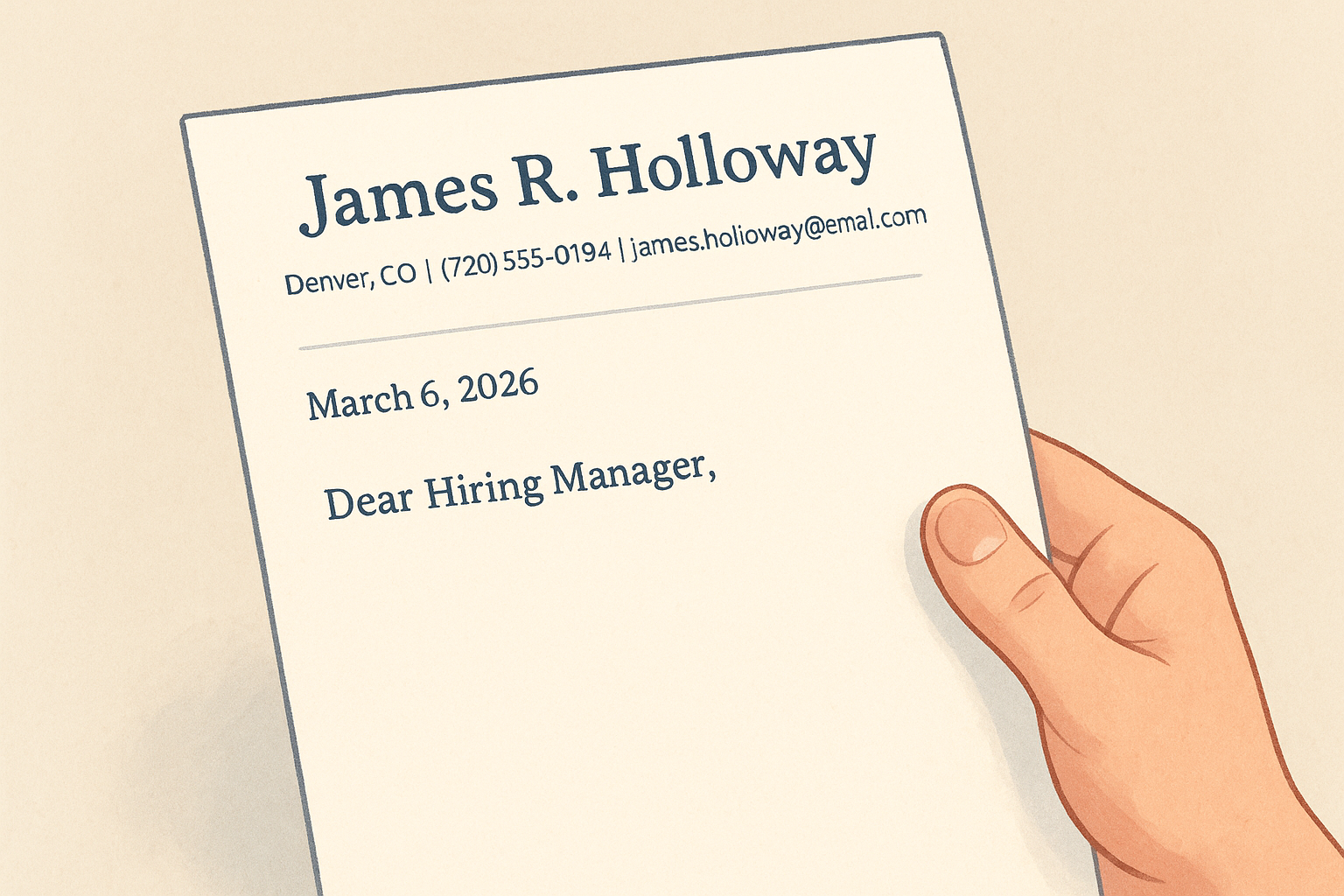
Your header should contain your name, phone number, email address, and the city and state where you’re based. You don’t need a full street address. Below your information, add the date, then the employer’s name, company, and address if the posting includes it. Keep it clean and left-aligned. Use the same font and size as the rest of your letter so the whole document looks intentional rather than assembled in a hurry.
Here’s a ready-to-use header template you can drop into any application:
James R. Holloway
Denver, CO | (720) 555-0194 | james.holloway@email.com

March 6, 2026

Mike Tran, Hiring Manager
Front Range Plumbing & Mechanical
1402 Commerce Drive, Denver, CO 80203
If the job post doesn’t list a specific contact person, skip the name line and use the company name alone. Never write “To Whom It May Concern” as a header element; that belongs in the greeting, and even there, you should avoid it.
Get the greeting right
The greeting is a short line, but it carries weight. If the job post includes a hiring manager’s name, use it. “Dear Mr. Tran,” is direct and professional. Using a real name shows you read the posting carefully and didn’t just fire off a generic application.
If you can’t find a name, call the company and ask who handles hiring for field technicians. That thirty-second phone call sets you apart from ninety percent of applicants.
When no name is available after checking the posting and the company’s website, use “Dear Hiring Manager,” as your fallback. It’s neutral, respectful, and keeps the focus on what matters: the content that follows. Avoid “Dear Sir or Madam” since it reads as outdated, and never address your letter to a job title like “Dear Plumbing Supervisor.” Keep the greeting tight, then move straight into your opening paragraph without adding a line like “I am writing to apply for…” That opener wastes your first sentence on information the employer already knows.
Step 4. Open with your license and value
Your opening paragraph in any plumber cover letter example carries more weight than the rest of the letter combined. Employers decide within the first few lines whether to keep reading, so you need to answer their most pressing question immediately: what are you licensed to do, and what have you delivered? Skip the preamble and open with credentials and impact in the same breath.
Lead with your credentials first
Your license level is the first filter every plumbing employer applies, so state it in your opening sentence. If you hold a journeyman license in Colorado, say that directly. If you’re a master plumber with a gas endorsement, lead with both. Hiding your credentials in the middle of your letter forces the reader to hunt for basic qualifying information, and most won’t bother.
Your first sentence should contain your license level, your state, and the number of years you’ve been working in the trade.
Here’s a ready-to-use opening template you can adapt to your situation:
I am a licensed Journeyman Plumber in [State] with [X] years of hands-on
experience in [residential service / commercial construction / new
construction]. In my most recent role at [Company Name], I [specific
result that ties to the job post].
Fill in your real details and you have an opener that immediately confirms your qualifications and gives the employer one concrete reason to keep reading. That’s the entire goal of your first paragraph.
Connect your value to the employer’s need
After you state your license and experience, your second sentence should tie directly to what the employer listed in their job post. If the posting emphasizes high-volume residential service, your opener should reference the number of service calls you’ve handled. If it’s a commercial construction role, mention the project scale or the systems you’ve installed. This connection tells the hiring manager you understand their operation, not just the trade in general.
Avoid statements like “I am passionate about plumbing” in your opening paragraph. These phrases take up valuable space and add no screening value for the employer. Instead, replace any opinion about yourself with a measurable fact. A sentence like “I completed 1,400 service calls over three years with a 96% first-visit resolution rate” tells the employer far more than any self-description could. Keep your opening to three sentences maximum, and make sure each sentence earns its place by giving the reader information they can act on.
Step 5. Show proof with numbers and results
Every employer reading your plumber cover letter example has seen the same claims hundreds of times: dependable, hardworking, detail-oriented. Those words carry zero weight because every applicant uses them. What actually moves a hiring manager is a specific number tied to a real outcome, because numbers are concrete and claims are not. This step is where you replace vague self-descriptions with the kind of evidence that forces a callback.
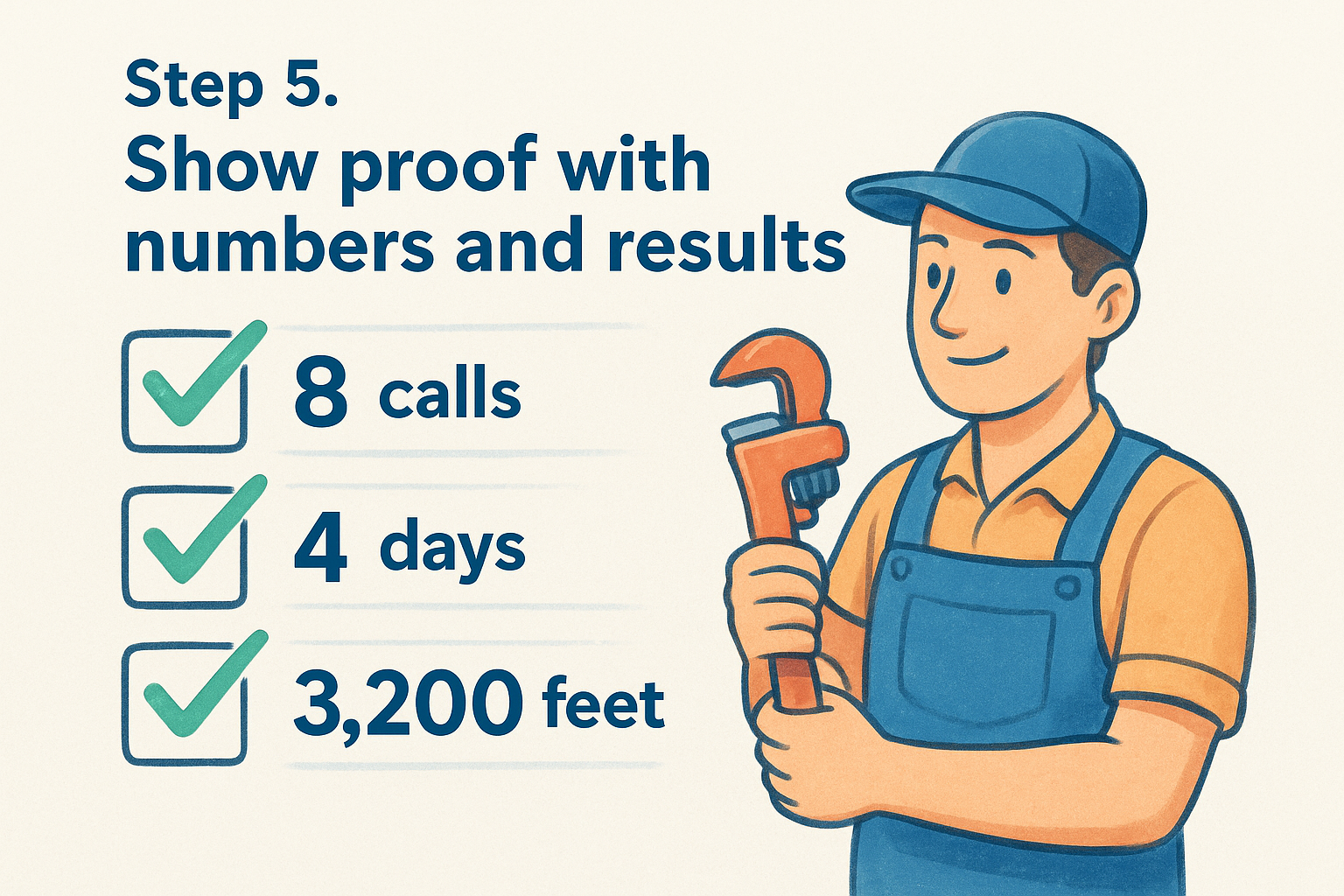
One strong, specific result in your cover letter does more work than three paragraphs of general praise.
Turn your work history into evidence
You already have the proof you need. You just need to frame your daily work as measurable output instead of a list of tasks. Think about volume, speed, scale, and outcomes. How many service calls did you average per day? How many linear feet of pipe did your crew install on a project? Did you reduce a company’s callback rate? Did you pass an inspection on the first attempt consistently?
Use the table below to translate common plumbing tasks into cover-letter-ready proof statements:
| Vague Claim | Proof-Based Version |
|---|---|
| “I handle high call volumes” | “I completed an average of 8 residential service calls per day for two years” |
| “I’m good at diagnosing problems” | “I identified a hidden slab leak two prior crews had missed, saving the client four days of rework” |
| “I work well under pressure” | “I completed a full commercial bathroom rough-in 12 hours ahead of a city inspection deadline” |
| “I have commercial experience” | “I worked on a 14-story medical facility fit-out, installing over 3,200 feet of sanitary drain line” |
| “I’m reliable” | “I maintained perfect attendance across 18 months on a fast-track hospital construction project” |
Pick one or two rows that match the job post’s priorities, and build your proof paragraph around those.
Use the claim-proof formula
Once you have your numbers, structure each proof statement using a simple two-part formula: state the action, then attach the result. This keeps your sentences short and concrete while giving the employer exactly the evidence they need to make a decision.
Here’s the formula in practice:
Action + Result = Proof Statement

"I serviced [X] residential accounts per week and maintained a
[Y]% customer satisfaction rating over [Z] months."

"I supervised a crew of [X] apprentices on a [project type]
and delivered the project [ahead of / on] schedule."
Fill in your real figures, cut any sentence that doesn’t follow this structure, and your proof paragraph writes itself in under ten minutes.
Step 6. Tailor for apprentice to master levels
Your career stage shapes what you lead with and what you leave out in your cover letter. A plumber cover letter example that works perfectly for a master plumber will actively hurt an apprentice’s application if they try to use it unchanged. The adjustment isn’t about making yourself sound more experienced than you are. It’s about framing the right strengths for the right audience at each level.
Writing as an apprentice or entry-level candidate
If you’re just starting out, your biggest mistake is apologizing for your lack of experience. Employers who hire apprentices already know they’re hiring someone early in their career. What they want to confirm is that you show up, follow direction, and take the trade seriously. Lead with your training program, any pre-apprenticeship certifications, and one example that shows your reliability or physical commitment to the work.
Never frame your limited experience as a weakness. Frame your training and availability as the asset it is.
Use this structure as your apprentice opening:
I am currently enrolled in [Training Program Name] and hold
a [certification or card, e.g., OSHA 10] certification.
I have completed [X] hours of hands-on training in
[specific area, e.g., residential rough-in and fixture installation]
and am looking to bring that foundation to a crew where I can contribute immediately and grow under licensed supervision.
Writing as a journeyman
Journeyman applicants should skip the training backstory entirely and open directly with license status, years in the trade, and a result. You have the credentials employers expect at this level, so the letter needs to prove what you’ve done with them. Employers hiring journeymen are screening for volume, reliability, and technical range, so your middle paragraph should address at least one of those three with a real number.
Use two strong proof statements from your most recent roles. One should speak to the type of work (residential, commercial, service, construction), and the other should quantify your output or a specific outcome. Keep both statements under two sentences each so your letter stays tight and readable.
Writing as a master plumber
At the master level, your license is the baseline, not the headline. Employers already expect it. What separates your application is what you’ve led, built, or improved. Your opening should move quickly past your license and into scope of responsibility: team size, project scale, inspection pass rates, or business results if you’ve run your own operation.
Replace any language about “looking for opportunities to grow” with language about what you deliver to a crew or a company. At this level, employers are asking whether you can add immediate leadership value, and your letter needs to answer that question in the first paragraph.
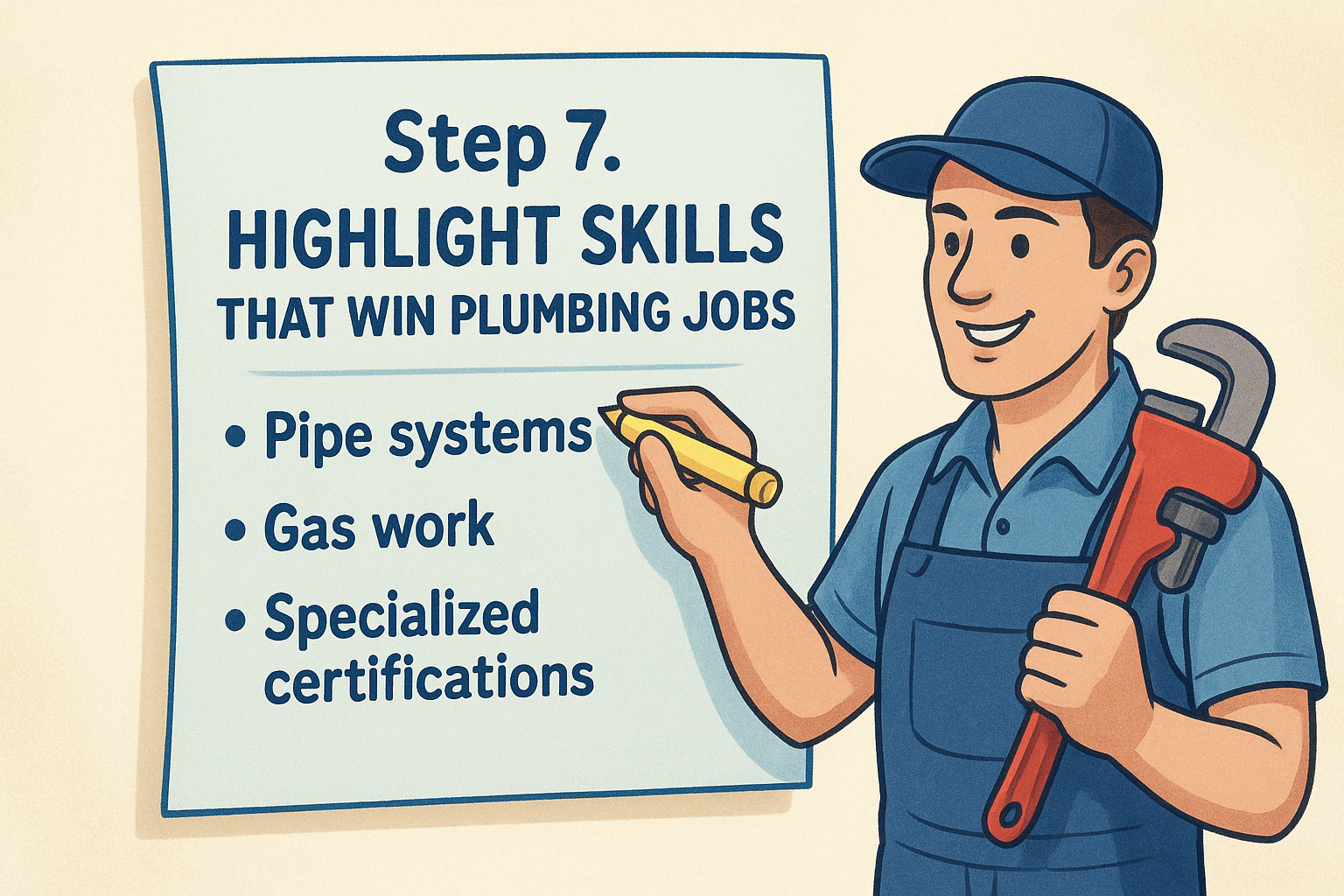
Step 7. Highlight skills that win plumbing jobs
Skills belong in your cover letter only when they’re directly tied to the job post. A long list of everything you can do wastes space and buries the credentials that matter most. In any strong plumber cover letter example, you pick the skills the employer asked for and confirm you have them with a brief, concrete example. That selection process, not the total number of skills you mention, is what separates a focused letter from one that reads like a résumé dump.
Technical skills that employers screen for
Plumbing employers scan for specific technical competencies before they consider anything else. Your cover letter should name the technical skills listed in the job post by their exact terms. If the posting mentions backflow prevention certification, use that phrase word for word. If it asks for experience with commercial hydronic systems or gas line installation, confirm your hands-on experience in those areas and attach a number or project type to back it up.
Use this table to find the right language for your specialty:
| Skill Category | Examples to reference |
|---|---|
| Pipe systems | Copper, PVC, PEX, cast iron, CPVC |
| Gas work | Natural gas, propane, CSST installation |
| Specialized certifications | Backflow prevention, cross-connection control |
| Commercial work | Hydronic heating, process piping, medical gas |
| Residential service | Water heater replacement, drain cleaning, fixture rough-in |
Pull the categories that match the job post and weave the relevant terms into your proof paragraph from Step 5. This approach confirms your qualifications without turning your letter into a skill inventory.
Soft skills that actually close the deal
Technical skills get you past the first screen, but soft skills answer whether you’re easy to work with. Employers hiring for service roles care how you handle customers. Those hiring for construction crews want to know you communicate clearly and stay on task when the schedule changes. Pick one or two soft skills the job post signals as important, and back each one with a single sentence of evidence.
Never list soft skills without attaching a quick example, or they read exactly like every other generic application.
Use this template as your model:
"I maintain clear communication with homeowners throughout each
service visit, which contributed to a [X]% satisfaction score
tracked through [Company Name]'s dispatch system over [X] months."
State the skill, then prove it happened. That two-part structure keeps your letter tight while giving the employer a concrete reason to trust what you’re saying about yourself.
Step 8. Close strong and proofread fast
Your closing paragraph is the last thing a hiring manager reads before they decide whether to call you, so it needs to do one specific thing: ask directly for the interview. Most applicants end with something passive like “I hope to hear from you soon,” which puts the decision entirely in the employer’s hands. In any strong plumber cover letter example, your closing takes a more direct approach by restating your value and naming the next step you expect to happen.
Write a closing that asks for the interview
Your final paragraph should run no longer than three sentences. The first sentence confirms your fit for the role in one concrete phrase. The second states your availability and willingness to meet. The third gives your contact information and asks clearly for the next step. That structure keeps the closing tight while making it impossible for the employer to miss your intent.
Passive closings lose interviews. A direct ask signals confidence, and confidence is exactly what plumbing employers hire for.
Use this closing template and replace the bracketed details with your own:
My [license level] license in [State], combined with [X] years of
[work type] experience, makes me a direct match for what you've
described. I'm available to meet at your convenience and can
start [timeframe, e.g., within two weeks of an offer]. You can
reach me at [phone number] or [email]. I look forward to
discussing how I can contribute to [Company Name].
Keep your tone direct without sounding demanding. You’re asking for a conversation, not making a demand, so keep the language professional and brief.
Proofread in three passes
A single typo or mismatched employer name can erase everything your letter built. Proofread in three distinct passes instead of reading it once and calling it done. Each pass serves a specific purpose, so treat them separately.
Use this sequence every time:
- First pass: Read for content. Confirm your license level, years of experience, and the company name are all correct.
- Second pass: Read for grammar and spelling. Read each sentence slowly from start to finish. Do not skim.
- Third pass: Read the letter out loud. Your ear will catch awkward phrasing and run-on sentences that your eyes skip over when reading silently.
After your three passes, check one final detail: confirm the job title in your letter exactly matches the title listed in the posting. A letter addressed to the wrong role or company name gets discarded immediately, and that’s a problem a sixty-second check prevents every time.
Next steps
You now have everything you need to write a strong plumber cover letter example from scratch. Start by pulling the key requirements from the job post, pick the template that matches your experience level, and build each paragraph around real numbers from your work history. Every sentence in your letter should earn its place by giving the employer a concrete reason to call you.
From here, the fastest move is getting your application in front of the right employers. PlumbingJobs.com lists plumbing positions across all 50 states, organized by role and location so you can find openings that match your license level and specialty. Browse open positions, apply directly, and put your new cover letter to work immediately.
For more career guidance specific to the plumbing trade, visit the PlumbingJobs.com blog where you’ll find salary data, licensing information, and industry updates to help you stay ahead at every stage of your career.
Want plumbing jobs delivered to your inbox?
Want plumbing jobs delivered to your inbox?
Partner Site

