

What Is Non Union Plumber Salary? Hourly And Yearly Pay 2026
Most plumbers in the United States work outside of organized labor agreements, yet solid data on non union plumber salary figures can be surprisingly hard to pin down. General job boards lump plumbing in with other trades, and outdated numbers float around the internet without context. If you’re trying to figure out what you should actually be earning, or paying, in 2026, you need current, plumbing-specific compensation data broken down in a way that’s useful.
That’s exactly what we focus on here at plumbingjobs. As a job board built exclusively for the plumbing industry, we track thousands of listings across all 50 states and see firsthand how pay varies by location, experience level, and role type. This gives us a direct line into what employers are offering right now, not what they offered two years ago.
Below, we break down average hourly and annual pay for non-union plumbers, compare those numbers against union scales, and show you how earnings shift from state to state. Whether you’re an apprentice weighing your options or a shop owner setting competitive wages, this guide gives you the numbers you need to make a smart move.
Why non union plumber pay varies so much
When you work outside a union, no collective bargaining agreement sets a wage floor for you. That means your pay gets determined by a combination of market forces, your individual qualifications, and where the job physically sits. Understanding the main drivers of that variation helps you benchmark your rate with confidence.
Without a union contract, your pay is negotiated on your own terms, which means knowing your market value is non-negotiable.
Geographic location and cost of living
Location is the single biggest factor that moves non union plumber salary figures up or down. States like California, Hawaii, and Alaska routinely post hourly rates 30-50% higher than states in the Southeast or Midwest, largely because the cost of labor tracks the cost of living. A plumber in San Francisco is competing in a fundamentally different market than one in rural Tennessee.
Beyond state lines, city versus rural work also shifts the numbers noticeably. Metro areas generate more commercial projects, more permit-driven work, and more employers competing for qualified labor, all of which push wages upward. If your current location is suppressing your earning potential, that is a practical reason to consider relocation or targeting metro-area employers who post higher base rates.
Experience level and certifications
Your license tier, whether apprentice, journeyman, or master plumber, is one of the clearest pay dividers in the trade. Employers set starting rates based on what you can legally do on a job site, and each step up the ladder typically adds several dollars per hour. A licensed master plumber with the ability to pull permits commands significantly more than an apprentice working the same hours on the same crew.
Specialty certifications in areas like medical gas, backflow prevention, or fire suppression further separate your earning potential from the general labor pool. Employers pay a premium for skills that are both rare and required by code, so adding a specialty credential directly translates to a higher ceiling on your hourly rate.
Average non union plumber salary in 2026
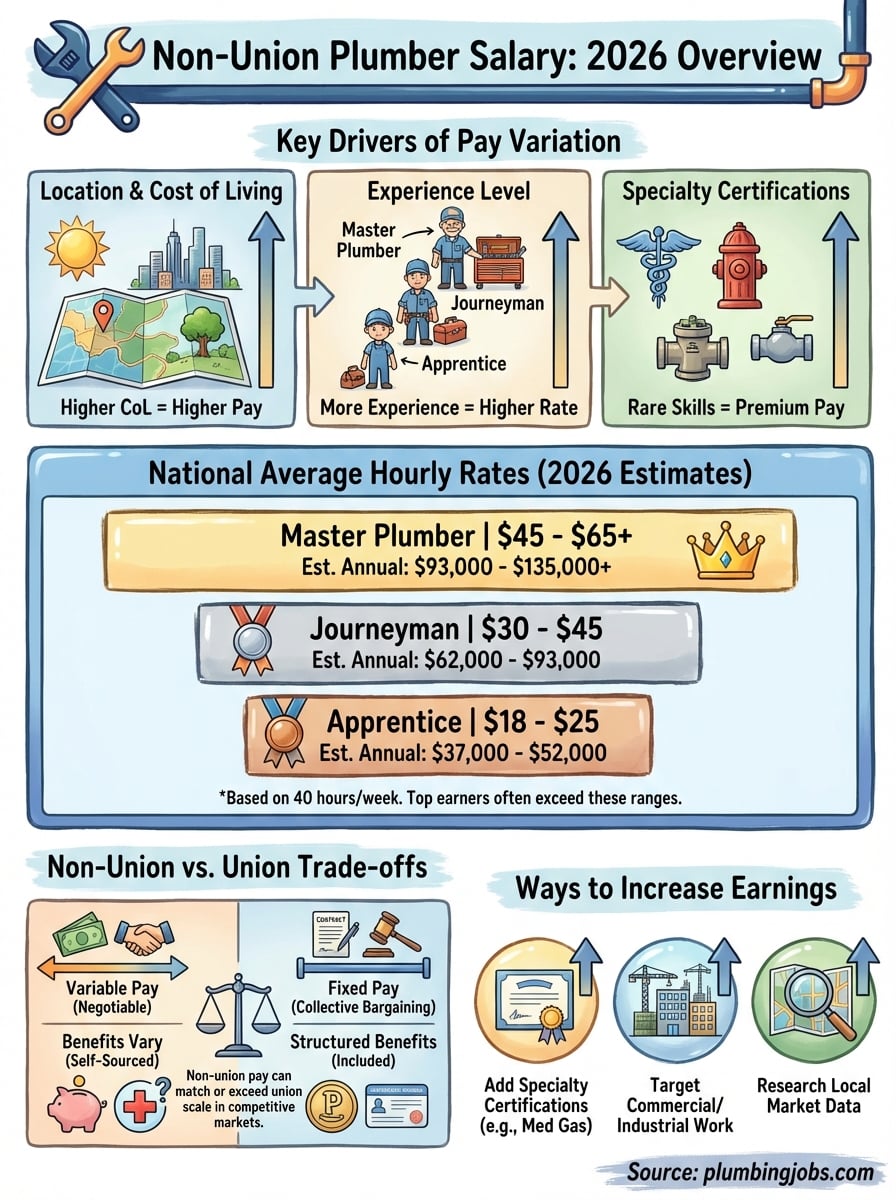
Based on plumbing job listings across all 50 states in early 2026, non union plumber salary figures span a wide range depending on your experience and location. The national midpoint for journeyman-level work lands around $30 to $45 per hour, which translates to roughly $62,000 to $93,000 annually at 40 hours per week.
Hourly Rates by Experience Level
Your license tier directly shapes your starting rate with most employers. Here is a breakdown of what active job postings reflect right now:

| Experience Level | Typical Hourly Rate | Estimated Annual Pay |
|---|---|---|
| Apprentice | $18 – $25 | $37,000 – $52,000 |
| Journeyman | $30 – $45 | $62,000 – $93,000 |
| Master Plumber | $45 – $65+ | $93,000 – $135,000+ |
Master plumbers in high-cost metro areas regularly clear $100,000 or more without any union membership.
What Drives the Top of the Range
Plumbers who specialize in commercial or industrial work consistently land at the higher end of these figures. Employers posting roles for large mechanical contractors or municipal projects often offer rates that outpace residential service work by $10 or more per hour, even for the same license tier. Knowing where those opportunities concentrate in your state puts you in a better position to target them directly.
Non union vs union pay and benefits
Union and non-union plumbers often earn comparable base wages, but the structure around that pay differs significantly. Understanding both sides helps you weigh the full picture, not just the hourly number on a job posting.

Pay Differences
Union plumbers work under a collective bargaining agreement that sets a fixed rate by tier and region, which removes room for negotiation but also removes the risk of being underpaid. A strong non union plumber salary at the journeyman level can match or exceed union scale in high-demand markets, especially when employers compete for licensed talent.
In competitive metro markets, non-union journeymen regularly earn at or above union scale without paying dues or waiting on seniority.
Benefits and Stability Trade-offs
Union membership typically includes structured pension plans, health insurance, and apprenticeship pipelines funded through the agreement itself. Non-union employers vary widely on benefits, with some offering full packages and others paying a higher hourly rate in exchange for you sourcing your own coverage. Your total compensation is what matters, so factor health insurance costs, retirement contributions, and paid time off into any side-by-side comparison before deciding which path fits your situation.
How to estimate your fair hourly rate
Estimating your fair hourly rate starts with gathering real data from your local market, not national averages that may not reflect what employers in your area actually pay. Your non union plumber salary target should be built from ground-level evidence, not guesswork.
Use Local Job Postings as Your Baseline
Scanning active plumbing job listings in your city or metro area gives you the most direct read on what employers are willing to pay right now. Focus on postings that match your license tier and the type of work you do, whether residential service, commercial construction, or industrial maintenance. Look at five to ten listings and note the range.
The middle of that local range is your starting benchmark, not the floor you should accept.
Factor in Your Full Cost Package
Your hourly rate only tells part of the story. If a prospective employer does not offer health insurance or retirement contributions, you need to add roughly $5 to $10 per hour to your target rate to cover those costs independently. Calculate your actual take-home value by accounting for benefits, overtime availability, and any tool or vehicle allowances before you compare two offers side by side.
Ways to increase non union plumber earnings
Your non union plumber salary is not fixed, and you have more control over it than most workers in salaried roles. A few deliberate moves can push your annual earnings meaningfully higher without requiring a job change or union membership.
Add Specialty Certifications
Backflow prevention, medical gas, and fire suppression are three certifications that consistently command higher pay because the work is regulated, code-specific, and not every plumber holds the credentials. Adding even one of these to your license profile gives employers a concrete reason to offer a higher rate, often adding $5 to $10 per hour above the standard journeyman pay in your area.
Specialty certifications are one of the fastest ways to separate your rate from the general journeyman pool.
Target Commercial and Industrial Work
Commercial and industrial projects pay noticeably more per hour than residential service calls for the same license tier. Employers running large mechanical contracts or municipal builds often post higher base rates and overtime availability, which compounds your total annual earnings faster than a residential shop typically allows. Searching specifically for these roles in your metro area gives you a direct path to the top of the pay range.
Next steps
You now have a clear picture of what drives non union plumber salary figures in 2026, from license tier and location to specialty certifications and the type of work you target. The national midpoint for journeyman-level work sits around $30 to $45 per hour, but your actual rate depends on the specific variables covered in this guide. Use that range as a starting point, not a ceiling.
Your next move is to put this information to work. If you are a plumber ready to find a role that pays what your skills are actually worth, browse current listings on plumbingjobs.com to see what employers in your area are offering right now. If you run a plumbing business and need to attract qualified, licensed talent, posting your open roles where serious plumbing professionals are already searching puts your listing in front of the right people faster.
Want plumbing jobs delivered to your inbox?
Want plumbing jobs delivered to your inbox?
Partner Site

