Plumbingjobs.com Logo

5 Best Places To Find Pipefitter Jobs Near Me (2026)

5 Best Places To Find Pipefitter Jobs Near Me (2026)

If you’ve been searching for pipefitter jobs near me, you already know the frustration of scrolling through generic job boards packed with irrelevant listings. Pipefitting is a specialized trade, and finding openings that match your skill level, location, and pay expectations takes more than a basic keyword search.

The good news: demand for pipefitters remains strong heading into 2026, with opportunities spanning industrial plants, commercial construction, and government facilities. Hourly wages and per diem packages vary widely depending on where you look and who’s hiring, which makes choosing the right job platform a real advantage. Whether you’re a seasoned journeyman or just starting out, knowing where to search matters.

At plumbingjobs, we connect plumbing and pipefitting professionals with employers across all 50 states, so we’ve seen firsthand which resources actually deliver results. Below, we break down the five best places to find pipefitter jobs in your area, including what each platform does well and where it falls short.

1. PlumbingJobs.com

PlumbingJobs.com focuses exclusively on the plumbing and pipefitting trade, which means every listing is relevant to your search. Unlike general job boards where pipefitter roles get buried under unrelated results, this platform filters out the noise before you even start.

What makes it a strong fit for pipefitters

The site organizes jobs by trade-specific roles including pipefitter, steamfitter, and industrial pipefitter positions. Employers posting here are targeting tradespeople directly, so listings tend to include license and certification requirements upfront rather than burying them in the fine print.

How to search by location, role, and shift type

You can filter pipefitter jobs near me by state, city, or zip code, then narrow results by job title and employment type. This cuts your search time significantly compared to platforms that make you scroll through unrelated postings to find anything relevant.

How to search by location, role, and shift type

Filtering by city and role at the same time gives you the most targeted results in under a minute.

What to look for in a solid listing

Strong listings will state pay range, shift schedule, and required certifications clearly in the body. Skip listings that omit compensation details or use vague language like "experience preferred" without specifying what certifications or hours are actually required.

  • Pay range listed (hourly or salary)
  • License or certification requirements spelled out
  • Shift type confirmed (day, night, rotating)
  • Direct contact information or application link

How to apply fast and follow up

Most listings link directly to the employer’s application portal, which cuts out the recruiter middleman. After submitting, follow up within 48 to 72 hours by contacting the employer directly if their details appear in the listing.

Fees and account basics

Creating a job seeker account is free. You can save searches and set up email alerts for new pipefitter postings in your area without paying anything.

2. Indeed

Indeed is one of the largest general job boards in the United States, and its sheer volume of listings makes it a practical starting point when you’re searching for pipefitter jobs near me.

What makes it useful for local pipefitter roles

The platform pulls listings from employer websites, staffing agencies, and direct company postings across the country, giving you broad coverage of industrial and commercial pipefitting roles in your area.

How to search by location, pay, and experience level

Enter "pipefitter" in the job title field, then set your location and commute radius. Use the salary filter to cut results down to a minimum hourly rate that actually meets your requirements.

How to spot high-quality postings and avoid scams

Prioritize listings posted directly by verified employers with a visible company name rather than anonymous third-party recruiters. Skip any posting that requests personal financial details before scheduling an interview.

If a listing has no pay range, no company name, and vague requirements, move on immediately.

How to apply fast and track applications

Indeed’s one-click apply works for many listings, but uploading a trade-specific resume that lists your certifications and field hours will improve your callback rate noticeably.

Fees and account basics

Creating a job seeker account is free. You can save searches and receive email alerts for new local pipefitter postings at no cost.

3. ZipRecruiter

ZipRecruiter’s automated matching system sends your profile to relevant postings without manual searching. For pipefitters, that means faster exposure to local hiring managers than most general platforms offer.

What makes it useful for quick hiring pipelines

Employers on ZipRecruiter often need to fill pipefitter roles quickly, which means faster response times for you. Many postings come from industrial contractors and mechanical firms that are actively hiring.

  • Faster hiring timelines than most platforms
  • Strong industrial and commercial employer base

How to set up searches and job alerts by area

Search by "pipefitter" and your zip code, then set a daily alert so new local postings reach your inbox before other candidates see them.

  • Use zip code over city name for tighter radius
  • Set alert frequency to daily, not weekly

How to use pay ranges and keywords like per diem

Filter by minimum hourly rate and add "per diem" as a keyword to surface travel pipefitter jobs near me with better total pay packages.

Adding "per diem" to your ZipRecruiter keyword search consistently pulls up higher-paying opportunities.

How to apply fast and improve response rates

Use one-click apply, but make sure your profile lists certifications and pipe systems experience clearly. The algorithm matches you to employers based on specific credentials, so an incomplete profile means missed opportunities.

  • List certifications by name
  • Include total years of field experience

Fees and account basics

Accounts are free for job seekers with no hidden costs. You can set up unlimited alerts and applications without paying anything.

  • No paid tier for candidates
  • No per-application fees

4. LinkedIn Jobs

LinkedIn Jobs gives you access to mechanical contractors, industrial firms, and long-term project-based roles that rarely show up on trade-specific boards. It works especially well for pipefitters looking for stable employment rather than short-term gigs.

What makes it useful for contractors and long-term roles

Employers posting on LinkedIn tend to be larger contractors and companies running multi-year projects that need reliable pipefitters for extended engagements. That makes it a stronger fit if you want steady work over repeated short stints.

How to search locally and find hiring managers

Search "pipefitter jobs near me" using LinkedIn’s location filter and sort by date posted to catch fresh listings. You can also view who posted the job and connect with hiring managers directly before submitting an application.

How to search locally and find hiring managers

How to use unions, contractors, and project keywords

Add keywords like "union pipefitter," "mechanical contractor," or "industrial project" to filter results toward higher-paying, longer-duration roles.

Searching "pipefitter" alongside a specific contractor company name surfaces roles that don’t appear in standard keyword results.

How to apply and message without wasting time

Use Easy Apply when available, and send a brief connection note to the recruiter that mentions your certifications and total field experience to stand out quickly.

Fees and account basics

A basic job seeker account is free. Premium features cost extra, but free search and direct messaging cover most of what you need to land an interview.

5. RoadDogJobs

RoadDogJobs focuses specifically on travel and per diem work, making it the strongest option for pipefitters willing to move for higher pay. If you’re searching for pipefitter jobs near me but open to traveling for better total compensation, this platform is built for you.

What makes it useful for travel and per diem work

The platform caters to traveling tradespeople who want per diem packages included in job listings. Most postings list daily per diem rates alongside hourly pay, so you can evaluate total compensation before applying.

How to filter by per diem, duration, and jobsite type

Filter results by per diem availability and project duration to find positions that match how long you want to travel. Selecting jobsite type helps narrow results to industrial, commercial, or power plant environments.

What details to confirm before you commit

Before accepting any offer, confirm housing arrangements and per diem terms in writing. Verify that the project start date and duration are locked in, not estimated.

Always get per diem terms confirmed in writing before you accept and make travel arrangements.

How to apply and prepare for a quick start

Submit your application with certifications and pipe systems experience listed clearly. Have your travel documents and tooling ready before you hear back, since travel roles move fast.

Fees and account basics

Creating an account is free for job seekers. You can browse listings and apply to travel pipefitter roles without any paid subscription.

pipefitter jobs near me infographic

Next Steps

You now have five solid platforms to start your search for pipefitter jobs near me, each suited to a different situation. Whether you want local full-time work, a long-term contract with a major contractor, or a travel role with per diem included, at least one of these options fits your goal.

Start with the platforms that match your current priority. If you want trade-specific listings with no clutter, PlumbingJobs.com gives you the most relevant results right out of the gate. If you’re open to travel work or need faster response times, layer in ZipRecruiter or RoadDogJobs alongside it.

Your next move is simple: set up your profile, add your certifications, and activate job alerts so new postings reach you immediately. Don’t wait for the right job to appear on its own. Visit PlumbingJobs.com and start searching pipefitter openings in your area today.
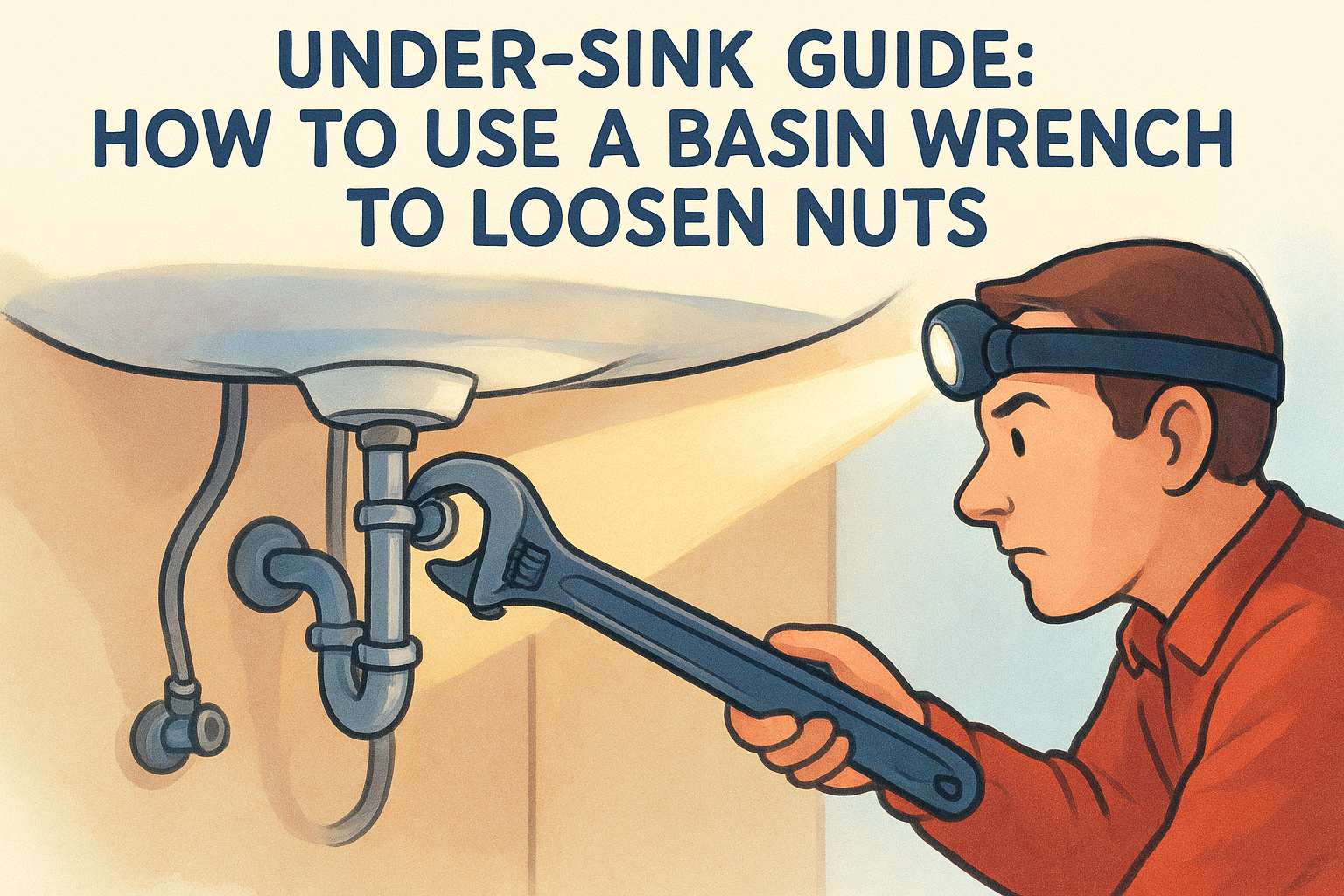
Under-Sink Guide: How To Use A Basin Wrench To Loosen Nuts

Under-Sink Guide: How To Use A Basin Wrench To Loosen Nuts

If you’ve ever tried to reach a faucet mounting nut buried behind a sink basin, you already know that standard wrenches won’t cut it. That’s exactly the problem a basin wrench solves. Knowing how to use a basin wrench properly is one of those fundamental skills that separates a confident plumber from someone still fumbling in tight spaces. Whether you’re an apprentice on your first service call or a journeyman brushing up on basics, this tool deserves a permanent spot in your bag.

At plumbingjobs, we build resources for plumbing professionals who take their craft seriously. Faucet replacements and under-sink repairs are bread-and-butter tasks in residential service work, the kind of work that shows up in job descriptions daily on our board. Getting comfortable with a basin wrench means faster installs, fewer scraped knuckles, and more efficient work on the job site.

This guide walks you through the exact steps to position, grip, and turn a basin wrench to loosen or tighten nuts in cramped spaces under a sink. You’ll learn how the jaw mechanism works, which direction to set it for loosening versus tightening, and how to avoid the most common mistakes. By the end, you’ll handle this tool like you’ve been using it for years.

What a basin wrench is and when to use it

A basin wrench is a long-handled plumbing tool with a pivoting jaw at one end, built specifically to reach up into tight spaces and turn nuts that no other wrench can get to. The handle typically runs 12 to 17 inches long, giving you the reach you need behind deep sink basins. The jaw swings 180 degrees, so you can switch it from loosening to tightening without repositioning your entire body.

The anatomy of the tool

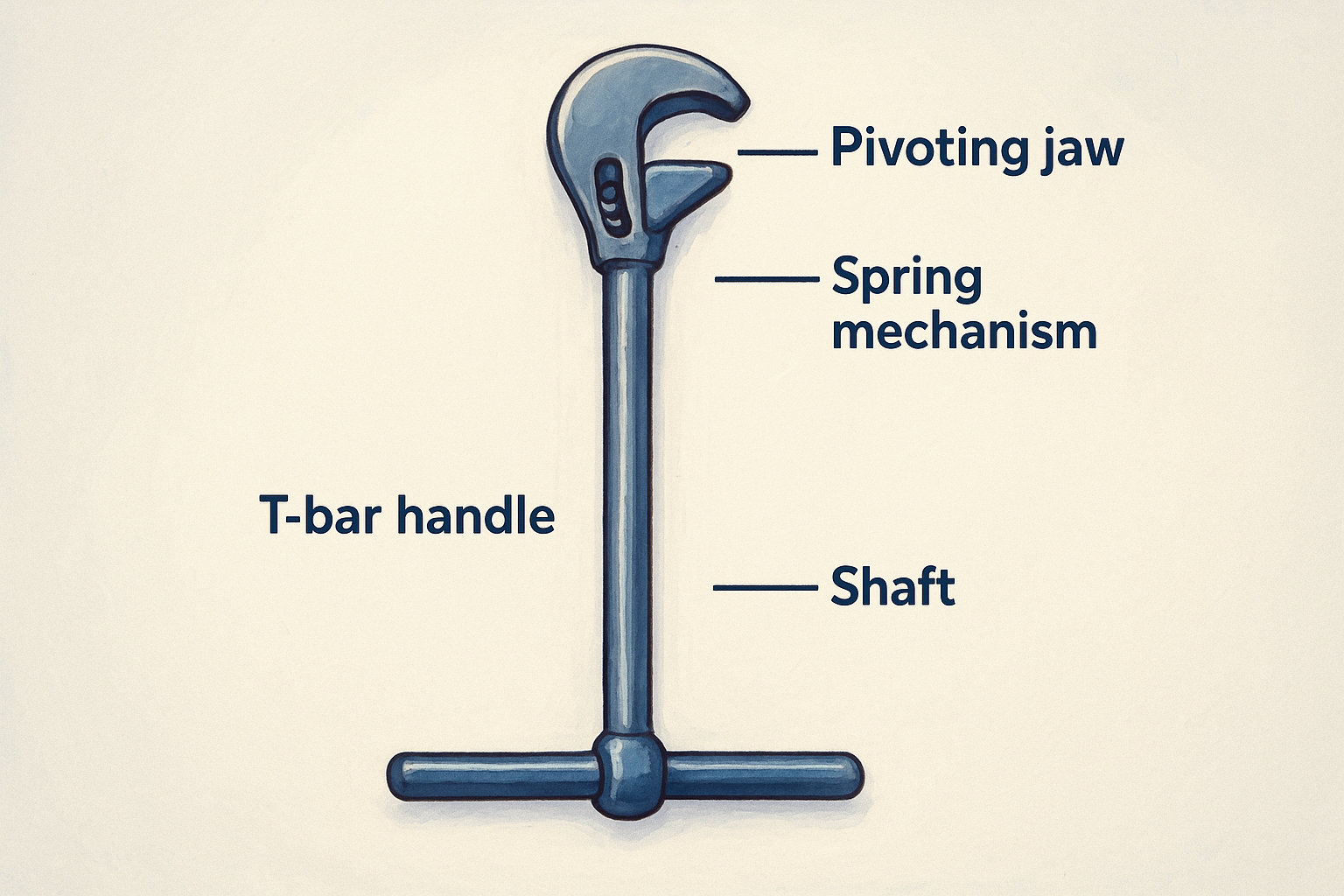
The tool has three main parts: the T-bar handle at the bottom for grip and torque, the shaft that extends your reach up behind the basin, and the pivoting jaw head at the top. The jaw has a spring-loaded design that grips a nut when you apply rotational force. Most jaws fit nuts ranging from 3/8 inch to 1-1/4 inches. Knowing how to use a basin wrench correctly starts with understanding how that jaw engages, because if you set the pivot direction wrong, the tool will spin freely instead of biting.

The anatomy of the tool

The jaw direction is the single most important setting on a basin wrench. Set it for the wrong rotation and you will turn all day without moving the nut.

Part Function
T-bar handle Provides grip and lets you apply torque
Shaft Extends reach up behind the sink basin
Pivoting jaw Grips the nut and transfers rotational force
Spring mechanism Keeps the jaw seated during rotation

When to reach for a basin wrench

You need this tool any time you’re removing or installing a faucet and the mounting nuts sit more than a few inches above the cabinet floor. Standard jobs include single-handle kitchen faucets, two-handle bathroom faucets, and any fitting where the nut is recessed tightly against the underside of the deck. If you can reach the nut with a standard adjustable wrench or channel-lock pliers, skip it. The moment your hand won’t fit, pull this tool out instead.

Reach for it on supply line locknuts, faucet mounting nuts, and any nut positioned directly above a deep sink basin. Those are the jobs it was built for.

Step 1. Get set up under the sink

Before you pick up the tool, spend two minutes preparing the workspace. A cluttered cabinet forces awkward angles, and awkward angles turn a five-minute job into a frustrating twenty-minute struggle. Clear out everything stored under the sink and shut off the water supply valves before you touch anything else.

Clear the cabinet and gather your supplies

Pull everything out from under the cabinet completely. You need open floor space to slide in and move your arms without restriction. Once the cabinet is empty, gather what you need before you go under: your basin wrench, a headlamp or clip light, a bucket, and a towel to catch residual drips from the supply lines. Knowing how to use a basin wrench efficiently starts with having everything within arm’s reach so you are not crawling in and out repeatedly mid-job.

Turn off both water supply valves fully and open the faucet handle to release pressure in the lines before you loosen any nuts.

Get your body positioned correctly

Lay a folded towel or thin kneeling pad on the cabinet floor and slide in feet-first so your back rests against the cabinet opening. This position keeps your arms free and your head angled up toward the sink basin without straining your neck. Point your headlamp directly at the mounting nuts before you raise the wrench, so you can see exactly where the jaw needs to land and confirm the jaw direction before you apply any force.

Step 2. Position the jaws so they bite, not slip

With your headlamp on and your eyes on the nut, raise the wrench so the jaw wraps around the flat sides of the mounting nut, not the corners. Gripping the corners is the most common reason the jaw slips under load, and on a corroded nut it can round off the edges fast, turning a simple job into a difficult extraction.

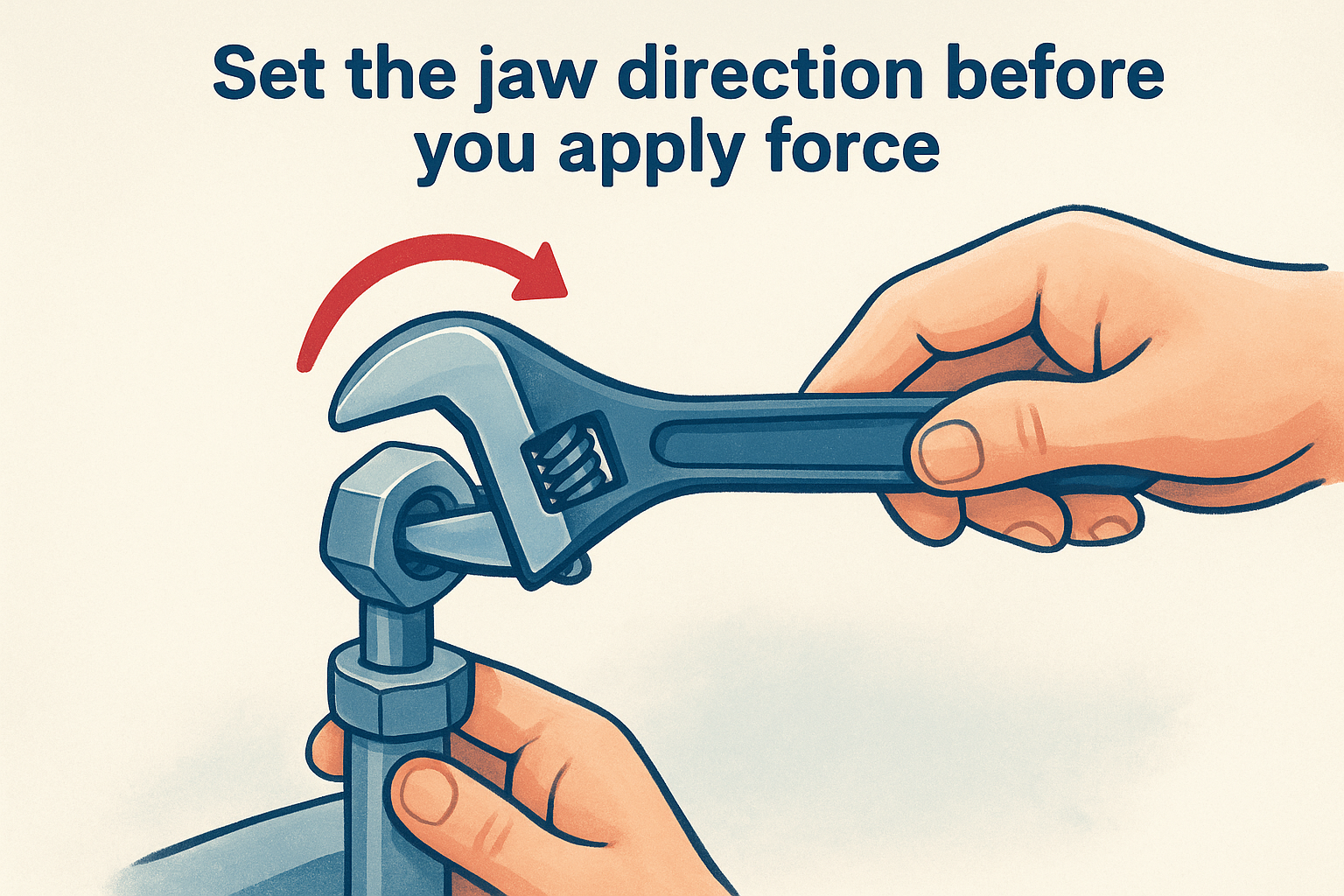
Set the jaw direction before you apply force

The pivoting jaw locks in one of two positions depending on which way you rotate it by hand. Swing the jaw toward the left to set it for loosening (counterclockwise), and swing it toward the right to set it for tightening (clockwise). You can feel the jaw click into position when it seats correctly. Flip the jaw direction by hand before raising the wrench into position so you are not adjusting it blind above the basin.

Set the jaw direction before you apply force

Always confirm the jaw direction before you apply torque. One hard turn in the wrong direction will kick the jaw off the nut and force you to start over.

Confirm the grip before turning

Once the jaw is set, pull the T-bar handle slowly in the loosening direction to feel the jaw load up against the nut. If the jaw bites and holds, you are seated correctly. If it spins or skips, drop the wrench and reposition the jaw squarely against the flat faces. Knowing how to use a basin wrench effectively comes down to this confirmation step: a solid bite on the flats delivers clean, controlled torque on every turn.

Step 3. Break loose stuck nuts and remove the faucet

Corroded or over-tightened nuts require more than a single hard pull. Apply slow, steady pressure on the T-bar handle rather than jerking it sharply. A sharp jerk kicks the jaw off the nut and can round the corners, turning a simple job into a difficult extraction. The goal is controlled torque that builds gradually until the nut breaks free.

Handle stuck nuts without damaging them

When a nut won’t budge, penetrating oil is your best first move. Spray it around the base of the nut, wait five to ten minutes, then apply pressure again with the basin wrench. For heavily corroded nuts, repeat the oil application a second time before you commit to full force.

If the nut still won’t move after two oil applications, work it back and forth in short strokes to crack the corrosion bond before pushing for a full counterclockwise turn.

Situation Action
Nut is stiff but turning Steady pressure, short controlled strokes
Nut is completely frozen Apply penetrating oil, wait 10 minutes
Jaw keeps slipping Recheck grip on flat faces, not corners

Remove the faucet cleanly once the nuts are off

Once both mounting nuts are fully loose, lower them by hand and set them aside where they won’t roll. Pull the faucet straight up through the deck opening. Knowing how to use a basin wrench correctly through this step means the deck surface stays undamaged and the supply lines disconnect without stress.

Check the supply line connections before you put your tools away. Hand-tighten the supply line nuts back onto the shutoff valves if you disconnected them, so the fittings are ready for the new installation. Keep the old mounting nuts in a small bag in case you need to match the thread size.

Step 4. Tighten nuts correctly after installation

Tightening mounting nuts after dropping in a new faucet uses the same basin wrench you used to remove the old one, but you flip the jaw direction. Swing the jaw toward the right to set it for clockwise rotation, then raise the wrench and confirm the jaw bites the flat faces before you apply any force.

Set the jaw and build torque evenly

Start each nut finger-tight by hand before you bring the basin wrench in. This prevents cross-threading, which can crack plastic nut bodies and strip threads on the faucet shank. Once the nut is hand-seated, use the wrench to add a quarter turn at a time, alternating between the two mounting nuts so the faucet deck plate seats evenly without cocking to one side. Knowing how to use a basin wrench for installation is just as important as removal: uneven tightening will leave the faucet loose and allow water to work past the base plate gasket over time.

Snug the nuts firmly, but stop before you reach maximum force. Plastic nuts crack under excess torque, and even brass nuts can strip the faucet threads if you overtighten.

Confirm the faucet is secure before turning the water back on

Once both nuts are tight, grip the faucet handle and try to rock it side to side. It should feel completely rigid with zero play. If it shifts at all, go back under and snug the loose nut further before restoring water pressure.

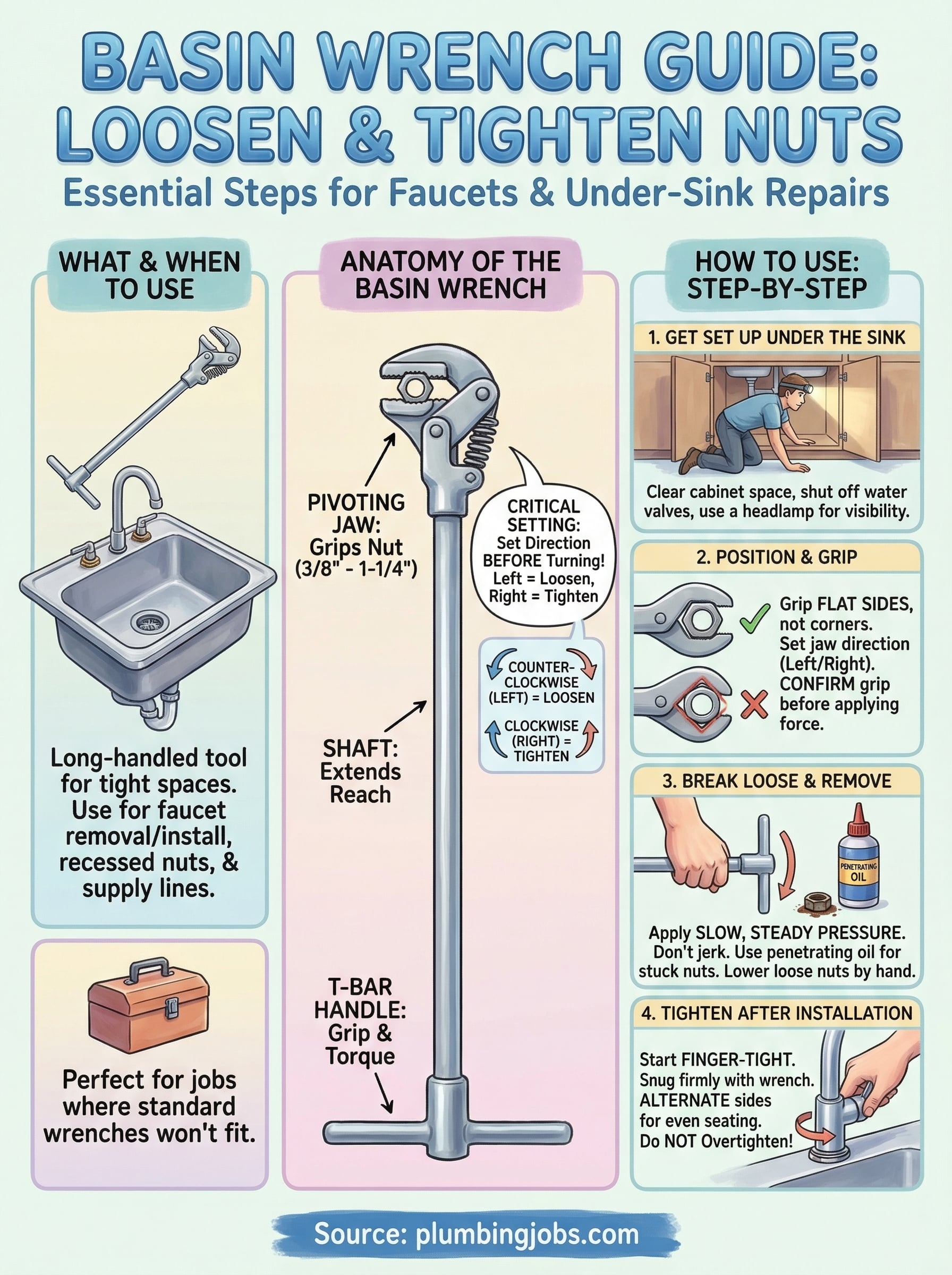
how to use a basin wrench infographic

Wrap-up and next steps

You now have a complete picture of how to use a basin wrench from setup through final tightening. The key moves are clearing your workspace before you go under, setting the jaw direction before you apply force, gripping the flat faces of the nut, and building torque steadily instead of jerking the handle. Follow those four steps and most faucet jobs go smooth and fast without rounded nuts or damaged threads.

Faucet replacements and under-sink repairs are some of the most common tasks listed on residential service calls, so this skill will come up on the job regularly. The more installs you complete, the faster your hands learn exactly where to position that jaw without thinking twice. If you’re looking to put these skills to work, browse the latest plumbing job listings on our blog for industry updates and career resources to keep moving forward in the trade.