
Journeyman Plumber Salary: Hourly Pay, Rates, And States
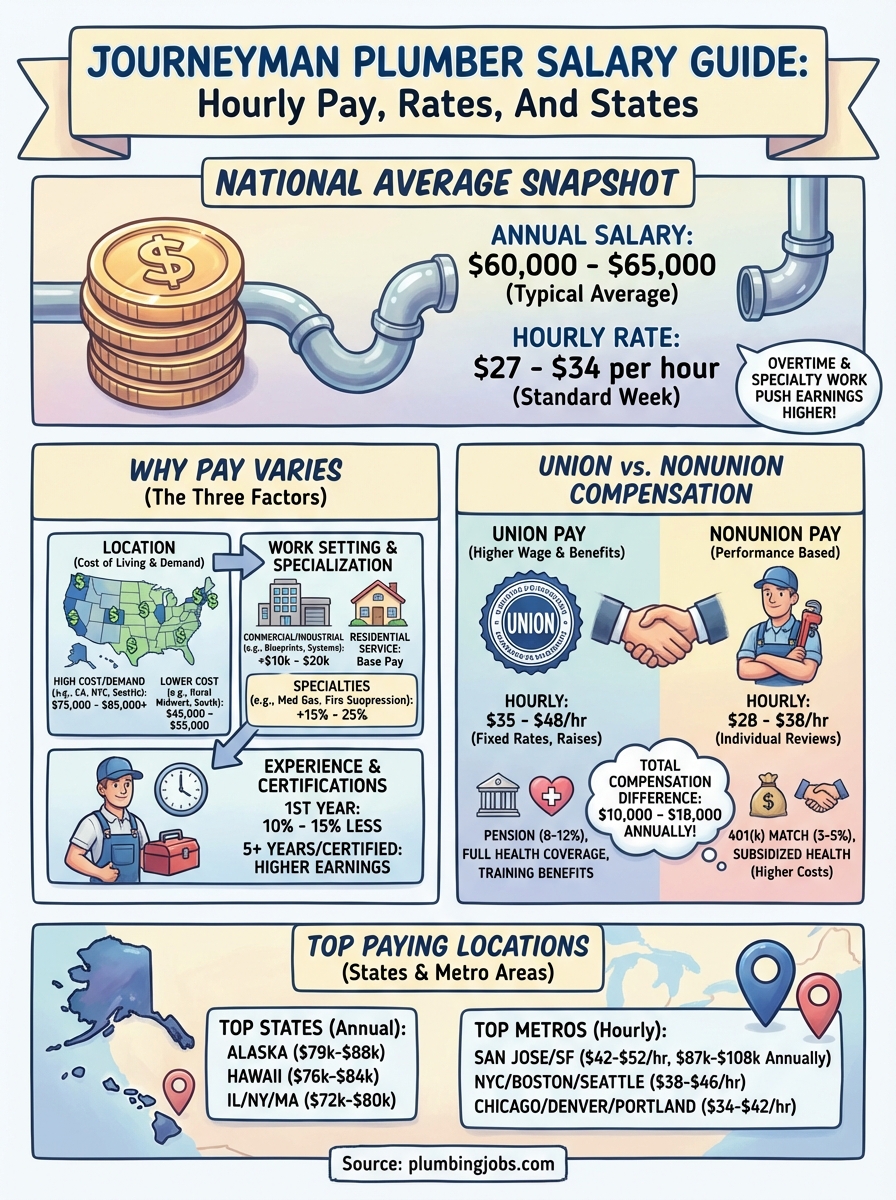
Earning your journeyman license marks a significant milestone in your plumbing career, and a substantial jump in earning potential. The average journeyman plumber salary sits around $60,000 to $65,000 annually, though your actual take-home depends heavily on where you work and who you work for.
Whether you’re negotiating your first journeyman position or considering a move to a higher-paying state, understanding the full compensation picture helps you make smarter career decisions. This guide breaks down hourly rates, annual figures, and the factors that push earnings higher or lower across the country.
At PlumbingJobs.com, we track thousands of plumbing positions nationwide, giving us direct insight into what employers are actually paying. Below, you’ll find current salary data by state, comparisons between union and non-union wages, and practical ways to increase your earning potential as a journeyman plumber.
Why journeyman plumber pay varies so much
Your journeyman plumber salary can swing by $30,000 or more depending on where you live and the type of work you take on. Unlike many careers with standardized pay scales, plumbing compensation reflects local market conditions, the complexity of jobs you handle, and the business model of your employer. Understanding these variables helps you target the highest-paying opportunities that match your skills and lifestyle.
Geographic cost of living and demand
States with higher housing costs typically pay plumbers more to offset living expenses. California journeymen often earn $75,000 to $85,000 annually, while those in rural Midwest states may see $45,000 to $55,000 for similar work. Metropolitan areas like New York City, Seattle, and Boston push wages even higher due to intense competition for skilled labor and strict building codes that require licensed professionals.
Demand patterns also shift regionally based on construction booms, aging infrastructure, and climate factors. Sun Belt states experiencing rapid population growth often pay premium rates to attract talent quickly, while areas with declining populations or oversaturated markets see stagnant wages.
A journeyman in Alaska can earn 40% more than the national average due to extreme weather challenges and limited available workforce.
Work setting and specialization
Commercial and industrial plumbers consistently out-earn residential service technicians by $10,000 to $20,000 annually. Large-scale projects require advanced skills in blueprint reading, system design, and coordination with other trades, which commands higher compensation. Government contracts and prevailing wage projects often guarantee rates above typical market levels, sometimes reaching $45 to $60 per hour.
Specializations like medical gas systems, fire suppression, or underground utilities can add 15% to 25% to your base pay. Emergency service work and on-call rotations also boost earnings through overtime premiums and after-hours differentials.
Experience and certifications beyond the license
Your first year as a journeyman typically pays 10% to 15% less than someone with five years of licensed experience. Employers value proven job site efficiency, customer service skills, and the ability to work independently without supervision. Additional certifications in backflow prevention, welding, or green building systems make you more valuable and position you for specialized roles that pay above standard rates.
Business owners and self-employed journeymen often earn significantly more than W-2 employees, though they absorb overhead costs like insurance, vehicle maintenance, and tool replacement. The trade-off between steady paychecks and entrepreneurial upside shapes your earning potential throughout your career.
What journeyman plumbers earn in 2026
The typical journeyman plumber salary in 2026 ranges from $55,000 to $70,000 annually, with the national median landing around $62,500. Your hourly rate translates to approximately $27 to $34 per hour for standard 40-hour weeks, though overtime and specialty work frequently push effective hourly earnings higher. These figures reflect current market conditions across residential, commercial, and industrial sectors, giving you a realistic baseline for salary negotiations or career planning.
National average and hourly breakdown
Most journeymen working full-time see gross annual earnings between $58,000 and $68,000 before taxes and deductions. Breaking this down hourly, you’re looking at $28 to $33 per hour as your base rate, with time-and-a-half overtime pushing that to $42 to $50 per hour for extra shifts. Weekend emergency calls and after-hours service work can command double-time rates, significantly boosting your annual take-home when you accept those assignments.
Overtime hours alone can add $8,000 to $15,000 to your base salary when you regularly take on emergency service rotations.
Service companies often structure pay differently than construction firms, sometimes offering commission splits on parts and materials that supplement your hourly wage. Large commercial contractors typically stick to straight hourly rates but provide more consistent 40-plus hour weeks year-round.
Pay ranges across experience tiers
First-year journeymen typically start at $24 to $28 per hour, earning $50,000 to $58,000 annually. After three to five years of licensed experience, your earning potential climbs to $32 to $38 per hour, translating to $66,000 to $79,000 for full-time work. Master plumber credentials or specialized certifications can push you beyond $80,000 when combined with supervisory responsibilities or complex commercial projects that require advanced technical knowledge.
Journeyman plumber salary by state and metro area
Your location determines 40% to 50% of your earning potential as a journeyman plumber, making geographic strategy one of the most powerful tools for maximizing income. States with strict licensing requirements, robust construction markets, and higher costs of living consistently pay $20,000 to $35,000 more than lower-demand regions. Understanding these regional differences helps you decide whether relocating or commuting to nearby metro areas makes financial sense for your career goals.

Top-paying states for journeymen
Alaska leads the nation with journeyman plumber salaries averaging $79,000 to $88,000 annually due to harsh weather conditions and remote work sites. Hawaii follows closely at $76,000 to $84,000, reflecting extreme cost of living and limited local workforce availability. Illinois, New York, and Massachusetts round out the top five, where union prevalence and prevailing wage laws push median earnings to $72,000 to $80,000 for experienced journeymen.
California journeymen earn 35% above the national average, with San Francisco Bay Area positions reaching $90,000 to $100,000 for commercial specialists.
Southern states like Mississippi, Arkansas, and Alabama typically pay $48,000 to $56,000, while Midwest states such as Kansas, Iowa, and Nebraska range from $52,000 to $62,000. These lower figures reflect regional living costs rather than demand, as many areas face critical plumber shortages but lack the tax base or construction budgets to match coastal wages.
Metropolitan areas with highest compensation
San Jose and San Francisco metro areas offer $42 to $52 per hour for journeyman work, translating to $87,000 to $108,000 annually with regular overtime. New York City, Boston, and Seattle metro regions pay $38 to $46 per hour, while Chicago, Denver, and Portland command $34 to $42 per hour for similar positions. These urban centers combine high project volume with strict code enforcement that requires licensed professionals, keeping wages elevated despite competition from surrounding suburbs.
Union vs nonunion pay and total compensation
Union membership creates a $10,000 to $18,000 annual wage gap compared to nonunion positions in the same geographic area. Your journeyman plumber salary jumps significantly when you join a local union, though the trade-off includes monthly dues, initiation fees, and less flexibility in choosing employers or job assignments. Total compensation packages extend far beyond base pay, incorporating retirement contributions, health insurance, and training benefits that nonunion shops rarely match dollar-for-dollar.
Union wage premiums and contract rates
Union journeymen earn $35 to $48 per hour in major metro areas through collective bargaining agreements that lock in annual raises and cost-of-living adjustments. Nonunion competitors in the same markets typically pay $28 to $38 per hour for equivalent work, relying on individual performance reviews rather than standardized scales. Prevailing wage projects legally require union-scale compensation even for nonunion contractors, creating temporary earning spikes that disappear once the job ends.
Union plumbers in Chicago average $42 per hour plus $18 per hour in fringe benefits, totaling $60 per hour in employer costs.
Your take-home pay reflects only part of the compensation story. Union packages include pension contributions of 8% to 12% of gross wages, full family health coverage, and apprenticeship fund payments that cost you nothing. Nonunion employers may offer 401(k) matches of 3% to 5% and subsidized health plans with $200 to $400 monthly employee contributions, leaving you responsible for covering the gap.
Benefits beyond the paycheck
Healthcare costs represent the largest hidden compensation difference between union and nonunion work. Union plans typically cover 90% to 100% of medical expenses with minimal deductibles, while nonunion insurance often carries $2,500 to $5,000 annual deductibles plus 20% coinsurance. Retirement security also diverges sharply, as defined benefit pensions guarantee monthly income for life versus 401(k) balances that fluctuate with market performance and your contribution discipline.
How to estimate your journeyman plumber pay
Calculating your realistic earning potential requires combining multiple data points rather than relying on a single national average. Your actual journeyman plumber salary depends on your specific market, skill set, and the type of employer you target. Building an accurate estimate helps you negotiate confidently and identify when an offer falls below market rate for your situation.
Calculate your base rate expectations
Start by researching current job postings in your metro area through job boards that specialize in plumbing positions. Filter listings by your exact license level and experience tier, then note the hourly or annual figures employers actively advertise. Track at least 10 to 15 positions to identify the typical range, discarding outliers that seem unrealistically high or low for standard work.
Cross-reference job board data with Bureau of Labor Statistics figures for your specific metropolitan statistical area to validate your findings.
Contact three to five local plumbers you know personally and ask what prevailing rates look like for journeymen with your background. Direct conversations reveal information employers don’t publish, including overtime availability, seasonal slowdowns, and which companies consistently pay above market. Adjust your expectations upward by 5% to 10% if you hold specialty certifications or downward if you’re entering a saturated market with limited commercial construction activity.
Factor in your total compensation package
Convert health insurance coverage into dollar values by comparing premium costs you’d pay out-of-pocket for equivalent plans. Employer-paid family coverage worth $1,200 to $1,800 monthly adds $14,400 to $21,600 to your effective annual compensation. Retirement contributions of 4% to 6% on a $65,000 salary equal $2,600 to $3,900 in additional value you should account for when comparing offers that differ in base pay but vary significantly in benefits.
What to do next in your plumbing career
Understanding journeyman plumber salary ranges gives you the foundation to negotiate better compensation and plan strategic career moves. Your next step involves actively applying this knowledge by researching specific employers in your target market, reaching out to union locals if prevailing wage projects interest you, and identifying certifications that align with higher-paying specializations in your region.
Start browsing current openings that match your experience level and geographic preferences. Compare posted rates against the data you’ve gathered here to spot opportunities that pay above market average. Companies desperate for skilled journeymen often reveal their urgency through higher starting wages and sign-on bonuses listed in job descriptions.
Browse our plumbing jobs blog for additional career guidance on licensing requirements, interview preparation, and industry trends that affect your earning potential. Your investment in market research today translates directly into thousands of extra dollars over your career span.
Want plumbing jobs delivered to your inbox?
Want plumbing jobs delivered to your inbox?
Partner Site

