

Plumber Annual Salary: 2026 Median Pay, By State & Role Data
Whether you’re entering the plumbing trade or preparing to negotiate your next position, understanding plumber annual salary data for 2026 is essential. What you earn depends heavily on where you work and your experience level, and the differences can be significant.
At PlumbingJobs.com, we connect plumbing professionals with employers across all 50 states and see thousands of job listings each month. This guide breaks down median pay figures, state-by-state comparisons, and role-specific salary ranges, giving you the numbers to benchmark your earning potential and plan your next career move with confidence.
What plumber annual salary means in 2026
Your plumber annual salary represents the total gross compensation you receive over 12 consecutive months before taxes and deductions. This figure includes your base wages, but it may also incorporate overtime, bonuses, profit sharing, and other forms of regular compensation depending on your employment structure. Understanding this number helps you evaluate job offers, plan your household budget, and compare opportunities across different employers or geographic markets.
How annual salary differs from hourly pay
Most plumbers start their careers earning hourly wages rather than fixed salaries, especially during apprenticeships and early journeyman years. Your employer pays you for each hour worked, which means your total annual earnings fluctuate based on how many hours you log. If you work 2,080 hours in a year (a standard full-time schedule of 40 hours weekly), you multiply your hourly rate by that total to estimate your gross annual income.
Salaried positions typically appear at management or ownership levels, where you receive a fixed amount regardless of hours worked. This structure provides income predictability but may eliminate overtime premiums that hourly technicians earn during busy seasons or emergency calls.
Annual salary calculations assume full-time employment, but many plumbers work variable schedules that significantly impact yearly totals.
What gets counted in your annual earnings
Base compensation forms the foundation, but your actual take-home varies based on supplemental income sources common in the plumbing trade. Overtime pay usually adds 10% to 25% to your total for service plumbers who respond to after-hours emergencies or work extended shifts during peak construction periods. Some employers offer performance bonuses tied to customer satisfaction scores, sales of fixtures or water heaters, or completion of projects under budget.
Commission structures exist at certain residential service companies, where you earn percentage-based incentives on repair recommendations or system replacements. Benefits like health insurance, retirement matching, and company vehicles don’t appear in your gross salary figure, but they represent real economic value that can equal 20% to 40% of your base pay. When you compare job offers, factor in these non-wage benefits alongside the stated annual salary to understand your true compensation package.
2026 national plumber pay: median, average, range
Understanding the current national pay landscape helps you evaluate where your earnings stand and what compensation you can reasonably expect as you advance. The latest data from the Bureau of Labor Statistics shows that plumber annual salary figures vary based on how you measure the center point of all earnings across the trade.
What the median tells you about typical pay
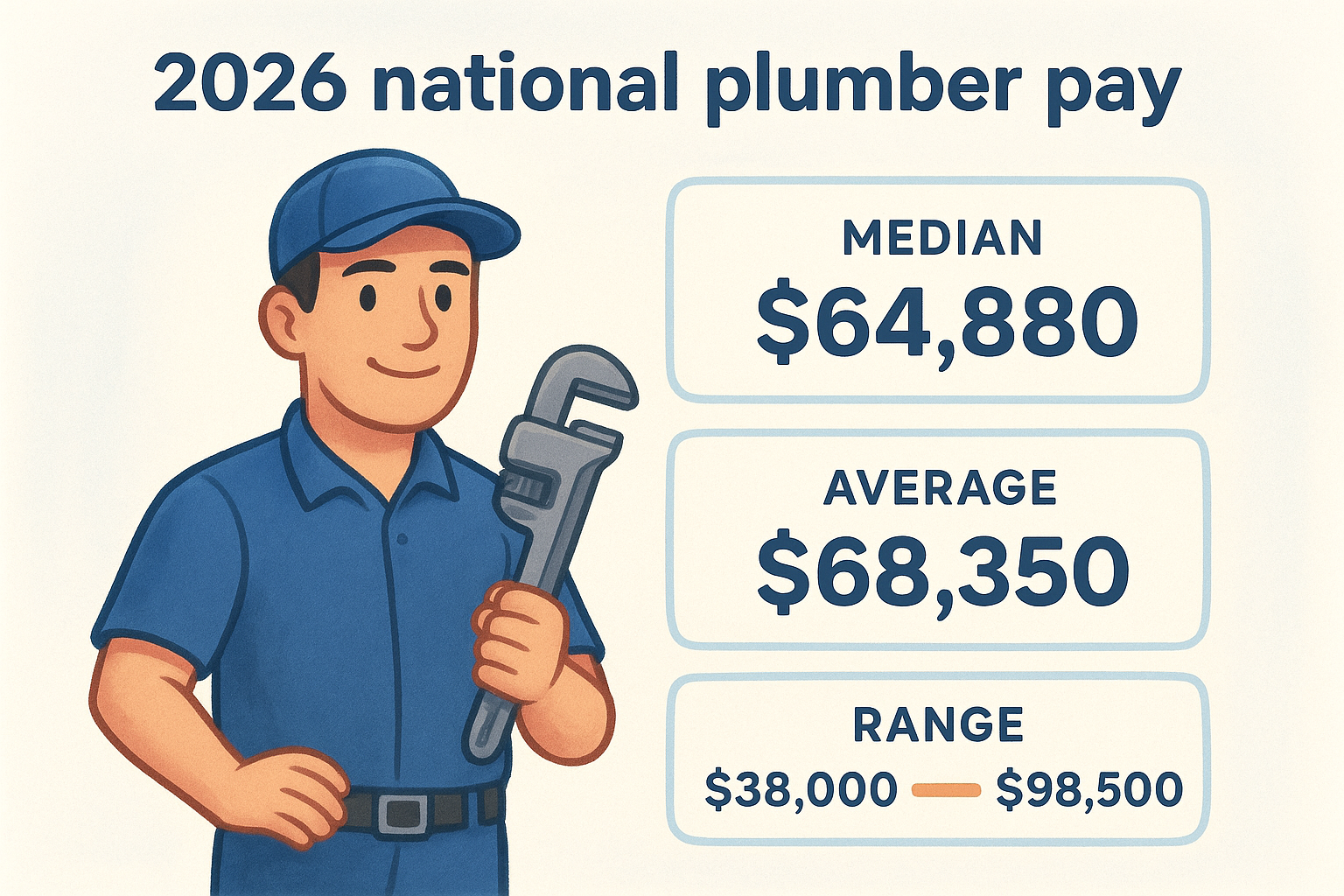
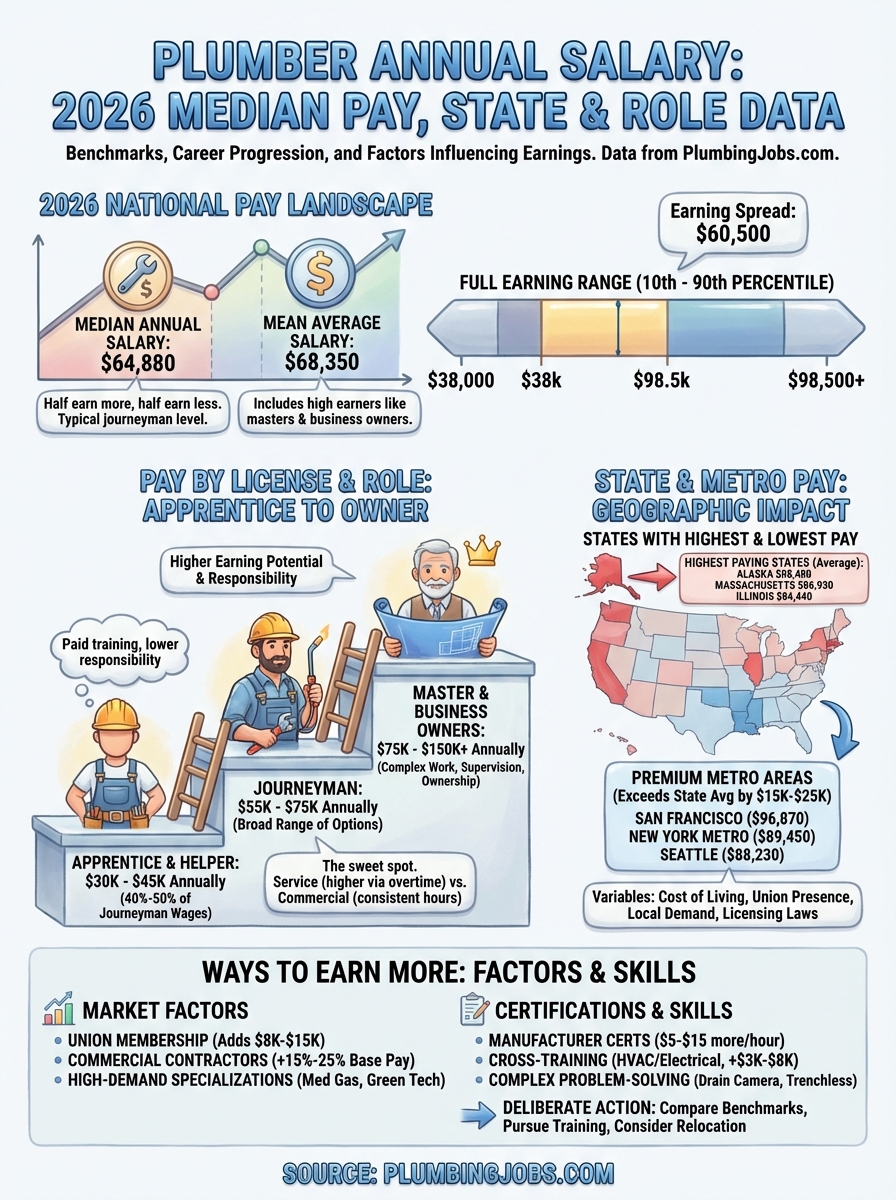
The median annual salary for plumbers in 2026 sits at $64,880, meaning half of all working plumbers earn more than this amount and half earn less. This middle-point figure represents the most common experience level you’ll find in the field, typically a journeyman plumber with three to seven years of hands-on work. You can expect to reach or exceed this benchmark once you complete your apprenticeship and build a reputation for reliable service work or commercial installations.
The median salary reflects what established plumbers actually take home, not entry-level or specialized outlier positions.
How average figures factor in high earners
The mean average salary reaches $68,350 because master plumbers, business owners, and specialized technicians working in high-cost metro areas pull the average upward. This number incorporates every plumber’s earnings, from first-year apprentices making $35,000 to master plumbers clearing $110,000 or more. Your actual position on this spectrum depends on your license level, work setting, and geographic market demand.
Full range from entry to top earners
National salary ranges span from $38,000 at the 10th percentile to $98,500 at the 90th percentile, creating a $60,500 earning spread across the profession. Entry-level positions cluster in the lower range, while experienced service plumbers, foremen, and specialized technicians occupy the upper brackets of this distribution.
Pay by license and role: apprentice to owner
Your earning potential increases significantly as you progress through licensing tiers and take on greater responsibility. Each advancement brings not just higher hourly rates but access to different types of work, client relationships, and job structures that directly impact your plumber annual salary.
Apprentice and helper starting pay
Apprentices typically earn 40% to 50% of journeyman wages during their training period, translating to $35,000 to $45,000 annually depending on your market. Your employer pays you to learn while you complete required hours under supervision, with scheduled pay increases tied to your training milestones. Helper positions without formal apprenticeship enrollment often start at $30,000 to $38,000, as these roles involve less technical responsibility and no structured progression path.
Journeyman compensation levels
Licensed journeymen command $55,000 to $75,000 in most markets, with your specific rate depending on whether you focus on residential service, commercial construction, or industrial maintenance. Service plumbers working for repair companies often earn the higher end of this range through overtime and commission opportunities, while commercial plumbers on large construction projects benefit from union scale rates and consistent 40-plus-hour weeks.
Your journeyman license opens access to the broadest range of employment options and represents the profession’s earning sweet spot.
Master plumber and ownership earnings
Master plumbers working as employees earn $75,000 to $95,000 handling complex installations, supervising crews, or managing projects. Business owners who hold master licenses report $85,000 to $150,000+ depending on their company size, though these figures include business profit rather than pure salary. Foremen and project managers with master credentials typically land in the $80,000 to $100,000 range at established mechanical contractors.
Plumber salary by state and metro areas
Geographic location creates the largest single variable in what you’ll earn as a plumber, with state-level differences reaching $40,000 or more between the highest and lowest paying markets. Your decision about where to work carries more weight than many other career factors because cost of living, union presence, and local construction activity directly shape compensation levels across the country.
States with highest and lowest plumber pay
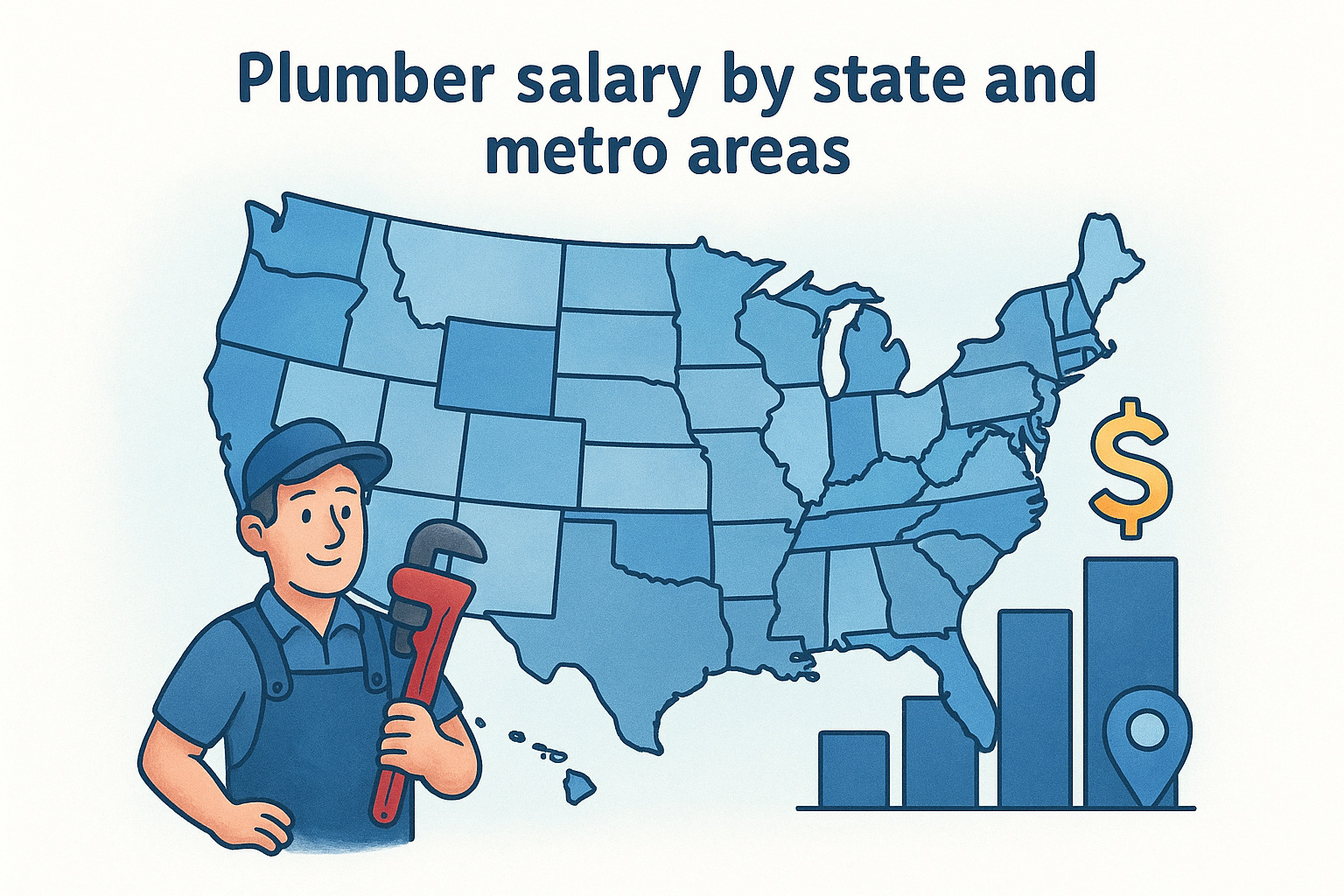
Alaska leads all states with an average plumber annual salary of $88,480, followed by Massachusetts at $86,930 and Illinois at $84,440. These markets combine strong union representation, harsh weather that increases emergency service demand, and high costs of living that push wages upward. On the opposite end, Mississippi averages $48,200, Arkansas sits at $49,830, and Louisiana reaches $51,940, reflecting lower living costs and less unionized workforce structures.
State licensing requirements and prevailing wage laws create protected markets that support higher compensation in certain regions.
Metro areas paying premium wages
Specific metropolitan areas often exceed their state averages by $15,000 to $25,000 because concentrated populations and commercial activity drive consistent demand. San Francisco pays plumbers an average of $96,870, while New York metro area averages $89,450, and Seattle reaches $88,230. You’ll find the strongest earning potential in coastal cities where housing costs and infrastructure complexity create both higher demand and justification for premium rates that clients expect to pay for skilled trades.
What changes plumber pay and how to earn more
Your plumber annual salary fluctuates based on factors you can control and external market forces you need to understand. Some variables like geographic location require relocation decisions, while others like certifications and specializations let you increase earnings within your current market through strategic skill development.
Market factors that control your earnings
Union membership adds $8,000 to $15,000 annually compared to non-union positions in the same region because collective bargaining establishes higher wage floors and benefit packages. Specializing in high-demand areas like medical gas systems, backflow prevention, or green plumbing technologies positions you for premium rates that general service plumbers can’t command. Working directly for commercial contractors rather than residential service companies typically increases your base pay by 15% to 25%, though you trade emergency call opportunities for more predictable schedules.
Markets with strict licensing enforcement and limited competition naturally support higher wages because barriers to entry reduce the available workforce.
Certifications and skills that boost pay
Adding manufacturer certifications for specific equipment brands like Navien, Rinnai, or PEX systems qualifies you for warranty work and specialized installations that pay $5 to $15 more per hour. Cross-training in HVAC fundamentals or basic electrical work makes you more valuable to employers handling complete mechanical systems, often resulting in pay increases of $3,000 to $8,000 annually. Building a reputation for difficult problem-solving through drain camera expertise, trenchless repair methods, or complex repiping projects lets you charge premium rates as clients specifically request your services for challenging work.
Next steps for your plumbing career
Understanding plumber annual salary benchmarks positions you to make informed decisions about your next career move, whether that means pursuing additional certifications, relocating to a higher-paying market, or negotiating better compensation with your current employer. You now have the state-specific data and role-based ranges that separate realistic expectations from industry myths.
Your earning potential grows through deliberate action rather than passive experience alone. Start by comparing your current compensation against the regional and experience-level benchmarks covered here, then identify specific gaps you can address through training, licensing advancement, or geographic opportunity. Stay current with market trends and employer demand by exploring our plumbing industry blog, where you’ll find ongoing updates about licensing changes, emerging specializations, and shifts in regional pay rates that affect your long-term earning trajectory.
Want plumbing jobs delivered to your inbox?
Want plumbing jobs delivered to your inbox?
Partner Site

