

Plumber Hourly Wage: Average Pay, Range, And Top States
Whether you’re negotiating a raise, evaluating a job offer, or planning your next career move, knowing the plumber hourly wage in your area gives you a real advantage. Plumbers across the United States earn vastly different rates depending on where they work, their license level, and how many years they’ve spent in the trade. Understanding these numbers helps you benchmark your earnings against industry standards.
At PlumbingJobs.com, we connect plumbing professionals with employers nationwide, and that means we see firsthand how compensation varies across roles and regions. We’ve compiled current wage data to give you a clear picture of what plumbers actually earn, from apprentices just starting out to master plumbers running complex projects.
This article breaks down average hourly pay, salary ranges by experience level, and the top-paying states for plumbing work. You’ll also learn how factors like union membership, specialization, and licensing directly impact your take-home pay.
Why plumber hourly wage matters
Knowing your market value puts you in control during salary negotiations and helps you spot when an employer’s offer falls below industry standards. You can’t effectively advocate for fair compensation without concrete wage data that reflects your skill level, experience, and location. Too many skilled plumbers accept positions that undervalue their expertise simply because they lack reliable benchmarks.
Career planning and financial decisions
Understanding the plumber hourly wage in your region shapes major life decisions beyond just job selection. You use this information to determine whether relocating to a higher-paying state makes financial sense, calculate realistic budgets for mortgage applications, and set income goals that align with your career timeline. When you know that master plumbers in Alaska earn significantly more than those in Mississippi, you can weigh the trade-offs of different geographic markets.
Accurate wage data transforms abstract career goals into concrete financial targets you can actually plan around.
Financial institutions also rely on income verification when you apply for business loans, vehicle financing, or home mortgages. Presenting documented wage ranges from your trade strengthens applications and demonstrates earning stability. This becomes particularly important for self-employed plumbers who need to project future income.
Evaluating job opportunities effectively
Comparing multiple job offers becomes straightforward when you understand standard hourly rates for your license level and geographic area. You can quickly identify which employers pay competitively and which ones expect you to work for below-market compensation. Benefits packages and overtime policies also make more sense when measured against a baseline hourly figure, letting you calculate total compensation rather than just focusing on base pay.
The wage information also helps you time career transitions strategically. Knowing that journeyman plumbers typically earn 30-40% more than apprentices lets you plan when to complete your licensing requirements. You can set specific dates for exam preparation and calculate the return on investment for additional certifications or specialized training that command premium rates.
Average plumber hourly wage in 2026
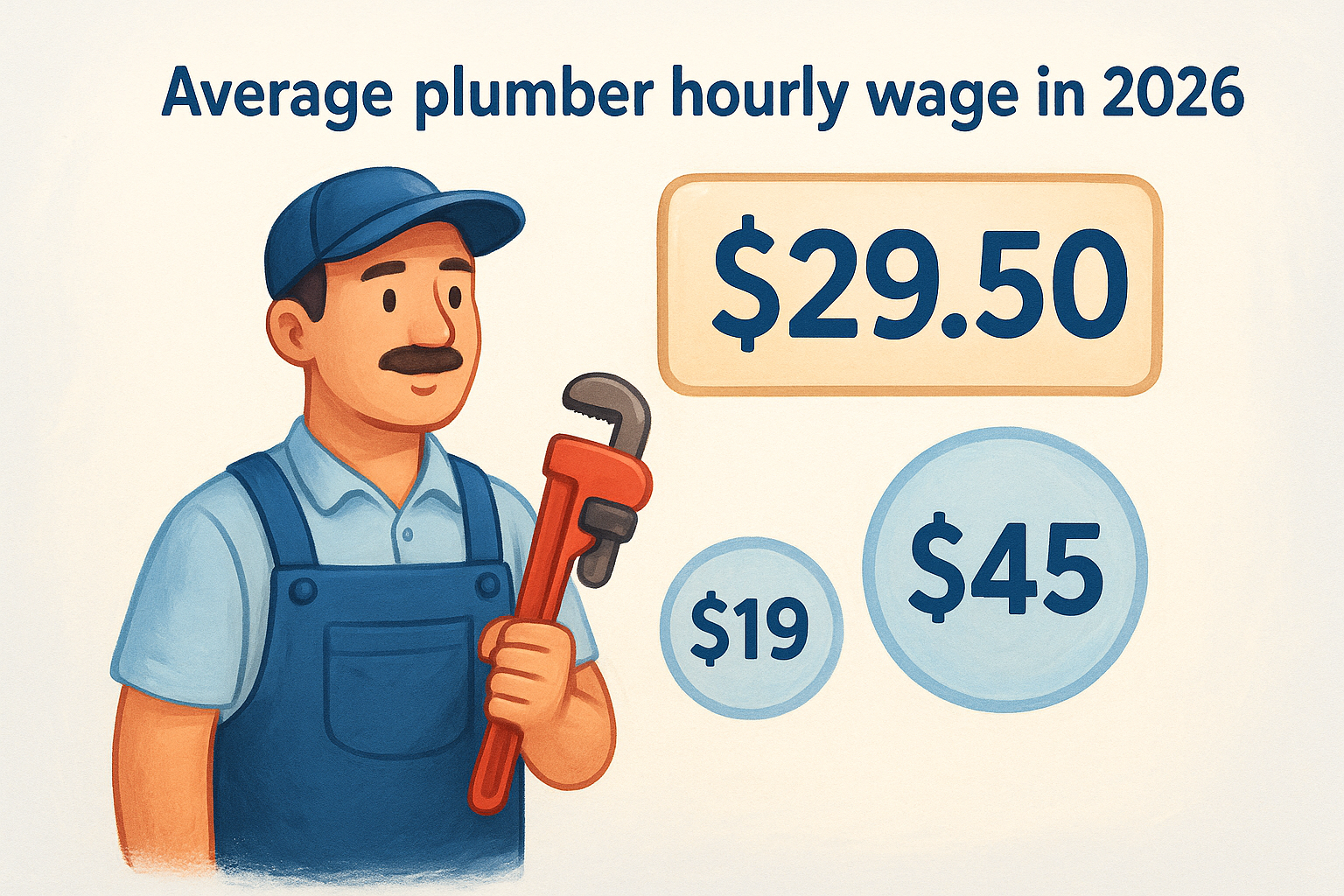
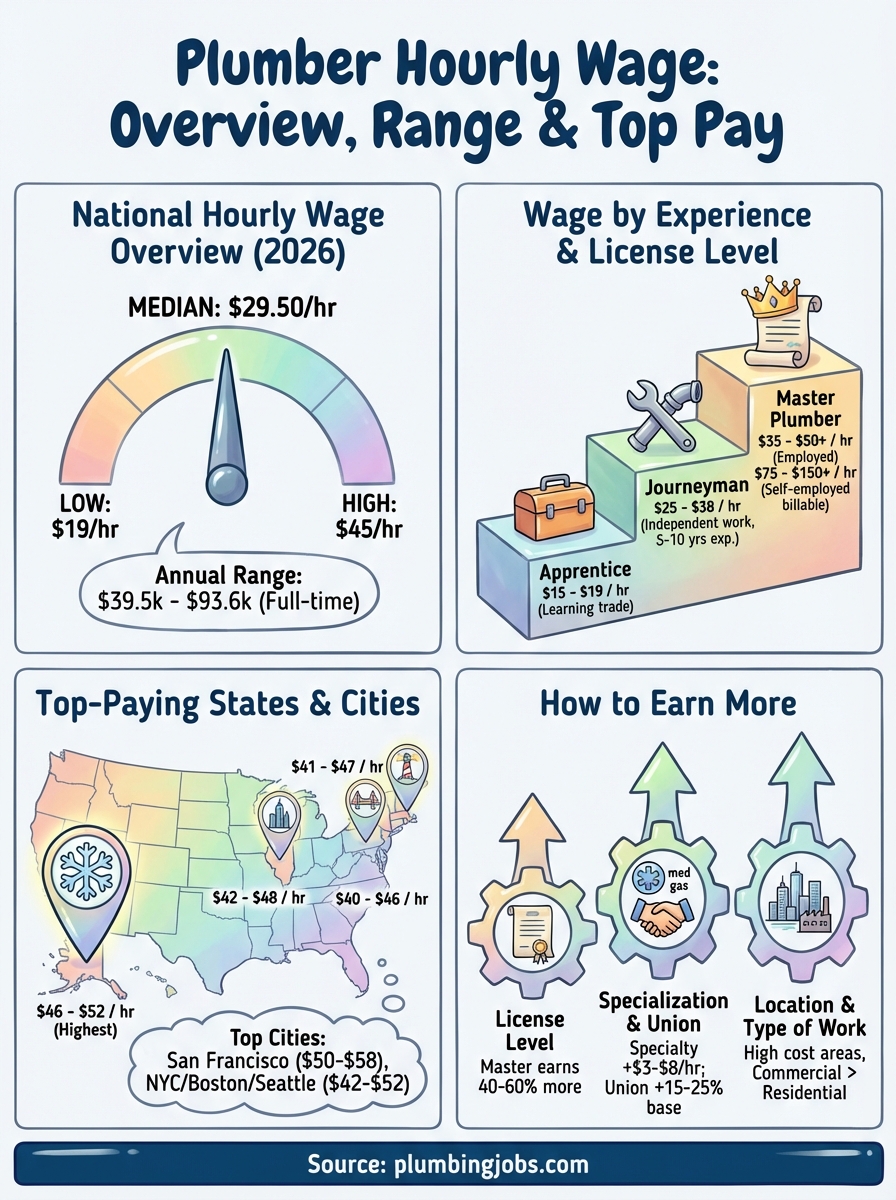
The national median plumber hourly wage sits at $29.50 according to current Bureau of Labor Statistics data, though your actual earnings likely fall somewhere between $19 and $45 per hour depending on your specific circumstances. This translates to an annual salary range of roughly $39,500 to $93,600 for full-time work. The middle 50% of plumbers earn between $23.75 and $36.80 hourly, which gives you a realistic target if you’re moving beyond entry-level positions.
What the numbers actually mean for your paycheck
You’ll notice significant variation even within these national averages based on factors you can directly control. Union plumbers consistently earn 15-25% more than non-union counterparts in the same markets, while specialized skills like medical gas installation or backflow prevention certification add $3 to $8 per hour to your base rate. The difference between working for a small residential outfit versus a large commercial contractor can mean $5 to $10 more per hour, even with identical qualifications.
Your location and specialization choices affect your earnings more than raw experience alone, making strategic career planning essential for maximizing income.
Most employers structure pay around 40-hour work weeks but offer overtime at time-and-a-half rates, which pushes effective hourly earnings higher during busy seasons. Emergency service calls and after-hours work typically command premium rates of $45 to $75 per hour, regardless of your standard daytime wage. These premium opportunities significantly boost annual income for plumbers willing to maintain on-call availability.
Hourly wage by experience and license
Your license level directly determines your earning potential more than any other single factor in the plumbing trade. Apprentices typically start at $15 to $19 per hour while building their foundational skills, journeyman plumbers command $25 to $38 hourly, and master plumbers earn $35 to $50 or more depending on their market. This progression creates a clear financial roadmap as you advance through licensing requirements and gain hands-on experience.
Apprentice and entry-level rates
Starting your career as an apprentice means accepting lower compensation while you learn the trade under supervision. Most programs pay between $15 and $19 per hour during your first year, with incremental raises every six months as you complete required training hours. Second and third-year apprentices see their plumber hourly wage climb to $18 to $24, reflecting increased responsibility and reduced supervision needs.
Your apprenticeship represents an investment in future earning power, with each completed year bringing you closer to journeyman rates that nearly double entry-level pay.
Journeyman plumber earnings
Licensed journeymen represent the backbone of the plumbing workforce and earn $25 to $38 per hour in most markets. You can work independently at this level, pull permits, and supervise apprentices, which justifies the significant pay increase over apprentice wages. Journeymen with five to ten years experience typically reach the upper end of this range without additional certifications.
Master plumber compensation
Holding a master license opens the highest-paying opportunities in the trade, with typical rates of $35 to $50 hourly for employed positions. Running your own business as a licensed master lets you bill $75 to $150 per hour for service calls, though your actual take-home depends on overhead costs and business expenses.
Highest-paying states and cities for plumbers
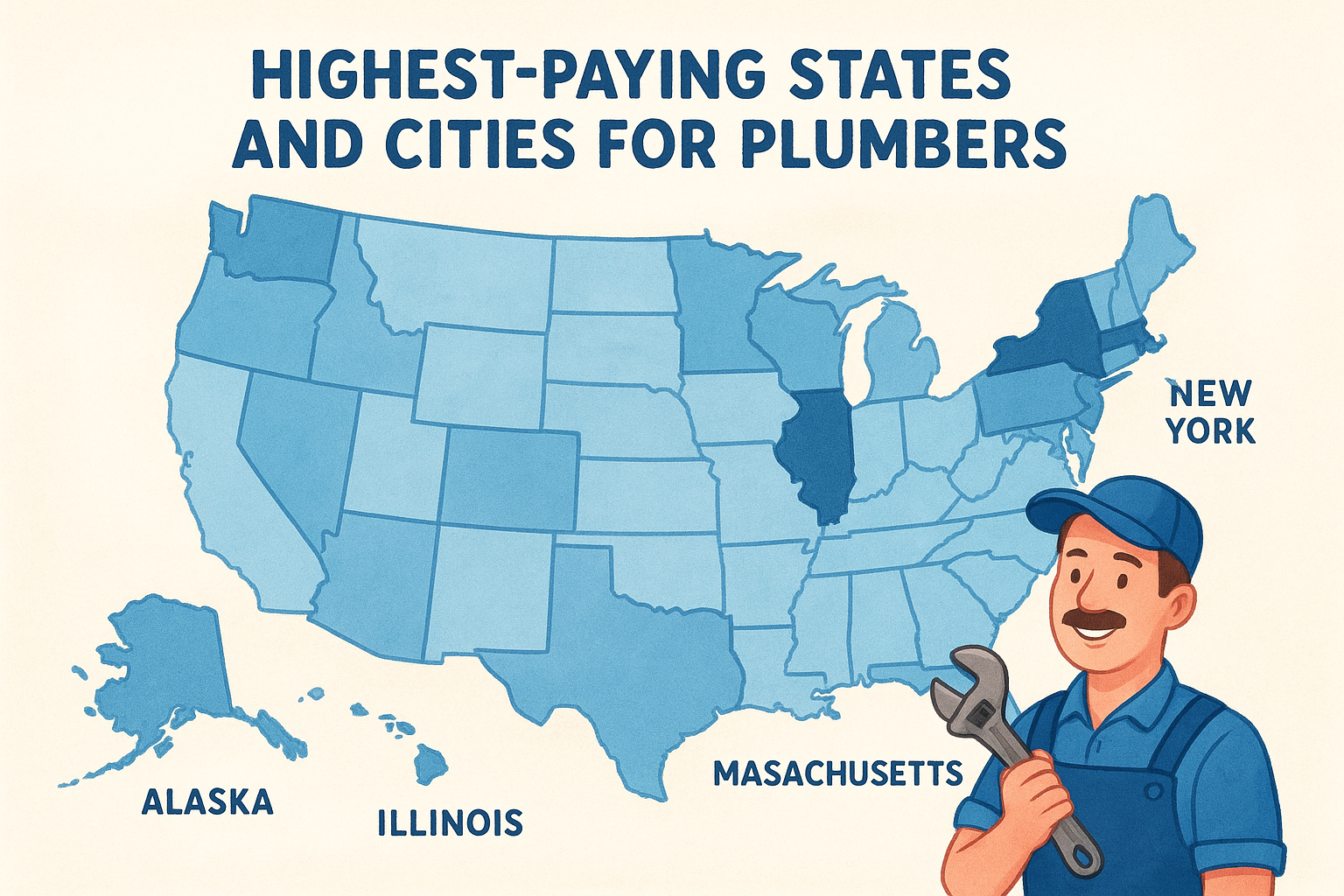
Geographic location determines your earning potential as much as your license level does. States with high costs of living and strong union presence consistently pay premium rates, while rural areas in the South and Midwest typically offer lower compensation. Alaska leads the nation with average plumber hourly wage rates of $46 to $52, followed by Illinois ($42 to $48), Massachusetts ($41 to $47), and New York ($40 to $46).
Top-paying states for plumbing work
Alaska’s extreme climate and remote locations create exceptional demand for skilled plumbers, pushing wages 20 to 30% above national averages despite a relatively small population. Hawaii follows closely with rates of $39 to $45 per hour, where island geography and shipping costs drive up construction expenses across all trades. Illinois benefits from Chicago’s massive commercial market and strong union presence, delivering consistent $42 to $48 hourly for journeyman plumbers.
Geographic wage differences often exceed 50% between the highest and lowest-paying states, making relocation a powerful strategy for boosting your income.
Metropolitan areas with premium rates
San Francisco tops the city rankings with journeyman rates reaching $50 to $58 per hour, though housing costs consume much of that premium. New York City, Boston, and Seattle all support $42 to $52 hourly for experienced plumbers, particularly in commercial and high-rise construction. Smaller cities like Fairbanks, Alaska and Trenton, New Jersey surprisingly outpace many larger markets, offering $45 to $50 with lower living expenses than coastal metros.
What affects plumber pay and how to earn more
Your plumber hourly wage responds directly to choices you make about licensing, specialization, and where you work. Union membership, certifications, and willingness to take on commercial projects all create immediate income opportunities. Understanding these levers gives you control over your earning trajectory rather than accepting whatever employers initially offer.
Key factors that determine your earnings
License level remains the single most powerful factor affecting your pay, with master plumbers earning 40-60% more than journeymen in the same market. Geographic location follows closely, as working in high-cost urban areas or states with strong construction markets can add $10 to $20 per hour compared to rural regions. Union membership typically adds 15-25% to base wages plus stronger benefits packages, while specialized certifications like backflow prevention or medical gas installation command premium rates.
Your willingness to relocate or pursue advanced certifications directly translates to measurable wage increases within 6-12 months.
Practical steps to increase your pay
Pursuing your master license creates the fastest path to higher earnings, typically boosting your hourly rate by $8 to $15 once completed. Adding specialty certifications in medical gas systems, backflow testing, or hydronic heating opens higher-paying commercial opportunities that general residential work cannot access. Joining a union provides immediate wage increases and standardized pay scales that remove negotiation uncertainty.
Building relationships with commercial contractors exposes you to larger projects that pay better than residential service calls. Developing expertise in new construction, industrial plumbing, or high-rise work positions you for premium assignments that smaller outfits cannot handle. Taking on-call emergency service rotations adds $5,000 to $15,000 annually through premium after-hours rates.
Next steps
Understanding the plumber hourly wage in your market gives you the foundation to make informed career decisions and negotiate effectively with employers. You now have concrete data on what apprentices, journeymen, and master plumbers earn across different states and cities, plus actionable strategies to increase your compensation through advanced licensing, specialized certifications, and strategic job selection that aligns with your goals.
Your next move depends on where you currently stand in your plumbing career. Job seekers can explore higher-paying opportunities that match their qualifications and experience level across all 50 states. Employers who need qualified plumbers can post a job with competitive wages that reflect current industry benchmarks and attract top talent to their teams. Whether you’re advancing your career or building your workforce, the right match starts with understanding what skilled plumbers actually earn in today’s competitive market.
Want plumbing jobs delivered to your inbox?
Want plumbing jobs delivered to your inbox?
Partner Site

