
Plumbing License Study Guide: Pass Journeyman & Master Exams
Passing your plumbing license exam is one of the biggest career milestones you’ll face as a tradesperson. Whether you’re preparing for a Journeyman or Master certification, the right plumbing license study guide can mean the difference between walking out confident and having to rebook for another attempt. These exams test everything from code knowledge and safety regulations to practical problem-solving, and they’re not designed to be easy.
That’s exactly why preparation matters. A structured study plan helps you focus on the topics that actually appear on the test instead of guessing your way through hundreds of pages of plumbing code.
Here at plumbingjobs, we help plumbers at every career stage find their next opportunity, and earning your license opens doors to higher-paying roles and greater job security. In this guide, we’ll break down the study materials, practice resources, and exam strategies you need to pass your Journeyman or Master plumber exam on the first try.
Know what your state exam covers
Before you open a single code book, you need to know exactly what your state requires for the exam you’re taking. Every state runs its own licensing program, and the exam content varies significantly. Some states use nationally administered tests from providers like PSI or Prometric, while others write and administer their own. Starting your plumbing license study guide without this information means you could spend weeks studying the wrong code edition or the wrong topic mix entirely.
Check your state’s plumbing licensing board website first. That single page will tell you which exam provider, which code edition, and which topics carry the most weight.
Journeyman vs. Master exam differences
The gap between a Journeyman and a Master exam goes beyond difficulty level. Journeyman exams focus heavily on installation practices, pipe sizing, fixture units, and safety code compliance. Master exams add a layer of business and project management knowledge, including blueprint reading, estimating, and sometimes state-specific contractor law. If you’re sitting for the Master exam, plan to spend extra time on the business-side topics even when they feel less technical than hands-on installation content.
How to find your state’s exam blueprint
Your state licensing board publishes a candidate information bulletin or exam content outline for each license level. This document lists every topic category and the percentage of questions assigned to each one. Download it before you study anything else. Once you have it, map each topic to a specific section of your code book so you know exactly where to find answers during the open-book portion of the exam.
- Download the candidate bulletin from your state licensing board website
- Highlight every topic category weighted at 15% or higher
- Note the exact code edition referenced (IPC, UPC, or a state-adopted version)
Step 1. Gather the right code books and tools
Once you know your exam blueprint, pull together every resource you’ll need before you study a single page. Most plumbing license exams are open-book, which means you can bring approved code books and a calculator into the testing room. Having the right edition of each book and knowing how to use it quickly is as important as understanding the content itself.
The code books you need
Your candidate bulletin will list the exact code edition your exam references. Most states use either the International Plumbing Code (IPC) or the Uniform Plumbing Code (UPC), so confirm which one applies to you before buying. Tab and index your book heavily because fast navigation during the exam directly affects your score.
- IPC or UPC (confirm the edition year)
- Your state plumbing code supplement, if one exists
- IFGC or fuel gas code, if your exam includes gas systems
Buy the physical book, not a digital version. Most testing centers require printed copies, and building physical familiarity with the layout speeds up your open-book searches on test day.
Calculator and reference tools
Bring a basic scientific calculator to every study session as part of your plumbing license study guide prep. Most exams allow a non-programmable model, so practice pipe sizing and drainage math with the same tool you plan to bring on test day.
Step 2. Study the high-frequency exam topics
Every plumbing license exam has a predictable set of high-frequency topics that appear far more often than others. Your candidate bulletin shows the percentage weights, so use those numbers to decide where to invest the most study time. Prioritizing the right topics is what makes any plumbing license study guide effective rather than overwhelming.
Core code topics to focus on
The following topics consistently appear across both Journeyman and Master exams regardless of state. Pipe sizing, drainage slope requirements, and venting configurations make up a significant portion of most tests, and you need to be able to find those answers quickly in your code book.
- Drainage, Waste, and Vent (DWV) sizing
- Fixture unit calculations
- Water supply pipe sizing
- Trap requirements and distances
- Backflow prevention devices
If a topic carries 15% or more of the exam weight, plan to spend at least two full study sessions on it before moving to anything else.
Master exam business topics
Master candidates need to allocate dedicated study time for contractor law, lien rights, and project estimating. These topics feel less familiar because they sit outside daily field work, but they often account for 20% or more of the total Master exam score.
Step 3. Practice open-book navigation and math
Most plumbing license exam failures come not from lacking knowledge but from wasting time searching through code books during the test. Practicing open-book navigation as a separate skill in your plumbing license study guide routine gives you a real advantage when the clock is running.
Tab your code book for speed
Physical tabs transform your code book into a rapid-reference tool. Assign a tab to every chapter you identified as high-frequency in your exam blueprint, and label each one with the chapter name and page range so you can flip directly to the right section in seconds.
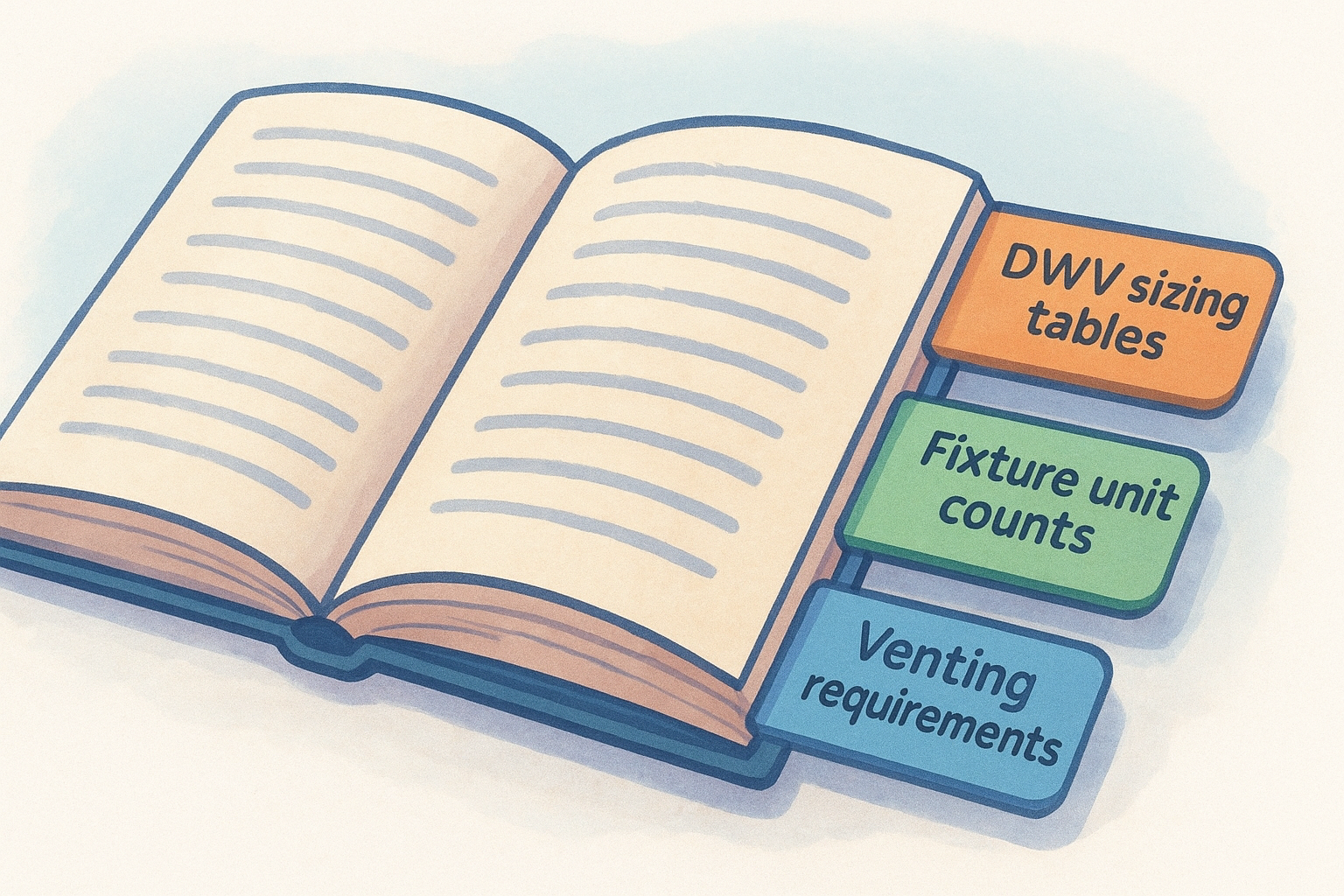
- DWV sizing tables
- Fixture unit counts
- Venting requirements
- Water supply sizing
- Backflow prevention
Drill the math problems
Pipe sizing and fixture unit calculations require consistent repetition before they feel automatic. Work through at least five math problems per study session, writing out each step rather than skipping to the answer. Time yourself on each problem to simulate the pressure of a real exam environment.
Aim to solve a standard pipe sizing calculation in under two minutes before your exam date.
Build a 2-week exam-day plan
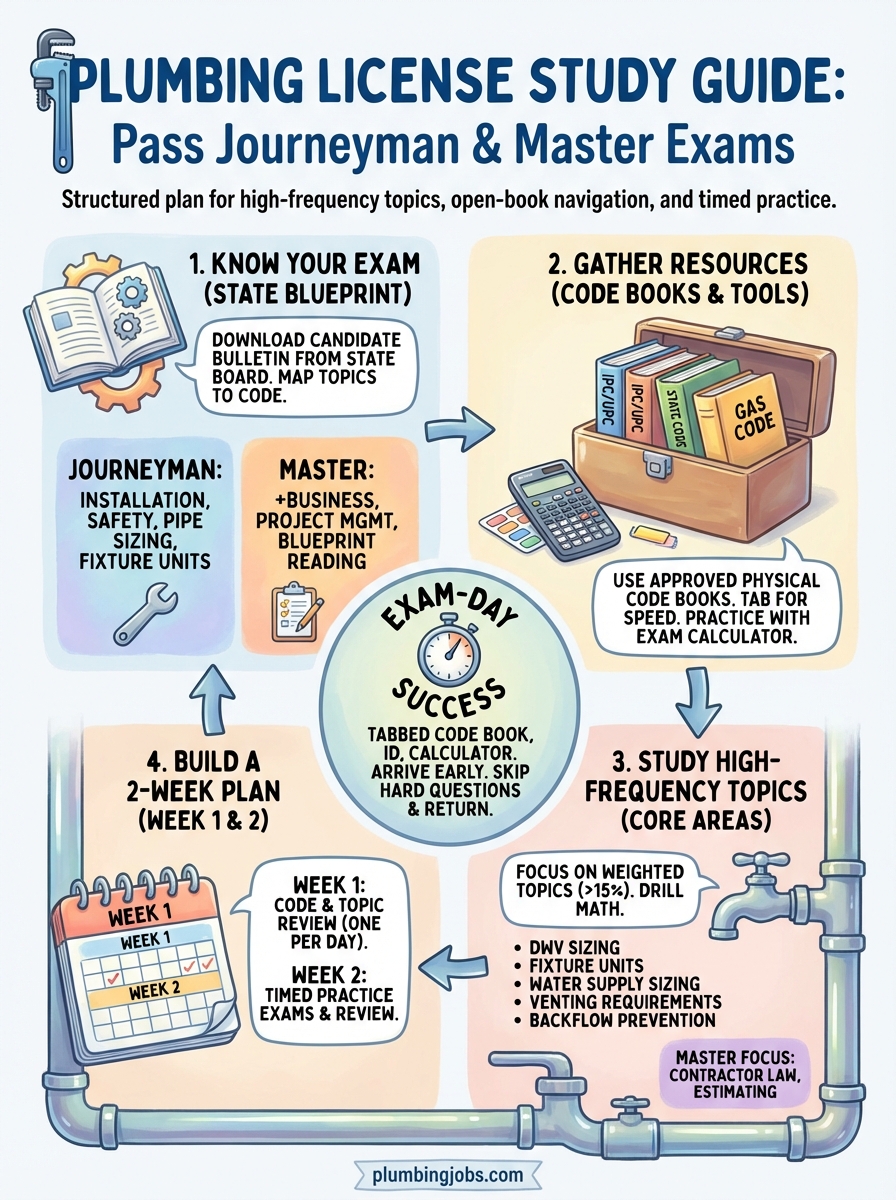
Two weeks gives you enough time to cover every high-frequency topic in your plumbing license study guide without burning out. Use the schedule below as a starting template, then adjust daily time blocks to fit your work schedule.
Week 1: Code and topic review
Spend the first week working through each high-priority topic from your exam blueprint, one category per day. Read the relevant code sections, then locate every referenced table in your book and mark it with a tab before moving on.
| Day | Focus Area |
|---|---|
| 1-2 | DWV sizing and fixture units |
| 3-4 | Venting requirements and trap rules |
| 5-6 | Water supply sizing and backflow prevention |
| 7 | Gas systems or business law (exam-dependent) |
Week 2: Timed practice and review
Run full practice exams in sessions of 60 to 90 minutes, simulating real test conditions. Review every wrong answer immediately after each session to close knowledge gaps before exam day.
Shift your focus entirely to timed practice during week two. Speed and accuracy under pressure come from repetition, not from reading more code.
Final check before test day
The night before your exam, stop studying. Your plumbing license study guide work is done, and cramming at this point does more harm than good. Instead, set out everything you plan to bring: your tabbed code book, a valid photo ID, your calculator, and any confirmation emails or scheduling documents from your exam provider.
On exam day, arrive at the testing center at least 15 minutes early so you have time to settle in before the clock starts. During the test, skip any question you can’t locate in under 60 seconds and return to it later so you don’t burn time on one problem while easier points sit unanswered.
Once you pass, you’re ready to pursue the roles your license unlocks. Higher pay and more responsibility come with each certification level, so don’t let the momentum stop here. Browse open plumbing jobs near you to find positions that match your new credentials and take the next step in your career.
Want plumbing jobs delivered to your inbox?
Want plumbing jobs delivered to your inbox?
Partner Site

