
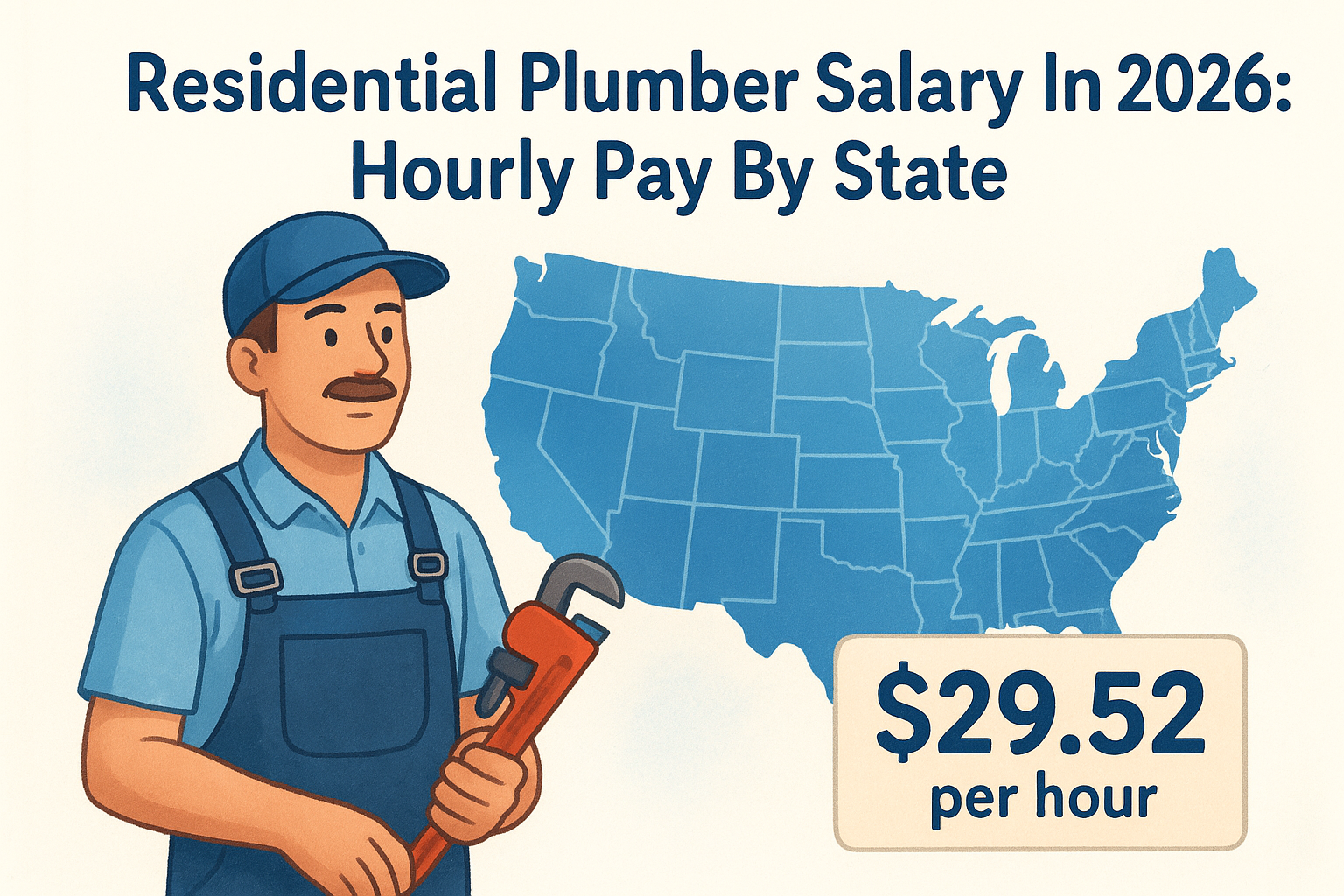
Residential Plumber Salary In 2026: Hourly Pay By State
Knowing your worth starts with knowing the numbers. The average residential plumber salary in 2026 varies significantly depending on where you work, your experience level, and the licenses you hold. Whether you’re an apprentice mapping out your career or a journeyman considering a move to a higher-paying state, having accurate salary data helps you negotiate better and plan smarter.
This guide breaks down hourly rates and annual earnings for residential plumbers across all 50 states. You’ll find data on how experience affects pay, which states offer the highest compensation, and how licensing impacts your earning potential. We’ve compiled this information to give you a clear picture of what residential plumbers actually earn, not vague national averages that ignore regional realities.
At PlumbingJobs.com, we connect plumbing professionals with opportunities that match their skills and salary expectations. This salary breakdown is part of our commitment to helping you make informed career decisions and find positions that pay what you’re worth in the residential plumbing trade.
What residential plumbers earn in 2026
The residential plumber salary landscape in 2026 shows substantial variation based on multiple factors, but clear patterns emerge when you analyze the data. Understanding these baseline figures helps you gauge whether your current compensation aligns with market rates and where you might need to negotiate for better pay. The numbers reflect real-world earnings from licensed professionals working in residential settings across the United States.
National average earnings
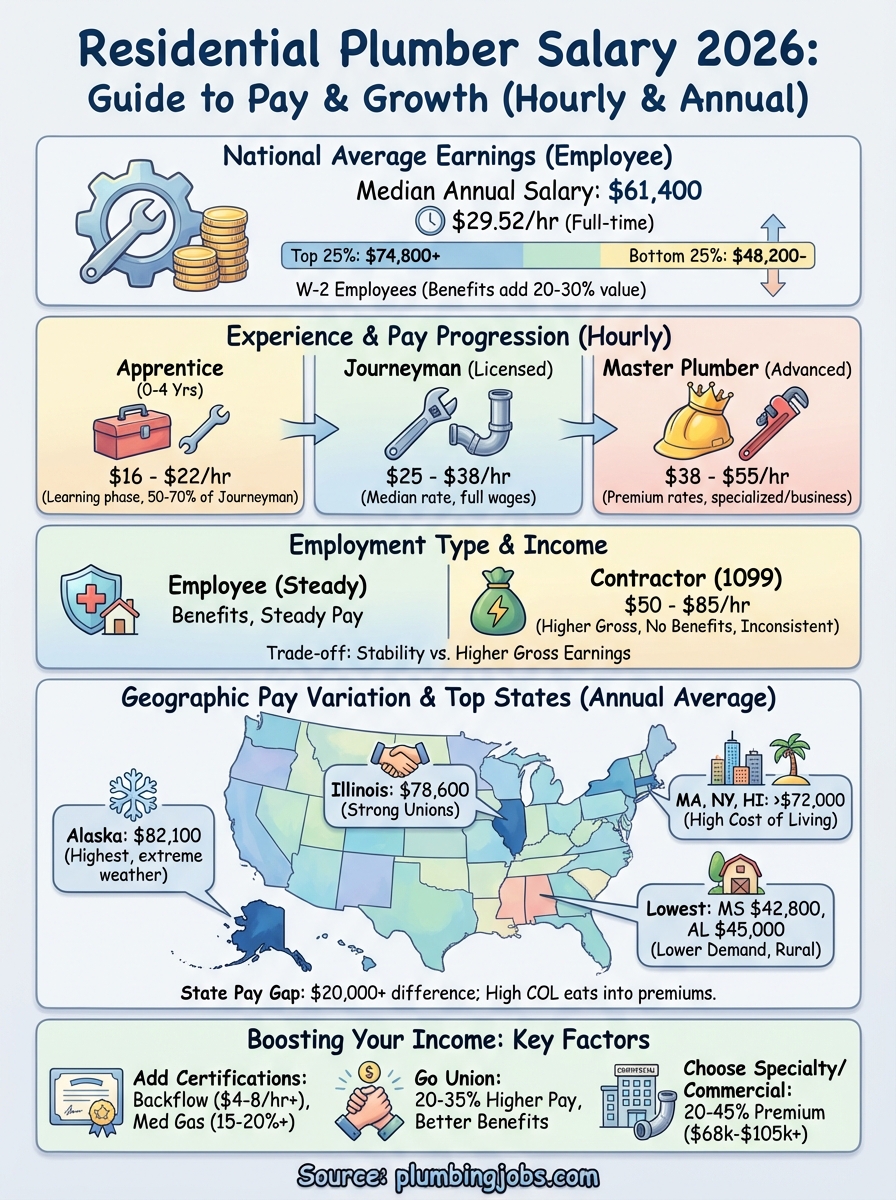
Residential plumbers earn a median annual salary of $61,400 in 2026, translating to approximately $29.52 per hour for full-time work. This places residential plumbing solidly in the middle-income bracket for skilled trades. Your actual earnings will differ based on your state’s cost of living and demand for plumbing services, but this figure provides a useful benchmark for career planning.
The top 25% of residential plumbers earn $74,800 or more annually, while the bottom 25% make $48,200 or less, showing significant earning potential as you gain experience.
These numbers reflect W-2 employees working for plumbing companies, not independent contractors who typically earn more per hour but cover their own expenses. If you’re comparing job offers, you need to factor in benefits packages that add 20-30% to total compensation value.
Entry-level vs experienced earnings
Starting out as an apprentice, you’ll typically earn $16 to $22 per hour depending on your state and the company training you. This represents roughly 50-70% of journeyman wages as you learn the trade under supervision. Most apprenticeships last four years, with gradual pay increases as you complete each training phase.
Journeyman plumbers with full licensing earn the median rates mentioned above, typically ranging from $25 to $38 per hour in most markets. After reaching journeyman status, your earnings plateau unless you pursue additional certifications or move into specialized work. Master plumbers command $38 to $55 per hour in residential work, though many masters transition to commercial projects or open their own businesses where earning potential increases dramatically.
Full-time vs contract work
Contractors working on a 1099 basis charge $50 to $85 per hour for residential service calls, significantly higher than employee wages. You keep this premium to cover equipment, insurance, licensing, and business overhead costs that employers typically handle. However, contract work means inconsistent hours and no paid time off or health benefits.
Staff plumbers receive steady paychecks, health insurance, retirement contributions, and paid vacation that independent contractors must fund themselves. The trade-off comes down to stability versus higher gross earnings. Many experienced plumbers start as employees, then transition to contract or business ownership once they’ve built a client base and can afford the business risks.
Hourly and annual pay by state
Geographic location creates the single largest pay variation for residential plumbers in 2026. Your earnings can differ by $20,000 or more annually simply by crossing state lines, even when performing identical work. These differences reflect cost of living, local demand for services, union strength, and state licensing requirements that limit labor supply.

Top-paying states for residential plumbers
Alaska leads the nation with residential plumbers earning an average of $82,100 annually or $39.47 per hour, driven by extreme weather conditions and a shortage of licensed tradespeople. Illinois follows at $78,600 yearly with strong union presence in Chicago and surrounding suburbs boosting wages. Massachusetts, New York, and Hawaii round out the top five, all offering annual salaries exceeding $72,000 for journeyman-level work.
West Coast states consistently pay 15-25% above the national median, with Washington, Oregon, and California offering $68,000 to $74,000 per year in major metro areas.
These high-wage states also carry elevated costs for housing and living expenses. You need to calculate whether the residential plumber salary premium covers the increased cost of living before relocating for higher pay.
States with the lowest plumber wages
Mississippi reports the lowest average at $42,800 annually or $20.58 per hour, reflecting lower service rates and weaker demand in rural areas. Arkansas, West Virginia, and Alabama cluster near $45,000 to $48,000 yearly, with limited union representation and abundant labor supply keeping wages compressed.
Southern and rural states generally pay 30-40% below coastal markets, though your purchasing power often remains comparable due to significantly lower housing costs. Many plumbers in these regions supplement income through side work or specialize in higher-margin services like gas line installation to boost earnings above these baseline figures.
What affects residential plumber pay
Multiple factors determine what you earn as a residential plumber, and understanding these variables helps you maximize your income potential. Your residential plumber salary depends less on luck and more on strategic decisions about where you work, what credentials you hold, and how you position yourself in the market. Knowing which factors carry the most weight lets you focus your efforts on changes that produce real income growth.
Experience and licensing level
Your license classification directly controls your earning ceiling in most states. Apprentices earn 40-60% of journeyman rates while learning the trade, with scheduled raises tied to completing training hours. Journeyman licenses unlock full market wages, typically $50,000 to $70,000 annually depending on your location. Master plumber credentials add another 15-25% to your base pay, though many masters choose to start their own businesses rather than remain employees.
Years in the field matter beyond official licensing. Plumbers with 10+ years of experience command premium rates because they diagnose problems faster, require less supervision, and generate fewer callbacks. Companies pay more for efficiency that directly impacts their profit margins.
Union membership and company size
Union plumbers earn 20-35% more than non-union workers in the same markets, with New York, Chicago, and San Francisco showing the largest union premiums. Collective bargaining delivers better hourly wages, guaranteed raises, and stronger benefit packages. However, union positions often require you to work on both residential and commercial projects as assigned.
Larger plumbing companies with 50+ employees typically pay $3 to $8 more per hour than small shops, offering structured advancement paths and consistent overtime opportunities.
Local market conditions
Housing growth drives demand for residential plumbers, with booming metro areas paying 15-30% above state averages. Areas with severe weather create year-round emergency work that boosts earnings through on-call premiums and overtime. States with strict licensing requirements limit plumber supply, pushing wages higher as companies compete for qualified workers.
Cost of living adjustments explain much of the state-to-state variation in pay rates. Your $65,000 salary in Phoenix provides similar purchasing power to $85,000 in Seattle when you account for housing costs and taxes.
Residential vs commercial and specialty plumber pay
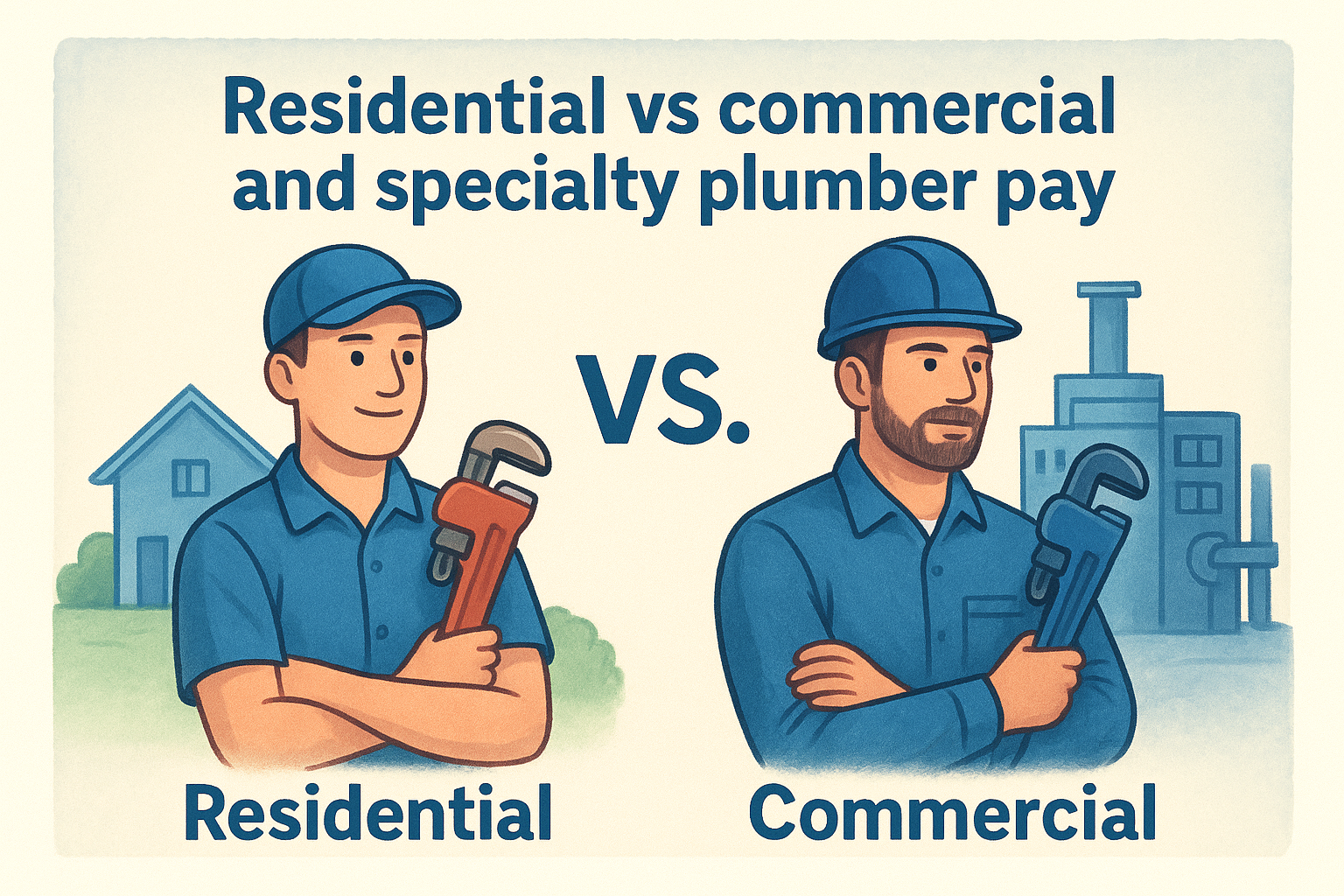
Choosing which sector to work in significantly impacts your earning potential as a licensed plumber. While residential work provides steady demand and predictable hours, commercial projects and specialty services typically pay 20-45% more per hour for comparable skill levels. Understanding these pay differences helps you plan your career trajectory and decide whether the trade-offs justify pursuing additional certifications or switching focus areas.
Commercial plumber earnings comparison
Commercial plumbers earn $68,000 to $92,000 annually, outpacing the residential plumber salary range by $7,000 to $30,000 depending on your market. You’ll work on office buildings, hospitals, and industrial facilities where projects run larger and building codes demand more complex installations. The premium reflects longer job durations, specialized knowledge of commercial systems, and often union-mandated wage scales.
Large commercial projects offer consistent overtime opportunities that can add $15,000 to $25,000 to your base salary. However, you sacrifice schedule flexibility and typically travel farther to job sites. Commercial work also slows during economic downturns when businesses delay construction projects, while residential service work remains steadier through recessions.
Specialty plumber pay scales
Specialized plumbers focusing on medical gas systems, backflow prevention, or hydronic heating command $75,000 to $105,000 yearly. These certifications require additional training beyond your standard license but open higher-paying niche markets with less competition. Medical gas certification alone can add $8 to $15 per hour to your rate when working in healthcare facilities.
Pipefitters and steamfitters, though technically separate trades, earn $72,000 to $98,000 annually and often transition from plumbing backgrounds by obtaining specialized certifications.
Service and repair plumbers working in luxury residential markets sometimes match commercial wages by charging premium rates for emergency calls and high-end fixture installations. Your specialty choice ultimately depends on whether you value income maximization over work-life balance and job site variety.
How to raise your pay as a residential plumber
Increasing your residential plumber salary requires strategic action beyond simply working more hours or waiting for annual raises. You control multiple levers that directly impact your earning potential, from acquiring new credentials to changing employers or markets. The most successful plumbers combine several tactics over time, building their value systematically rather than hoping for lucky breaks.
Add valuable certifications
Backflow prevention certification adds $4 to $8 per hour to your rate in most markets, requiring only 40 hours of training and passing a state exam. Medical gas installer credentials open healthcare facility work at 15-20% higher pay than standard residential rates. Gas line certifications let you capture high-margin installation work that many general plumbers avoid due to liability concerns.
Each additional certification you earn makes you more valuable to employers and harder to replace. Companies pay premiums for plumbers who can handle diverse work without subcontracting specialized tasks. You recoup training costs within 3-6 months through higher hourly rates or expanded job opportunities.
Change employers or go independent
Switching companies delivers faster pay increases than waiting for internal promotions, typically netting 12-18% raises when you move. Larger plumbing firms with established commercial divisions pay more than small residential-only shops. Research company sizes and service offerings before interviewing to target higher-paying employers in your market.
Independent contractors and business owners earn $65,000 to $120,000+ annually by capturing both labor and profit margins that employed plumbers never see.
Starting your own operation requires business licenses, insurance, and marketing investment, but you set your own rates and keep all profits. Many successful independent plumbers begin by taking side jobs evenings and weekends while employed, then transition to full-time self-employment once they’ve built a steady client base.
Next steps
Understanding the residential plumber salary landscape across different states and experience levels gives you the information needed to evaluate your current position and plan your next career move. You now have concrete numbers to reference during salary negotiations, data to inform relocation decisions, and clarity on which certifications deliver the strongest return on investment for your time and training dollars.
Your career growth depends on taking action with this knowledge. Compare your current compensation against the state averages and experience-level benchmarks we’ve outlined. If you’re earning below market rate, prepare to negotiate with your employer or start exploring higher-paying opportunities. Companies actively recruit skilled plumbers who know their worth and can justify their salary expectations with market data. For more insights on advancing your plumbing career, including job search strategies and industry trends, explore our plumbing career resources and guides to stay informed about opportunities that match your salary goals.
Want plumbing jobs delivered to your inbox?
Want plumbing jobs delivered to your inbox?
Partner Site

