
How To Get A Plumbing License: Costs, Steps, By State (2026)
A plumbing license does more than hang on your wall, it determines which jobs you can legally take, how much you can earn, and whether employers will consider you for their best positions. If you’re serious about building a career in the trades, understanding how to get a plumbing license is the first real step toward long-term job security and higher pay.
The process isn’t identical everywhere. Each state sets its own rules for education hours, apprenticeship requirements, exam formats, and fees. Some states offer reciprocity agreements; others make you start from scratch. Knowing your state’s specific requirements before you begin saves time, money, and frustration down the road.
At PlumbingJobs.com, we connect plumbers with employers across all 50 states, and we see firsthand how licensing status affects hiring decisions. Employers posting on our platform often specify whether they need an apprentice, journeyman, or master plumber. The right license opens doors to better-paying positions and more responsibility.
This guide breaks down everything you need to know: the typical steps to get licensed, what each license level means, average costs you should budget for, exam preparation tips, and a state-by-state overview of requirements. Whether you’re just entering the trade or ready to advance from journeyman to master, you’ll find the information you need to move forward.
What a plumbing license is and which one you need
A plumbing license is state-issued documentation that authorizes you to perform plumbing work legally within specific jurisdictions. Without this credential, you cannot install pipes, repair fixtures, or perform any plumbing service that requires a permit. The license confirms that you’ve met minimum education and experience standards, passed required exams, and understand local building codes that protect public health and safety.
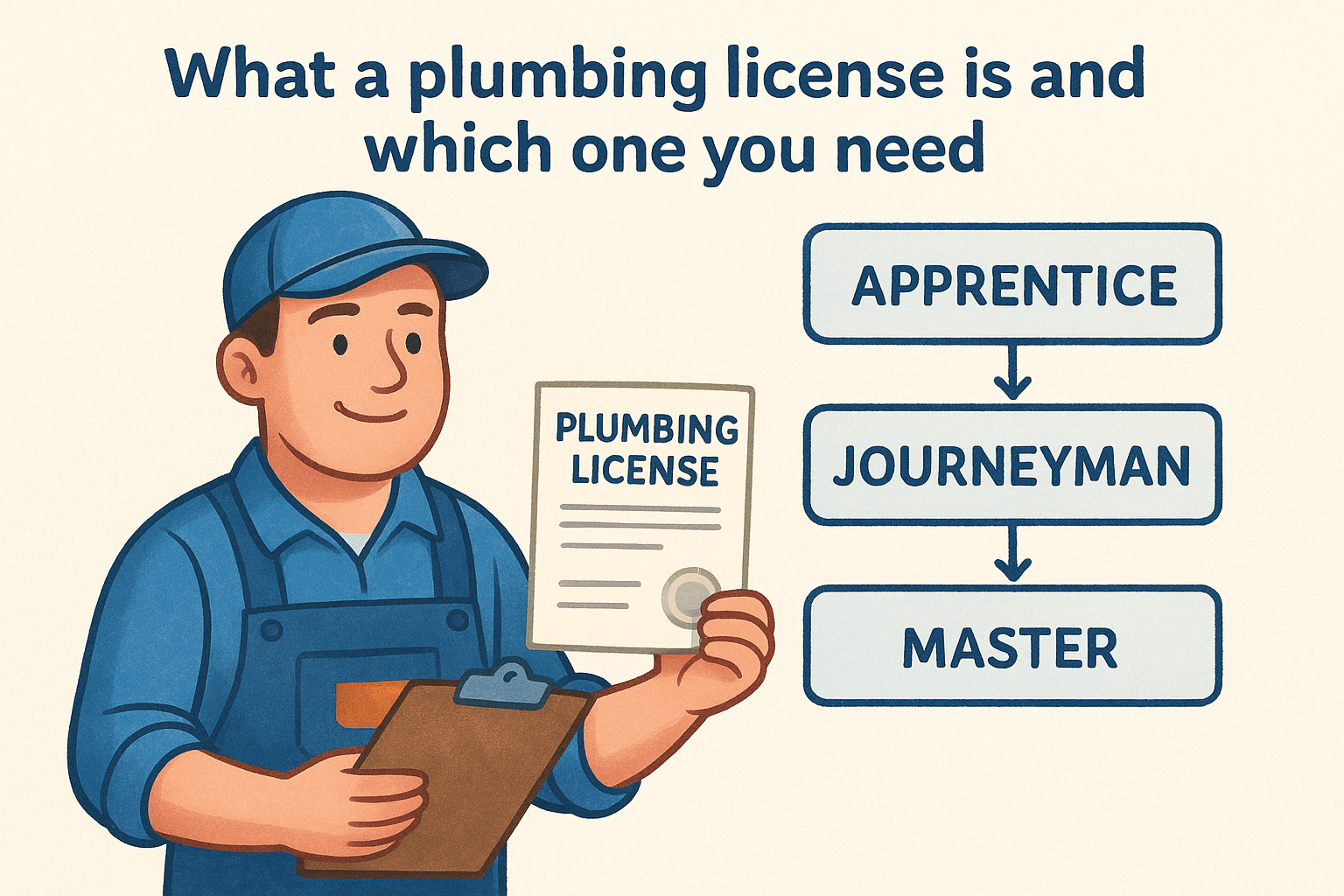
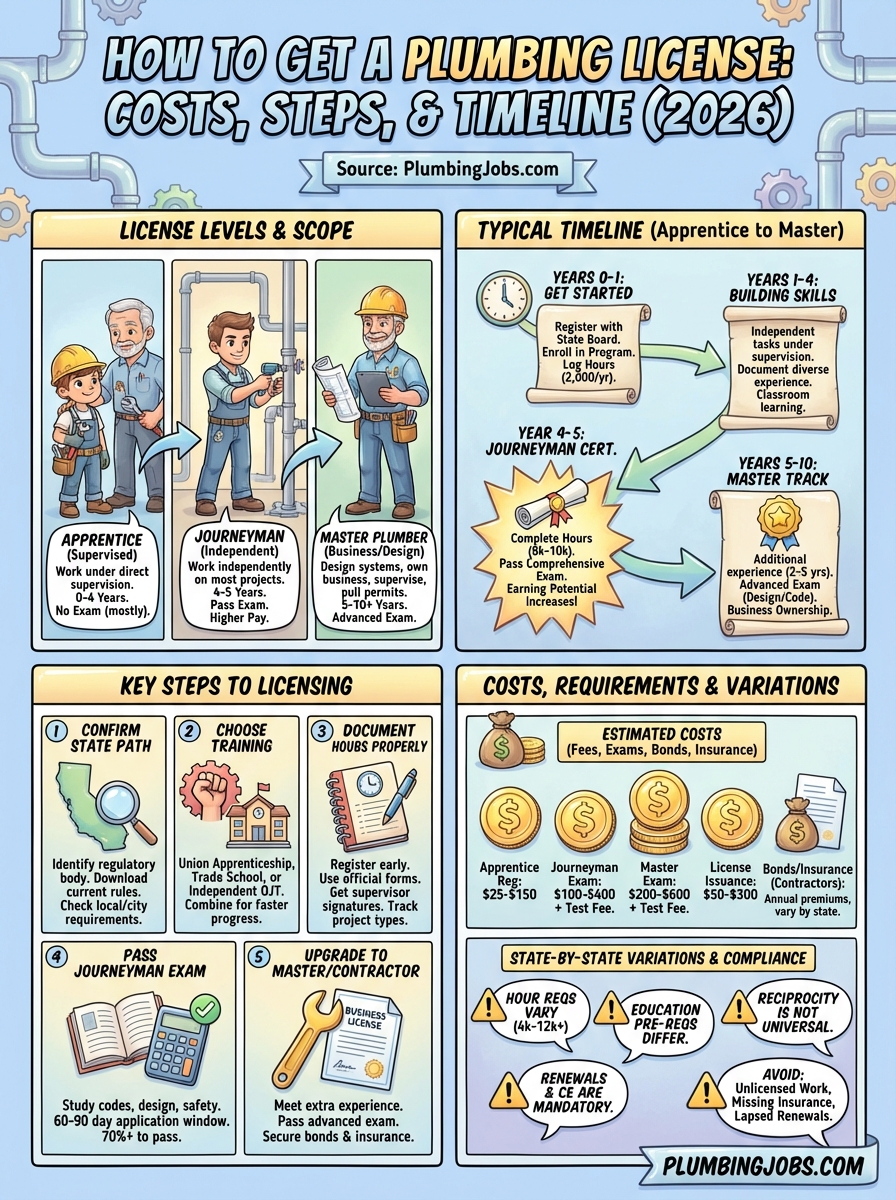
Your license level determines the scope of work you can perform. Apprentices work under supervision, while journeymen operate independently on most standard projects. Master plumbers can design systems, pull permits without oversight, and supervise other licensed professionals. Each level builds on the previous one, creating a clear progression path that employers recognize and value.
State licensing boards exist to protect consumers from unqualified contractors and ensure all plumbing work meets safety standards that prevent contamination, flooding, and structural damage.
Most states recognize three primary license categories, though some use different terminology or add specialized certifications. Understanding which license you need depends on your current experience level and career goals. If you’re just starting, you’ll begin as an apprentice. For those with several years of documented field experience, the journeyman license is your next target. Established professionals seeking business ownership or supervisory roles pursue master status.
The three main license levels
Apprentice plumbers work under direct supervision of licensed journeymen or master plumbers. You don’t take an exam for this level in most states; instead, you register with your state board, enroll in an approved training program, and begin logging hours. Your supervising plumber signs off on your work, verifying that you’re gaining the practical experience required for advancement.
Journeyman plumbers have completed their apprenticeship hours (typically 4,000 to 10,000 depending on state) and passed a comprehensive exam. This license allows you to work independently on most residential and commercial projects. You can pull permits for standard installations and repairs, but you typically cannot submit plans, own a contracting business in your name alone, or supervise multiple job sites without additional credentials.
Master plumbers represent the highest standard of licensure. You must work as a journeyman for several years (usually two to five), pass a more rigorous exam covering system design and advanced code interpretation, and meet higher insurance requirements. This license permits you to own a plumbing business, submit blueprints to building departments, and train apprentices. Many municipalities require a master plumber’s signature on any commercial permit application.
Some states also issue specialty licenses for specific work types:
| License Type | Typical Scope |
|---|---|
| Residential Plumber | Single-family homes, duplexes, small apartments |
| Commercial Plumber | Larger buildings, industrial systems, complex installations |
| Medical Gas Installer | Hospital and healthcare facility gas systems |
| Backflow Prevention Specialist | Testing and certifying backflow prevention devices |
Which license level matches your career stage
If you’re entering the trade with no prior experience, you need an apprentice registration before you can legally work on job sites. Contact your state licensing board to find approved training programs and employers willing to hire entry-level apprentices. Most community colleges and trade unions offer structured programs that combine classroom instruction with paid on-the-job training.
You should pursue your journeyman license when you’ve completed required apprenticeship hours and feel confident in your skills across basic plumbing systems. This typically happens after three to five years of continuous work. The exam tests your knowledge of local codes, system design principles, safety protocols, and practical problem-solving. Passing this exam significantly increases your earning potential and allows you to take on jobs without constant supervision.
Consider advancing to master status when you want to operate your own business or manage larger commercial projects. This step makes sense after you’ve worked as a journeyman long enough to understand the business side of plumbing, including estimating, project management, and customer relations. The master license exam covers advanced topics like hydraulic calculations, complex system design, and building department procedures that you won’t encounter in everyday service work.
Geographic factors also influence which license you need. Some cities require a local business license in addition to your state plumbing license. Other jurisdictions accept out-of-state licenses through reciprocity agreements, while some make you retake exams even if you’re already licensed elsewhere. Before planning how to get a plumbing license, verify the exact requirements where you intend to work.
Typical timeline from apprentice to licensed plumber
Understanding how to get a plumbing license starts with realistic expectations about time investment. Most plumbers spend four to five years reaching journeyman status, then another two to five years before qualifying for a master license. This timeline varies by state requirements, your training path, and how consistently you document work hours.
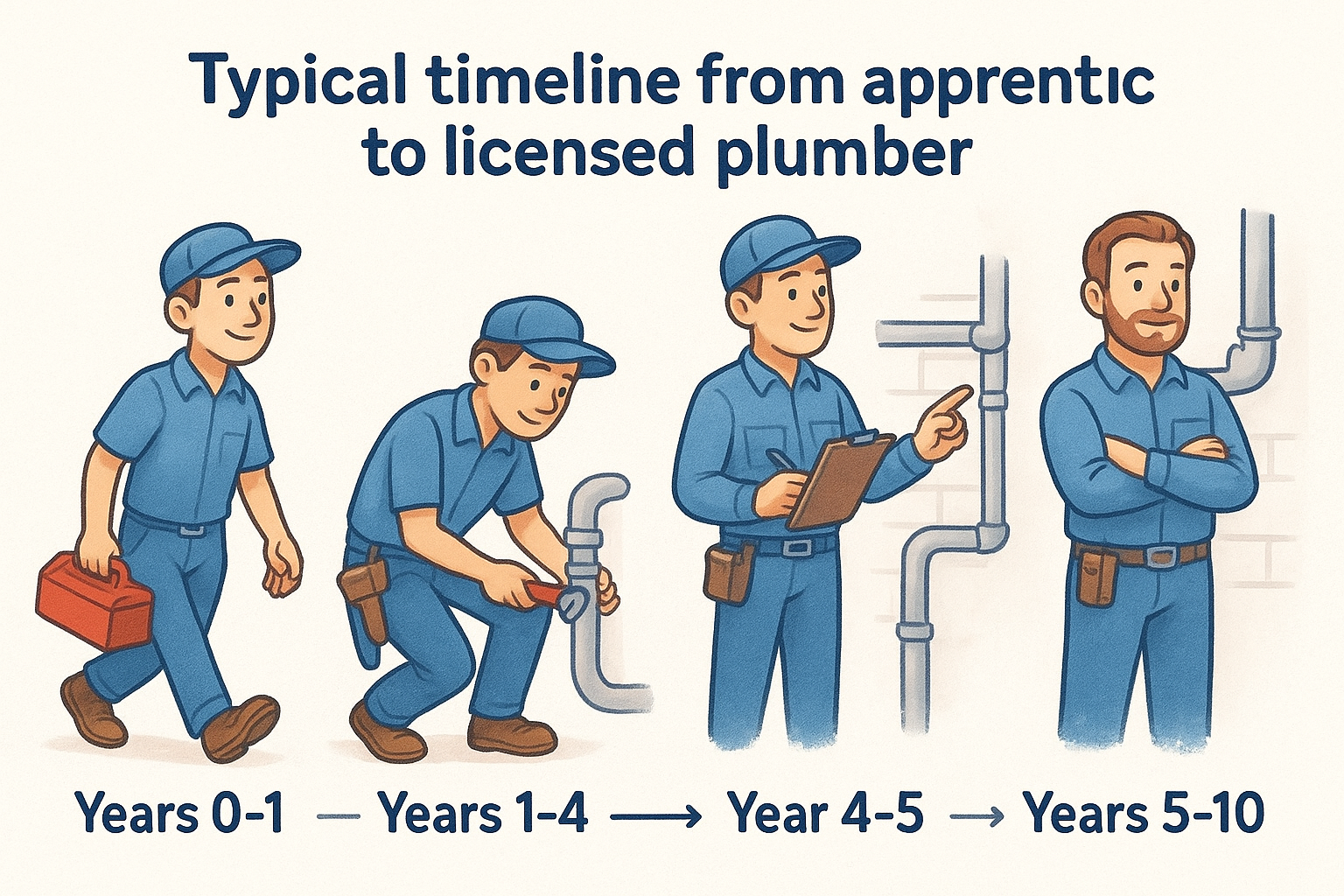
Your progression speed depends on factors you can control and some you cannot. States with higher hour requirements naturally extend your timeline. Full-time employment speeds up the process compared to part-time work. Some apprentices complete their hours faster by working overtime or taking on diverse projects that expose them to different system types.
Years 0-1: Getting started as an apprentice
You begin by registering with your state board and enrolling in an approved program. During your first year, expect to spend most days assisting licensed plumbers with basic tasks like carrying materials, digging trenches, and learning tool operation. Evening or weekend classes cover fundamental concepts like blueprint reading, basic math, and safety protocols.
Your supervising plumber signs timesheets verifying your hours. Most states require you to log 2,000 hours per year if working full-time, though some accept classroom hours as partial substitutes. Keep detailed records from day one because you’ll need them when applying for your journeyman exam.
Years 1-4: Building hours and skills
Mid-apprenticeship is when you transition from helper to skilled assistant. You’ll start installing fixtures independently, running pipe, and troubleshooting common problems under supervision. Your classroom work advances to cover code requirements, system design basics, and specialized installations like gas lines or backflow prevention.
Track every project type you work on because exam boards often require documented experience in multiple categories like residential service, new construction, and commercial installations.
Documentation becomes crucial during this phase. You need proof of diverse experience across different plumbing systems, not just repetitive work on identical installations. Many apprentices fail to qualify for exams because their logged hours don’t show sufficient variety.
Year 4-5: Journeyman certification
After completing required hours (typically 8,000 to 10,000 total), you submit your application and schedule your journeyman exam. Preparation takes two to three months of focused study. The exam covers local plumbing codes, hydraulics, drainage systems, fixture installation, and safety regulations.
Passing rates vary by state but generally range from 60% to 75% for first-time test-takers. You can work while preparing, though many apprentices reduce their hours during exam prep to focus on weak areas. Once licensed, your earning potential increases by $5 to $15 per hour depending on your market.
Years 5-10: Master plumber track
Your state requires additional journeyman experience before you can apply for master status, usually two to five years of documented independent work. This period lets you develop business skills, learn project management, and understand the administrative side of running jobs. The master exam tests advanced design principles, complex code interpretations, and contractor responsibilities that journeymen rarely encounter.
Step 1. Confirm your state and local licensing path
Before you invest time and money learning how to get a plumbing license, you need to identify which agency regulates plumbing in your state and what specific requirements they enforce. Each state operates differently. Some handle licensing through a dedicated plumbing board, while others assign oversight to the Department of Labor, Consumer Affairs, or a construction trades division. Your first action is locating the correct regulatory body and downloading their current application packet.
States change requirements regularly. Fee structures shift, exam formats update, and hour requirements increase or decrease based on legislative changes. Never rely on secondhand information from forums or outdated websites. Go directly to your state’s official licensing board website or call their office to request the most recent requirements document. Ask specifically about any changes taking effect in 2026 that might affect your timeline.
Confirming requirements upfront prevents costly mistakes like enrolling in a training program your state doesn’t recognize or logging hours under an improperly licensed supervisor.
Find your state board contact information
Start by searching “[your state] plumbing board” or “[your state] contractor licensing board” in your web browser. Most states maintain dedicated websites listing application requirements, fee schedules, approved training programs, and exam dates. Look for official .gov domains rather than private sites claiming to explain state rules.
Write down the board’s phone number and office hours. Call them with specific questions about your situation. Ask whether your previous construction experience counts toward apprenticeship hours, if your state accepts online coursework, and what documentation format they prefer. Staff members answer these questions daily and provide accurate guidance that generic web searches cannot match.
Check if your city or county adds requirements
Your state license represents minimum standards, but municipalities often impose additional rules. Major cities like New York, Chicago, and Los Angeles operate their own licensing programs that supplement state credentials. You might need to register with both agencies, pay separate fees, and meet additional insurance requirements before working within city limits.
Contact your city’s building department to ask whether they require local plumber registration. Some jurisdictions only mandate city licenses for contractors who own businesses, while others require every plumber pulling permits to hold dual credentials. Clarify these rules before starting your apprenticeship because some cities require you to log hours within their jurisdiction to qualify for local licensing.
Verify reciprocity if you plan to work across state lines
Reciprocity agreements allow licensed plumbers to transfer credentials between states without retaking exams. Not all states participate in these programs, and those that do often limit reciprocity to specific license levels or require additional paperwork. Check your target state’s reciprocity policy if you plan to relocate or work on projects in multiple states.
Your state board maintains a list of jurisdictions that accept its licenses. Review this information carefully because terms vary. Some states grant full reciprocity, immediately recognizing your credentials. Others offer partial reciprocity, requiring you to pass a local code exam but waiving the trade knowledge portion. A few states provide no reciprocity at all, forcing you to start the licensing process from scratch regardless of your experience.
Step 2. Choose training: apprenticeship, school, or both
Your training path directly affects how quickly you advance and which employers will hire you. States require documented education and work experience before you can test for any license level. You can satisfy these requirements through union apprenticeships, trade school programs, independent on-the-job training, or a combination of formal classroom instruction and paid work hours.
Each approach offers distinct advantages. Union programs provide structured curricula and guaranteed employment. Trade schools deliver concentrated technical knowledge in shorter timeframes. Independent apprenticeships give you flexibility to work with different employers and learn diverse systems. Many successful plumbers combine options, attending evening classes while working full-time apprenticeships.
Union-sponsored apprenticeships
Union programs through organizations like the United Association (UA) offer comprehensive five-year training that combines classroom instruction with paid field work. You apply through your local union hall, complete an aptitude test, and interview with the apprenticeship committee. Accepted candidates earn wages while learning, starting at 40% to 50% of journeyman rates and increasing annually.
These programs guarantee 8,000 to 10,000 documented hours under licensed supervision. Your instructors are experienced plumbers who teach current code requirements and real-world problem-solving. Union credentials carry significant weight with contractors, and many jurisdictions recognize union completion certificates as meeting educational prerequisites for journeyman exams.
Trade school programs
Technical colleges and vocational schools offer concentrated plumbing courses lasting six months to two years. You complete classroom theory covering pipefitting, drainage systems, fixture installation, and code compliance. Schools provide lab environments where you practice installations on mock systems before entering job sites.
Trade school graduates typically find apprenticeship positions faster because they arrive with fundamental knowledge that reduces employer training costs.
Expect tuition ranging from $3,000 to $15,000 depending on program length and location. Financial aid often covers these costs. Verify your state accepts your chosen school’s curriculum before enrolling because not all programs meet licensing board requirements.
Independent apprenticeships
You can register as an apprentice and find employment directly with licensed contractors without formal schooling. This path works well if you already know plumbers willing to train you or if your area has strong demand for entry-level workers. You learn entirely through hands-on experience, though most states require supplemental classroom hours.
Document every project and skill you develop because proving educational equivalency becomes your responsibility. Independent apprentices often take longer to accumulate required hours compared to structured programs.
Combining school and work
Attending trade school while working part-time as an apprentice accelerates your progress toward understanding how to get a plumbing license. You apply classroom concepts immediately in field situations, reinforcing both technical knowledge and practical skills. This dual approach satisfies educational requirements faster while building your professional network.
Step 3. Register and document work hours the right way
Proper documentation separates plumbers who advance smoothly through licensing levels from those who face application rejections and delays. Your state board requires proof that you completed minimum hour requirements under qualified supervision. Missing paperwork, incomplete timesheets, or unsigned verification forms force you to restart portions of your apprenticeship, wasting months or years of work you’ve already completed.
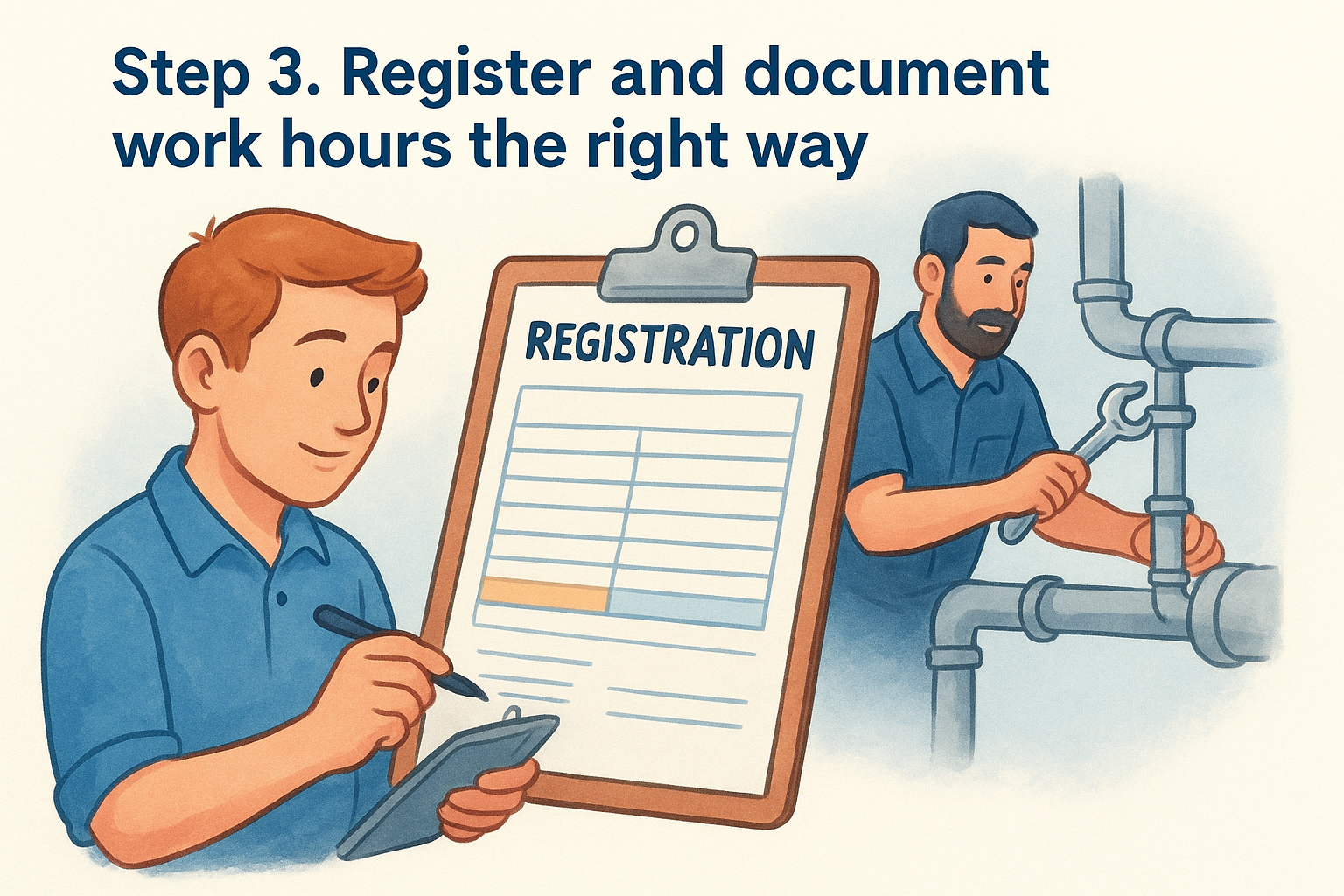
Registration establishes your official start date and creates your apprentice record in state databases. File your registration within 30 days of beginning work to ensure all subsequent hours count toward licensing requirements. Late registration often means losing credit for work you performed before your paperwork processed. Understanding how to get a plumbing license includes mastering these administrative tasks that protect your career investment.
Complete your initial apprentice registration
Your state board requires you to submit an apprentice application before you can legally work on plumbing installations. Download the current form from your licensing board’s website and complete every section. You need your Social Security number, proof of age (usually 18 or older), and high school diploma or GED certificate. Some states require you to pass a background check or drug screening before approval.
Attach your employer verification letter on company letterhead confirming your hire date and supervising plumber’s license number. Your supervisor must hold an active journeyman or master license in good standing. Pay the registration fee (typically $25 to $100) and submit everything by certified mail or through your state’s online portal. Keep copies of all submitted documents in a dedicated folder you maintain throughout your apprenticeship.
Track hours using your state’s required format
States specify exact documentation formats for logging work hours. Most require monthly or quarterly timesheets that list dates worked, hours per day, project types, and tasks performed. Your supervising plumber signs each timesheet verifying the accuracy of reported hours and confirming you worked under their direct supervision.
Detailed hour logs that break down work by project type prove you gained diverse experience across residential, commercial, and service plumbing rather than repetitive tasks on identical installations.
Create a tracking system from day one. Use this template structure:
| Date | Hours | Project Type | Tasks Performed | Supervisor Signature |
|---|---|---|---|---|
| 03/15/2026 | 8 | Residential New Construction | Roughed in bathroom drains, installed water lines | [Signature] |
| 03/16/2026 | 8 | Commercial Service | Repaired backflow preventer, cleared floor drains | [Signature] |
Download your state board’s official timesheet template and use it consistently. Never wait until exam application time to compile documentation because reconstructing years of work history from memory leads to incomplete records the board rejects.
Get proper supervisor verification
Your supervising plumber must submit periodic reports to the state board confirming your progress and skill development. These reports typically occur every six months or annually. Schedule meetings with your supervisor before deadline dates to review your logged hours and request their signature on verification forms.
Maintain professional relationships with all licensed plumbers you work under because you need their cooperation years later when applying for examinations. Keep their current contact information updated in your records since state boards verify employment by contacting supervisors directly.
Step 4. Apply for and pass the journeyman exam
Reaching the journeyman exam represents the culmination of years of documented work and structured learning. You submit your application once you’ve completed required hours (typically 8,000 to 10,000) and met your state’s educational prerequisites. Your state board reviews your documentation, verifies your supervisor’s credentials, and schedules your exam date if everything meets their standards. This step transforms you from a supervised apprentice into a licensed professional who can work independently and command higher wages.
Submit your application package
Gather every document your state board requires before starting your application. You need signed timesheet verification from all supervising plumbers, completion certificates from approved training programs, proof of apprentice registration, and payment for application fees (usually $100 to $300). Some states require you to submit original documents rather than copies, so plan accordingly and keep duplicates for your records.
Complete your application 60 to 90 days before your target exam date because board review processes take four to eight weeks. Call your state board to confirm current processing times and ask about any recent requirement changes. Missing documents or incomplete sections delay your application, pushing your exam date back by months.
States reject applications when supervising plumbers listed on timesheets cannot verify employment or when their licenses show expired or suspended status during your documented work period.
Study for the exam using these methods
Your exam covers local plumbing codes, drainage systems, water supply design, fixture installation, gas piping, and safety regulations. Allocate 12 to 16 weeks for focused preparation because journeyman exams test both theoretical knowledge and practical problem-solving. Purchase your state’s adopted code book (usually the International Plumbing Code or Uniform Plumbing Code) and tab important sections for quick reference during the open-book exam portion.
Join study groups with other apprentices preparing for the same test. Many trade schools and union halls offer exam prep courses that cost $200 to $500 and provide practice questions mirroring actual test formats. Focus your study time on areas where you have limited field experience because exam questions cover all system types regardless of what you worked on most frequently during your apprenticeship.
What to expect on exam day
Arrive 30 minutes early with your government-issued photo ID, approved calculator, and allowed reference materials. Most states administer four-hour exams containing 80 to 100 multiple-choice questions. You need to score 70% or higher to pass. Questions test code interpretation, system design principles, math calculations for pipe sizing, and troubleshooting scenarios you encounter on job sites.
Understanding how to get a plumbing license includes knowing that exam results typically arrive two to four weeks after your test date. Passing scores trigger your license issuance process. If you fail, most states allow retesting after 30 days, though you pay the full exam fee again.
Step 5. Upgrade to master plumber or contractor status
Your master plumber license represents the highest certification level most states offer and opens doors to business ownership, supervisory positions, and complex commercial projects. You become eligible after working as a licensed journeyman for two to five years, depending on your state’s requirements. This advancement significantly increases your earning potential and allows you to submit plans directly to building departments, train apprentices under your license, and operate your own plumbing contracting business without partnering with another master plumber.
Meet the experience and education requirements
States require documented journeyman experience ranging from 4,000 to 12,000 hours before you can apply for master status. You must prove you worked independently on diverse projects that exposed you to system design, complex installations, and supervisory responsibilities. Track every project where you served as lead plumber, managed helpers, or coordinated with other trades because exam boards specifically look for leadership experience.
Most jurisdictions mandate additional classroom hours focused on business management, contractor law, and advanced code interpretation. These courses cover topics like hydraulic calculations, backflow prevention system design, medical gas installations, and building department procedures that journeymen rarely encounter. Expect to complete 48 to 200 hours of approved coursework depending on your state’s standards.
Master plumber exams fail applicants who lack documented experience in commercial installations, system design, or supervisory roles even if they logged sufficient total hours as journeymen.
Prepare for the advanced examination
Your master exam tests knowledge beyond installation mechanics into system design principles, load calculations, and contractor responsibilities. Purchase the most recent edition of your state’s adopted code book along with reference materials covering commercial plumbing standards and complex drainage systems. Schedule your exam when you have dedicated study time because this test covers material you may not use daily in residential service work.
Applications require higher fees than journeyman testing (typically $200 to $500) and often include background checks verifying your business history. Submit proof of insurance coverage meeting your state’s minimum requirements, usually $300,000 to $1,000,000 in general liability protection.
Secure contractor licensing for business operation
Understanding how to get a plumbing license extends to obtaining your contractor’s license if you plan to operate a business. Many states issue separate credentials for contracting that supplement your master plumber license. You file paperwork with your state contractor licensing board, post required bonds (often $10,000 to $25,000), and prove you carry adequate liability and workers’ compensation insurance.
Your business license application includes financial statements demonstrating you can meet contractual obligations and background verification ensuring you have no disqualifying criminal convictions or previous license revocations. Processing takes 30 to 90 days before you can legally advertise plumbing services under your business name.
What it costs: fees, exams, bonds, and insurance
Financial planning matters when you map out how to get a plumbing license because costs accumulate quickly across multiple stages. You pay separate fees for apprentice registration, exam applications, license issuance, and annual renewals. Beyond basic licensing costs, business owners face additional expenses for bonding and insurance that protect clients and meet legal requirements. Total investment from apprentice registration through master licensure typically ranges from $2,000 to $8,000 depending on your state and whether you pursue contractor status.
Budget appropriately from the start because unexpected fees delay your progress. Some states charge renewal fees annually while others operate on two or three-year cycles. Your costs increase significantly if you fail exams and must retake them at full price or if you let credentials expire and face reinstatement penalties.
Application and examination fees
Your initial apprentice registration costs $25 to $150 depending on your state board’s fee structure. Journeyman exam applications range from $100 to $400, with the exam itself adding another $50 to $200. Master plumber testing runs higher at $200 to $600 for application review plus exam administration. These figures represent one-time charges, though failed exams require you to pay full testing fees again for each retake attempt.
States do not refund exam fees if you fail, miss your scheduled test date, or decide not to pursue licensing after submitting your application.
License issuance adds $50 to $300 once you pass your exam. Annual renewal fees typically cost $75 to $200 for journeymen and $100 to $300 for master plumbers. Calculate these recurring expenses into your long-term budget because working with an expired license carries serious penalties including fines and potential criminal charges.
Bonding requirements for contractors
Contractor bonds protect consumers from incomplete work or code violations. Your state mandates bonds ranging from $5,000 to $50,000 depending on your license type and whether you operate in residential or commercial markets. Annual bond premiums cost 1% to 3% of the total bond amount, so a $15,000 bond runs approximately $150 to $450 per year based on your credit score and business history.
Bonding companies evaluate your financial stability before issuing coverage. Applicants with poor credit or previous business failures pay higher premiums or face bond denials that prevent them from obtaining contractor licenses.
Insurance coverage minimums
General liability insurance protects you from property damage and injury claims. States require $300,000 to $1,000,000 in coverage depending on your license level and business structure. Annual premiums range from $800 to $3,000 for basic policies. Workers’ compensation insurance becomes mandatory once you hire employees, adding $2,000 to $10,000 annually depending on your payroll size and claims history.
Commercial auto insurance covers your work vehicles and typically costs $1,200 to $2,400 per vehicle annually. Professional liability insurance, though not always required, protects against errors in system design or code interpretation with premiums averaging $500 to $1,500 per year.
Plumbing license requirements by state for 2026
Requirements vary dramatically from state to state, making it impossible to follow a single roadmap when learning how to get a plumbing license. Texas requires 8,000 apprenticeship hours for journeyman status while Virginia mandates 8,000 hours plus 576 classroom hours. California separates licensing by specialty, issuing different credentials for residential versus commercial work. Some states like Delaware require four years of experience without specifying exact hour counts, while others measure everything in documented work hours with strict verification processes.
You cannot assume that information about one state applies to your location. Fee structures differ, exam formats vary, and reciprocity agreements exist between some states but not others. Your first step involves downloading your specific state’s current application packet and requirements document directly from the licensing board’s official website.
Core requirements that vary by jurisdiction
Apprenticeship hours represent the most significant difference between states. Minimum requirements range from 4,000 to 12,000 hours depending on where you work. Most states accept a combination of on-the-job training and classroom instruction, but the ratio between these two components differs. New York credits 144 classroom hours as 1,000 work hours, while other states count classroom time separately without substitution formulas.
Educational prerequisites create another variation point. Several states accept high school diplomas or GED certificates as sufficient education. Others mandate algebra courses or specific trade school completion before approving your apprentice registration. States like Oregon require background checks and fingerprinting while many jurisdictions skip these steps entirely.
Your state board’s website lists exact hour requirements, acceptable training programs, exam schedules, and current fees that supersede any general information you find elsewhere.
Representative state comparison
This table shows how requirements differ across a sample of states for journeyman licensing:
| State | Total Hours | Classroom Hours | Exam Format | Application Fee |
|---|---|---|---|---|
| California | 8,000 | None required | Open book, 100 questions | $200 |
| Florida | 10,000 | None required | Open book, 80 questions | $291 |
| Illinois | 8,000 | 576 | Closed book, 100 questions | $75 |
| Texas | 8,000 | None required | Open book, 100 questions | $98 |
| Washington | 8,000 | 48 per year | Open book, 120 questions | $152 |
Contact your state licensing board directly using phone numbers and addresses listed on their official government website. Staff members answer specific questions about your situation and clarify confusing requirements that generic sources cannot address accurately.
Renewals, reciprocity, and common compliance mistakes
Your plumbing license requires active maintenance through regular renewals and continuing education requirements. States suspend or revoke credentials when plumbers miss renewal deadlines, fail to complete mandatory training hours, or violate code compliance rules. Understanding how to get a plumbing license includes knowing how to keep it valid throughout your career because license lapses interrupt your ability to work legally and can damage your professional reputation with employers and clients.
License renewal deadlines and continuing education
Most states require you to renew your license every one to three years depending on their administrative cycle. Mark your renewal deadline on your calendar six months in advance because late renewals often carry penalty fees ranging from $50 to $200 on top of standard renewal costs. Some jurisdictions grant short grace periods while others immediately suspend your license the day after expiration, prohibiting you from working until you complete reinstatement procedures.
Continuing education requirements vary significantly by state. You might need to complete four to sixteen hours of approved coursework covering code updates, safety regulations, or specialized topics like backflow prevention before your renewal application gets approved. Document your course completion certificates and submit them with your renewal paperwork. States that track CE hours electronically still require you to maintain personal records proving you attended approved training sessions.
Expired licenses require you to retake portions of your original examination in many states, essentially restarting the licensing process and losing years of established credentials.
Interstate reciprocity and credential transfers
Reciprocity agreements allow you to transfer your license when relocating to another state without repeating the full apprenticeship and examination process. Your state board maintains a current list of reciprocal jurisdictions that recognize your credentials. Some states grant full reciprocity while others require you to pass a local code supplement exam testing your knowledge of their specific regulations.
Apply for reciprocal licensing before you start working in the new state because practicing without proper credentials violates both states’ laws. Submit your original state’s license verification, proof of active status, and any required examination scores. Processing takes four to twelve weeks, so plan your move accordingly.
Common compliance errors that risk your license
Plumbers lose licenses through preventable mistakes that boards consider serious violations:
Working outside your scope – Journeymen who design systems or pull permits reserved for master plumbers face disciplinary action and fines up to $5,000 per incident.
Inadequate supervision – Master plumbers who sign off on apprentice hours without providing actual oversight risk license suspension when boards investigate complaints.
Missing insurance coverage – Allowing your liability or workers’ compensation policies to lapse while actively working violates contractor licensing requirements in every state.
Unpaid renewal fees – Ignoring renewal notices because you changed addresses without updating your board records leads to automatic suspension.
Wrap it up and plan your next move
Understanding how to get a plumbing license gives you a clear roadmap from apprentice registration through master certification. You now know the hour requirements, exam preparation strategies, costs to budget for, and state-specific variations that affect your timeline. Your next action depends on where you currently stand in the licensing process.
Start by contacting your state board this week to verify current requirements and download application forms. If you’re still building hours, focus on documenting every project properly and maintaining strong relationships with your supervising plumbers. Licensed professionals ready to advance should schedule their next exam and allocate dedicated study time.
Your credentials open doors to better opportunities across the plumbing industry. Browse active plumbing positions at PlumbingJobs.com to see which roles match your current license level and where demand runs strongest in your region. Employers post apprentice openings, journeyman positions, and master plumber roles daily.
Want plumbing jobs delivered to your inbox?
Want plumbing jobs delivered to your inbox?
Partner Site

