
How Long Does It Take To Get A Plumbing License In 2026?
If you’re considering a career in plumbing or ready to advance to the next level, you’ve probably asked yourself: how long does it take to get a plumbing license? The short answer is anywhere from a few months to over a decade, depending on the license type and your state’s requirements. The longer answer involves understanding apprenticeship hours, exam prerequisites, and state-specific regulations that vary significantly across the country.
Plumbing licensure isn’t a one-size-fits-all process. An apprentice license might take just weeks to obtain in some states, while earning a master plumber credential could require 8+ years of documented experience. Each state sets its own rules for work hours, education, and testing, meaning a journeyman in Texas faces different requirements than one in California. Knowing these timelines upfront helps you plan your career path and avoid costly surprises.
At plumbingjobs.com, we connect plumbing professionals with employers across all 50 states, and we know that understanding licensing requirements is essential to landing the right position. This guide breaks down the exact timeframes for apprentice, journeyman, and master licenses, explains what factors speed up or slow down the process, and provides state-by-state insights so you can map out your path forward. Whether you’re just starting out or eyeing that master certification, you’ll find the answers you need to take your next step.
What a plumbing license lets you do
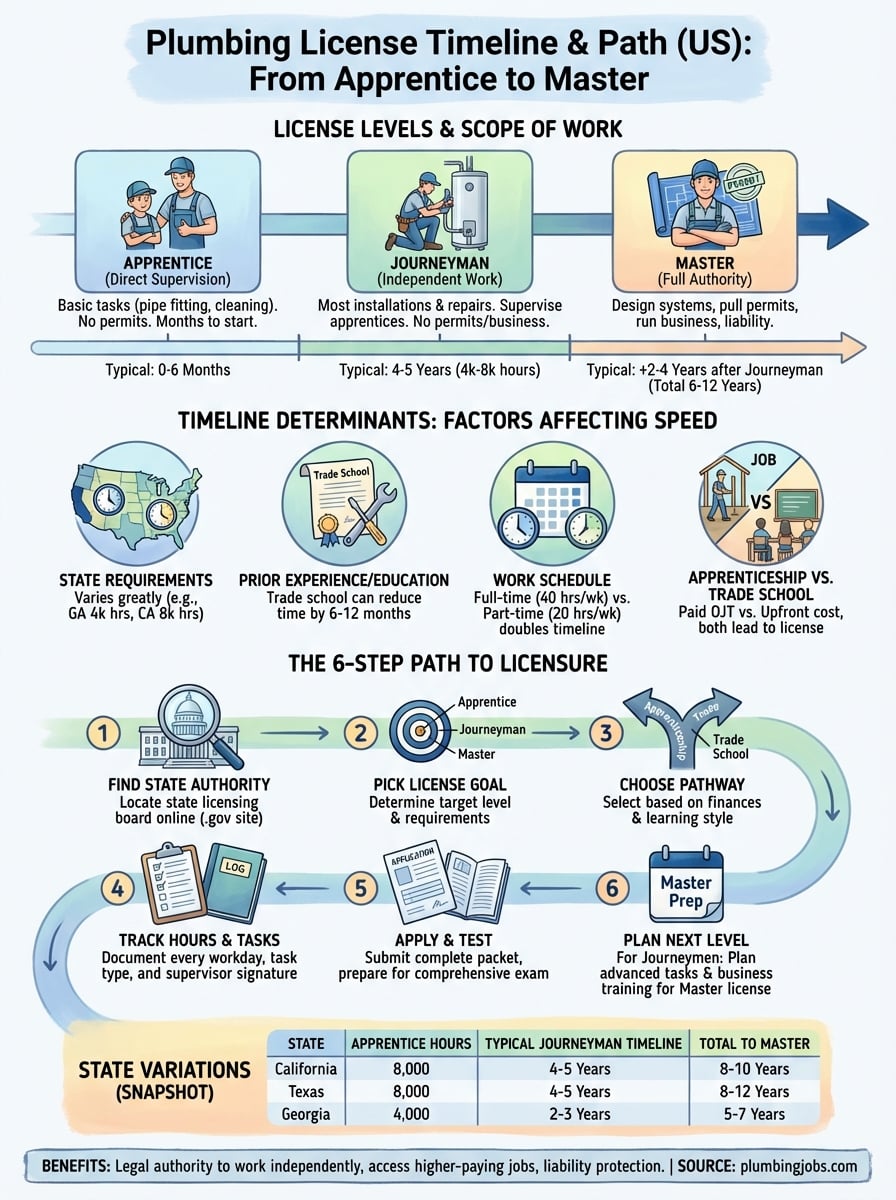
Your plumbing license acts as your legal permission to perform specific types of plumbing work in your state, and the scope of what you can do expands dramatically as you move from apprentice to journeyman to master. An apprentice license means you can work on plumbing systems only under direct supervision of a licensed professional, while a journeyman license allows you to handle most installations and repairs without oversight. Master plumbers hold the highest credential, which grants them the authority to design systems, pull permits, and operate their own contracting business.
The practical difference between license levels shows up every day on job sites. If you hold an apprentice license, you can assist with pipe fitting, drain cleaning, and fixture installation, but you cannot sign off on completed work or obtain permits from the local building department. Journeymen can work independently on residential and commercial projects, install water heaters, troubleshoot complex system failures, and supervise apprentices. Master plumbers take on the most advanced responsibilities: they review blueprints, ensure code compliance, bid on municipal contracts, and ultimately take legal responsibility for all work their company performs.
A master plumber’s signature on a permit means they accept full liability for that project meeting state and local plumbing codes.
Legal authority to work independently
Your license level determines whether you need supervision to perform plumbing tasks legally. States enforce these distinctions strictly because improper plumbing work creates health hazards through contaminated water systems or sewage backup. With an apprentice license, you must work under the continuous oversight of a licensed journeyman or master, meaning they need to be on-site or immediately available to inspect your work. This restriction limits which jobs you can take and how much employers will pay you.
Once you earn a journeyman license, you gain the right to work without direct supervision on most standard plumbing projects. You can respond to service calls alone, complete residential installations from start to finish, and sign off on your own work in many jurisdictions. However, you still cannot pull permits in your own name or operate as an independent contractor in most states. Those privileges require a master license, which gives you full autonomy to bid jobs, hire employees, and take complete legal responsibility for plumbing projects.
Access to higher-paying positions
License progression directly impacts your earning potential and job opportunities. Entry-level apprentices typically earn $15 to $20 per hour while learning the trade, but journeymen command $25 to $40 per hour depending on their location and specialization. Master plumbers working as employees often earn $50 to $75 per hour, and those running their own businesses can generate six-figure annual incomes through commercial contracts and emergency service calls.
Employers use license status as a primary hiring filter when posting positions on job boards. A commercial plumbing contractor won’t hire you for their service van fleet without at least a journeyman license because you need to handle calls independently. Government agencies and union shops often require specific license levels for particular pay grades, meaning you hit a salary ceiling until you advance your credential. Understanding how long does it take to get a plumbing license at each level helps you plan your career trajectory and set realistic income expectations.
Protection from liability and legal consequences
Working without the appropriate license exposes you to serious legal penalties including fines, criminal charges, and liability for property damage or injuries. States impose these requirements because faulty plumbing causes flooded homes, gas leaks, and contaminated drinking water. If you perform journeyman-level work with only an apprentice license, you personally face civil lawsuits and regulatory sanctions, not just your employer.
Your license also provides professional credibility that protects your reputation and career longevity. When homeowners or business owners verify your credentials through state licensing boards, they see your work history, any disciplinary actions, and your continuing education status. Licensed plumbers carry insurance more easily and qualify for bonding requirements on commercial projects. This documentation becomes essential when bidding on government contracts or working in regulated facilities like hospitals and schools where unlicensed workers cannot enter mechanical rooms.
Licensing protects both you and the public by establishing clear accountability chains for plumbing work. If a system you installed fails, your license number ties you to that project, but it also proves you met minimum competency standards. States can revoke licenses for serious code violations, but that same system prevents unqualified individuals from endangering public health through improper installations.
What determines your licensing timeline
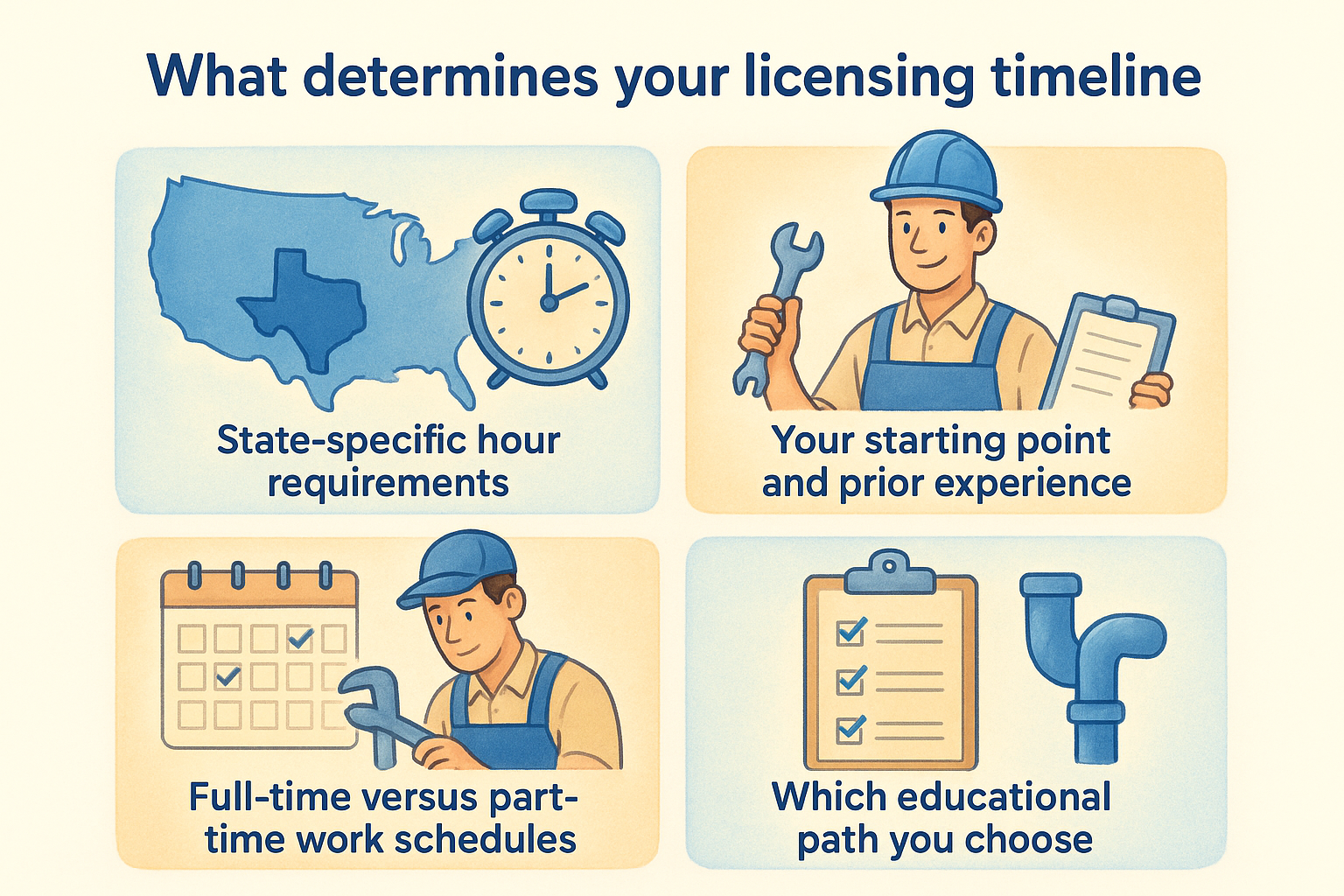
The timeline for how long does it take to get a plumbing license depends on four primary factors that you control or must navigate: your state’s specific hour requirements, your current experience level when you start, whether you work full-time or part-time, and which educational path you choose. These variables combine to create vastly different timelines for different people pursuing the same license type. A full-time apprentice in Texas with no prior experience faces a completely different timeline than a part-time apprentice in New York who already completed trade school.
State-specific hour requirements
Your state sets the minimum work hours you must complete before qualifying for each license level, and these numbers vary dramatically across the country. California requires 8,000 hours of apprenticeship work before you can take the journeyman exam, while Georgia mandates only 4,000 hours for the same credential. Some states like Florida measure experience in years rather than hours, requiring two years as an apprentice regardless of how many hours you actually work. You need to check your specific state’s requirements because assuming a national standard will derail your timeline planning.
States also differ in how they count eligible work hours. Most jurisdictions only recognize hours worked under a licensed professional, but some allow a portion of your trade school classroom time to substitute for on-the-job hours. Texas, for example, lets you apply up to 1,000 classroom hours toward your apprenticeship requirement. Understanding these nuances helps you calculate your actual timeline instead of relying on generic estimates.
Your state licensing board’s website lists the exact hour requirements for each license level, making it your most reliable source for timeline planning.
Your starting point and prior experience
You accelerate your licensing timeline significantly if you enter the trade with relevant construction experience or technical education. Trade school graduates often complete their apprenticeship 6 to 12 months faster than those who start with zero experience because they already understand pipe fitting, code basics, and tool operation. Some states grant advanced standing to military veterans with plumbing training or individuals who hold HVAC or electrical licenses.
Your credit for prior work also depends on documentation quality. States require detailed proof of your experience through contractor affidavits, pay stubs, or apprenticeship program records. Missing documentation can force you to repeat hundreds of hours you already completed, adding months or years to your timeline. Starting organized from day one protects your investment.
Full-time versus part-time work schedules
Working full-time means you accumulate required hours twice as fast as someone working part-time. If your state requires 8,000 apprenticeship hours and you work 40 hours weekly, you complete that requirement in four years. A part-time worker at 20 hours per week needs eight years to hit the same milestone. This math applies at every license level and explains why serious plumbing professionals commit to full-time positions during their apprenticeship phase.
Your work schedule also affects your exam readiness and knowledge retention. Full-time plumbers encounter diverse projects and problems daily, building practical skills faster than weekend workers. Regular exposure to code applications, tool techniques, and troubleshooting scenarios means you pass licensing exams on your first attempt instead of retaking them multiple times.
Step 1. Find your state licensing authority
Your journey to understand how long does it take to get a plumbing license starts with identifying the government agency that issues licenses in your state. This authority sets all the rules you must follow, including hour requirements, exam dates, application fees, and documentation standards. Each state operates differently, with some placing plumbing licenses under a Department of Labor while others use a dedicated Board of Plumbing Examiners or a combined Construction Industry Licensing Board. Finding the correct agency now prevents you from wasting months preparing under wrong requirements or outdated information.
Where to locate your state board online
You find your state plumbing licensing authority by searching “[Your State] plumbing license” or “[Your State] contractor licensing board” in any search engine. Most states maintain dedicated pages that explain license types, application processes, and current fee structures. Your state’s official government website uses a .gov domain, which distinguishes it from third-party sites that aggregate information but don’t control actual licensing rules.
Look for these specific details on the official site: the complete name of the licensing agency, their physical address for mailing applications, a phone number for direct questions, and downloadable application forms. California residents work with the Contractors State License Board, while Texas plumbers contact the Texas State Board of Plumbing Examiners. These agencies publish exact hour requirements for each license level, current exam schedules, and any recent rule changes that affect your timeline.
Calling your state licensing authority directly gives you answers specific to your situation that generic online guides cannot provide.
What information to verify on the official site
Once you locate your state’s licensing agency, you need to confirm four critical pieces of information that determine your timeline. First, verify the total work hours required for apprentice, journeyman, and master licenses because these numbers dictate how many years you spend at each level. Second, check whether your state allows trade school hours to substitute for on-the-job experience, which can reduce your timeline by six months to a year.
Third, identify the exam frequency and application deadlines because some states only offer licensing exams twice annually, while others test monthly. Missing an application deadline adds three to six months to your timeline. Fourth, download the actual application forms and review what documentation you need to gather now, such as high school transcripts, employer verification letters, or proof of legal work authorization. Starting this documentation process early prevents last-minute scrambles that delay your exam date when you finally meet the hour requirements.
Review your state board’s continuing education requirements as well, even if you haven’t earned your first license yet. Understanding these obligations helps you plan the long-term costs and time commitments of maintaining your license once you obtain it.
Step 2. Pick your license level goal
You need to decide which license level you’re working toward before you start accumulating hours because each tier requires different preparation strategies and timeline commitments. Most plumbers advance through all three levels over their career, but your immediate goal determines which applications you file, which exams you study for, and how you track your work experience. Setting the wrong initial goal wastes time on documentation that doesn’t count toward your actual target license.
Understanding the three license tiers
The apprentice license serves as your entry point into legal plumbing work and requires minimal experience in most states. You typically need a high school diploma or GED, pass a background check, and register with your state board or an approved apprenticeship program. Some states issue apprentice licenses within 2 to 4 weeks of application, while others process them the same day you register with a licensed contractor who agrees to supervise you. This license expires if you stop working under supervision or fail to document your hours properly.
Your journeyman license represents full professional competency and requires 4,000 to 8,000 documented work hours depending on your state. Most plumbers reach this level after 4 to 5 years of full-time apprenticeship work, though part-time workers need 8 to 10 years to accumulate the same hours. You must pass a comprehensive exam covering code knowledge, system design, and troubleshooting before receiving this credential. Journeyman status qualifies you for independent work on most projects but prevents you from pulling permits or operating a contracting business in your own name.
The master license grants you complete professional authority and demands 2 to 4 additional years beyond journeyman status. States require 6,000 to 12,000 total career hours and a passing score on an advanced exam covering system design, code interpretation, and business law. Master plumbers who work full-time from apprentice to master typically invest 8 to 12 years total before earning this highest credential. This timeline explains how long does it take to get a plumbing license at the peak level of the profession.
Your license level goal determines which exam prep materials you buy, which continuing education courses you take, and which job opportunities you qualify for at each stage.
Mapping your career timeline
Create a written timeline that plots each license milestone against your current situation and work schedule. If you work full-time at 40 hours weekly and your state requires 8,000 apprentice hours, you complete that phase in 4 years (8,000 hours ÷ 2,080 annual work hours). Add 6 months for exam preparation and administrative processing, bringing your realistic journeyman timeline to 4.5 years from your start date.
Calculate the same way for master status by adding your state’s journeyman-to-master hour requirement. A state demanding 4,000 additional hours means another 2 years of full-time work plus exam prep. Your total investment from apprentice registration to master license spans 6.5 to 7 years under this scenario.
Step 3. Choose apprenticeship or trade school
You face a critical decision that directly affects how long does it take to get a plumbing license: whether to start working immediately as an apprentice or spend time in formal trade school education first. Both paths lead to the same licenses, but they offer different timelines, costs, and learning styles that match different personal situations. An apprenticeship throws you into paid work from day one, while trade school front-loads theoretical knowledge before you touch real plumbing systems.

The apprenticeship route
You enter an apprenticeship by finding a licensed plumber or contractor willing to hire and supervise you while you learn on the job. This path costs you nothing beyond licensing fees and tool purchases because you earn a paycheck from your first day. Most apprentices start at $15 to $20 per hour while working 40 hours weekly, which means you support yourself financially while accumulating the required experience hours. Your learning comes from direct exposure to residential service calls, commercial installations, and emergency repairs rather than classroom lectures.
Apprenticeships require you to find your own placement, which can take weeks or months depending on your local job market and networking connections. Union apprenticeship programs offer structured placements but have competitive application processes with entrance exams and waiting lists. Non-union positions open up faster through direct contact with plumbing contractors who need entry-level help. You progress at whatever pace your employer’s project schedule allows, meaning some weeks you work on diverse systems while others you repeat the same basic tasks.
Apprentices who document every task and system type they work on build stronger license applications and pass exams more easily than those who just track total hours.
The trade school path
Trade school programs compress plumbing theory and code knowledge into 6 to 24 months of full-time study, giving you a foundation before you start your apprenticeship hours. You pay tuition ranging from $3,000 to $15,000 depending on program length and location, but many states let you substitute classroom hours for up to 1,000 on-the-job hours. This substitution reduces your total apprenticeship timeline and helps you enter the workforce with proven technical knowledge that employers value.
Programs teach you pipe materials, code interpretation, blueprint reading, and system design through hands-on lab work with real fixtures and tools. You graduate with a certificate or diploma that makes you more attractive to contractors hiring apprentices, often securing higher starting wages than apprentices with no formal education. Technical schools also provide job placement assistance and industry connections that speed up your transition from student to working apprentice.
How to decide which path fits your situation
Your financial situation determines much of this decision because trade school requires upfront tuition payment while apprenticeships generate immediate income. If you cannot afford to stop earning money for 6 to 24 months, direct apprenticeship makes more sense despite the potentially longer timeline. However, if you qualify for financial aid, veterans benefits, or family support, trade school accelerates your knowledge base and can reduce your total time to journeyman status by a year or more.
Consider these factors when making your choice:
| Factor | Direct Apprenticeship | Trade School First |
|---|---|---|
| Immediate income | Yes, $15-$20/hour | No, must pay tuition |
| Learning style | Hands-on, job-site based | Structured classroom + lab |
| Timeline to journeyman | 4-5 years full-time | 3.5-4.5 years with hour credit |
| Upfront cost | Minimal (tools, fees) | $3,000-$15,000 |
| Job placement difficulty | Self-directed search | School assistance provided |
Your local job market also matters because some areas have abundant apprenticeship openings while others require extensive networking or union connections. Research contractors in your city and ask which credential they prefer when hiring entry-level workers.
Step 4. Track required hours and job tasks
You need a systematic tracking method from your first day on the job because states reject license applications with incomplete or poorly documented experience records. Most licensing boards require detailed logs showing not just total hours but also the specific types of plumbing work you performed, the systems you installed or repaired, and verification signatures from your supervising licensed plumber. Waiting until you near your hour requirement to organize this documentation means you’ll spend months reconstructing records that should take minutes to maintain daily.
Your tracking system directly impacts how long does it take to get a plumbing license because missing or disputed hours force you to work additional months to meet minimum requirements. States audit experience claims randomly, and they disqualify any hours you cannot prove through pay stubs, contractor affidavits, or approved program records. Building strong documentation habits now protects years of your career investment.
Create your daily work log template
You document your experience by recording every workday in a consistent format that captures the information your state board demands. Most states require you to track the date worked, total hours, job location, type of work performed, and the license number of your supervisor. Create a spreadsheet or use a dedicated apprentice tracking app that lets you enter this data within 24 hours while details remain fresh in your memory.
Use this template structure for daily entries:
| Date | Hours | Job Type | Tasks Performed | Systems/Materials | Supervisor License # |
|---|---|---|---|---|---|
| 2026-02-08 | 8 | Residential service | Replaced water heater, cleared main line stoppage | Gas/electric water heater, copper pipe, cable machine | PL-12345 |
| 2026-02-09 | 10 | Commercial rough-in | Installed drain lines for restaurant kitchen | PVC Schedule 40, cast iron, grease trap | PL-12345 |
Track specific details beyond generic descriptions because states verify that you gained diverse experience across multiple system types. Writing “plumbing work” for every entry raises red flags during application review, while detailed task lists prove you handled the full scope of required competencies.
Your daily log becomes your legal proof of experience when you apply for journeyman or master status, making it the most important document in your career file.
Document task categories your state requires
States divide plumbing work into mandatory experience categories that you must demonstrate competency in before qualifying for higher licenses. California, for example, requires documented experience in water supply systems, drainage systems, medical gas, and irrigation. Review your state board’s category list and create a master checklist that tracks how many hours you’ve logged in each area.
Mark off categories monthly to identify gaps in your experience before they become problems. If you’ve worked 2,000 hours but spent all of it on residential service calls, you lack the commercial and industrial exposure many states demand. Speak with your employer about rotating through different project types to fill these gaps while you still have time.
Secure employer signatures every month
You protect your accumulated hours by getting written verification from your supervising plumber monthly rather than waiting years to collect signatures. Contractors close businesses, move out of state, or lose track of old employees, making it impossible to verify your hours retroactively. Print monthly summaries of your work log and have your supervisor sign and date them, then scan these documents into multiple backup locations including cloud storage.
Step 5. Apply, test, and get your first license
You reach the final stages of understanding how long does it take to get a plumbing license when you submit your application, prepare for the exam, and receive your credential. This phase typically takes 2 to 6 months depending on your state’s processing speed, exam schedule, and how thoroughly you prepare. States verify every detail of your application before approving you to test, so incomplete submissions get rejected and restart the entire approval cycle. Planning this phase carefully prevents unnecessary delays after you’ve already invested years accumulating experience hours.
Submitting your complete application packet
You gather all required documents before starting your application because missing items trigger rejection letters that add 4 to 8 weeks to your timeline. Most states require your completed application form, documented work hours with supervisor signatures, proof of apprenticeship completion or trade school graduation, government-issued identification, and application fees ranging from $50 to $300. Some states also demand background check results, passport photos, and notarized affidavits from employers verifying your experience.
Create a checklist from your state board’s requirements and mark off each item as you collect it:
- Completed application form with original signatures
- Official transcripts from trade school (if applicable)
- Detailed work log with 4,000+ documented hours
- Supervisor verification letters on company letterhead
- Copy of high school diploma or GED
- Application fee (check or money order, verify accepted payment methods)
- Two passport-style photos
- Background check clearance certificate
Mail your application via certified mail with return receipt so you have proof of submission and delivery dates. States process applications in the order received, and tracking your submission protects your place in line.
Your application approval triggers your exam authorization letter, which lists your testing window and scheduling instructions.
Preparing for your licensing exam
You need 3 to 4 months of focused study to pass most state journeyman exams on your first attempt, though this varies by your learning style and daily study time commitment. Purchase your state’s recommended code books and exam prep guides from the licensing board’s approved vendor list. Focus your study on code interpretation, system design calculations, and troubleshooting scenarios that appear repeatedly on standardized plumbing exams.
Set a daily study schedule of 1 to 2 hours minimum covering one code section per week. Practice with sample questions and timed practice exams to build speed and confidence.
Receiving your official license
States mail your physical license 2 to 4 weeks after passing your exam, though some offer digital credentials immediately. Register your license with your current employer and begin tracking hours toward your next credential level the day you receive it.
Step 6. Plan the journeyman to master timeline
You begin planning your master license timeline the day you receive your journeyman credential because this final phase requires 2 to 4 additional years of documented experience and demands the most rigorous exam preparation in your plumbing career. Understanding how long does it take to get a plumbing license at the master level helps you make strategic decisions about when to start your own business, which advanced projects to pursue, and how to balance continuing education with full-time work. Your journeyman-to-master period differs from apprenticeship because you work independently while tracking specific high-level competencies that prove you can design systems, supervise other plumbers, and take full legal responsibility for complex installations.
Calculate your additional hour requirement
You need to identify your state’s exact journeyman-to-master hour requirement and whether those hours must include specific advanced tasks like system design review, permit applications, or supervision of other licensed plumbers. Most states demand 4,000 to 6,000 additional hours beyond your journeyman total, which translates to 2 to 3 years of full-time work. Some jurisdictions require proof that you supervised at least two apprentices or journeymen during this period, meaning you cannot advance unless your employer assigns you leadership responsibilities.
Create a tracking system that captures these advanced competencies:
| Required Master-Level Task | Hours Needed | Hours Completed | Documentation |
|---|---|---|---|
| System design and blueprint review | 500 | 0 | Engineer sign-off required |
| Permit applications and inspections | 300 | 0 | Copy of permits pulled |
| Supervision of licensed plumbers | 1,000 | 0 | Contractor affidavit |
| Commercial/industrial installations | 1,500 | 0 | Project completion certificates |
| Code compliance audits | 200 | 0 | Inspection reports |
Your master license application gets rejected if you cannot prove you performed supervisory and design work, not just additional installation hours.
Set your master exam preparation schedule
You commit to 6 to 9 months of intensive study for the master exam because it covers advanced hydraulics, business law, contractor regulations, and complex code scenarios that journeyman exams never address. Start your exam prep 12 months before you meet the hour requirement so you can take the test immediately after your application approval. Purchase the most recent editions of your state’s adopted plumbing code, the International Plumbing Code, and master exam prep guides that include practice questions on system design calculations.
Allocate study time differently than you did for journeyman preparation by spending 40% of your time on business and contractor law topics including insurance requirements, lien rights, and contract disputes. Master exams test your ability to operate a legal contracting business, not just install pipes correctly.
Factor in business and code training
Your state likely requires you to complete continuing education courses in business management, safety supervision, and advanced code updates before approving your master application. Budget 40 to 60 classroom hours spread across your journeyman period for these mandatory courses, which typically cost $200 to $500 total. Many contractors pay these fees for valued journeymen they plan to promote, so negotiate this benefit during your annual review. Track certificate completion dates carefully because expired course credits force you to retake classes that delay your application by months.
State-by-state timeline snapshots for 2026
Your timeline for how long does it take to get a plumbing license changes dramatically based on where you live and work. Each state sets its own hour requirements, exam schedules, and experience documentation rules that can add or subtract years from your career progression. Understanding these specific state differences helps you decide whether to pursue licensure in your current location or relocate to a state with faster pathways and better reciprocity agreements. Some states let you reach journeyman status in just 3 years, while others demand 6 or more years before you qualify to test.
Quick reference comparison table
You can compare major state requirements using this snapshot that shows apprentice-to-journeyman timelines, total hours needed, and typical master requirements for states with the largest plumbing workforces. These figures represent minimum requirements under ideal conditions where you work full-time and document every hour correctly. Your actual timeline extends longer if you work part-time, change employers frequently, or fail exams on first attempts.
| State | Apprentice Hours | Journeyman Timeline | Total to Master | Key Requirement |
|---|---|---|---|---|
| California | 8,000 | 4-5 years | 8-10 years | Certified apprenticeship program required |
| Texas | 8,000 | 4-5 years | 8-12 years | 4 years as journeyman minimum |
| Florida | 4 years (not hours) | 4-5 years | 7-9 years | 1 year master plumber supervision |
| New York | 5 years | 5-6 years | 10-12 years | NYC requires separate license |
| Georgia | 4,000 | 2-3 years | 5-7 years | Fastest pathway for full-time workers |
| Illinois | 8,000 | 4-5 years | 8-10 years | Chicago has separate city requirements |
States that measure experience in years rather than hours give you more flexibility in work schedules but make it harder to accelerate your timeline through overtime.
Regional timeline patterns
Southern and Southwestern states typically require fewer total hours and shorter experience periods than Northeastern and Western states, creating a 2 to 3 year difference in journeyman timelines. Georgia, Arizona, and Nevada let you reach journeyman status with 4,000 to 5,000 hours, while California, Massachusetts, and Oregon demand 8,000 hours or more. This pattern reflects different construction markets and union influence, with heavily unionized states imposing longer apprenticeship periods to maintain wage standards and limit competition.
Your location choice affects more than just speed because some states offer reciprocity agreements that let you transfer licenses across state lines. Journeymen licensed in states with higher hour requirements often qualify for automatic licensure in states with lower standards, but the reverse rarely works. Research reciprocity rules before committing to a long apprenticeship in a state you might leave.
Documentation and processing speeds
State processing times for license applications vary from 2 weeks to 6 months depending on staff levels and application volume. Arizona and Texas process most applications within 30 days, while California and New York average 90 to 120 days for initial review. Factor this administrative delay into your career timeline when planning your exam date and job transitions.
Next steps to take now
You now understand how long does it take to get a plumbing license depends on your state’s requirements, your work schedule, and which license level you target. Your next move is to contact your state licensing board today and request their current application packet, hour requirement sheet, and exam schedule. Create your documentation system this week so you start tracking hours correctly from day one, not months into your apprenticeship when you’ve already lost valuable records.
Start building your professional network immediately by joining local plumbing associations, attending trade shows, and connecting with licensed contractors who hire apprentices. If you need employment opportunities while pursuing your license, explore our comprehensive resources at PlumbingJobs.com where you’ll find industry insights, licensing updates, and connections to employers across all 50 states. Set calendar reminders for your exam application deadlines now, budget for your application fees and study materials, and commit to the timeline you mapped out using this guide.
Want plumbing jobs delivered to your inbox?
Want plumbing jobs delivered to your inbox?
Partner Site

