
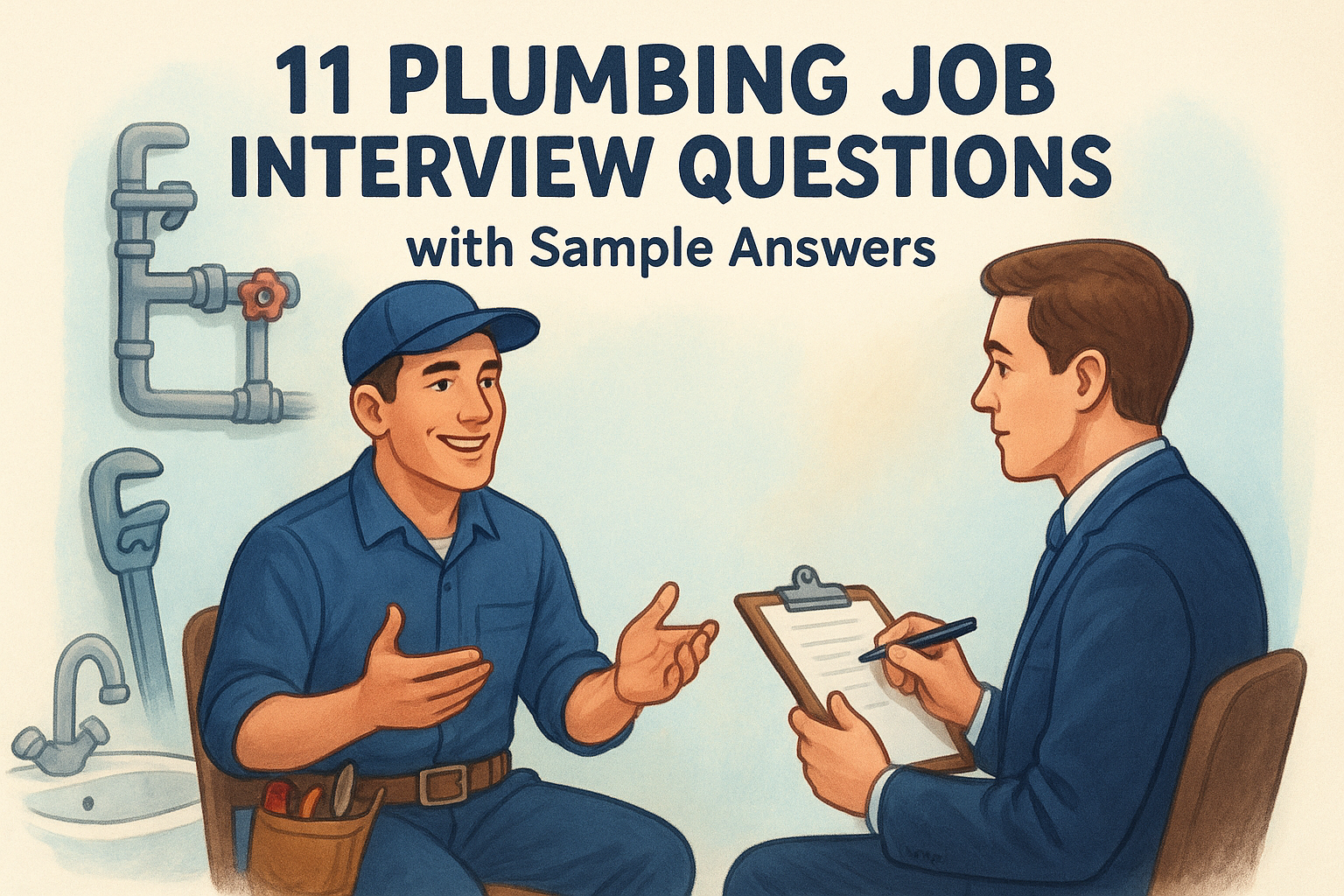
11 Plumbing Job Interview Questions (With Sample Answers)
Whether you’re a candidate walking into your first shop interview or a seasoned journeyman eyeing a better position, preparing for plumbing job interview questions ahead of time gives you a real edge. Hiring managers in this trade aren’t just checking credentials, they want to know you can think on your feet when a job goes sideways. And if you’re on the employer side, asking the right questions is the fastest way to separate qualified plumbers from those who just look good on paper.
At plumbingjobs, we connect plumbing professionals with employers across the United States every day. That gives us a front-row seat to what hiring managers actually ask and what answers make candidates stand out. We used that insight to put together this list of 11 common interview questions, complete with sample answers you can adapt to your own experience and skill level.
1. How did you hear about this plumbing job?
This question opens nearly every interview, and most candidates treat it as small talk. It isn’t. Your answer tells the hiring manager how engaged you are with the industry and whether you’re actively pursuing this specific opportunity or just mass-applying to anything available.
What the interviewer wants to learn
The interviewer is checking two things: how you found the role and how seriously you’ve researched the company. A candidate who found the job through a targeted plumbing job board signals focus. One who says “I don’t remember, I applied to a lot of places” signals the opposite. They also want to know if someone inside the company referred you, which carries its own weight.
How to answer in a way that stands out
Be specific. Name the exact source where you found the listing, whether that’s a trade-specific job board, a referral from a coworker, or a local union posting. Then connect it to why you applied to this company in particular. Mention something concrete you know about them, such as the type of work they do, their service area, or their reputation in the local market.
Showing that you did your homework before the interview tells the employer you’ll do your homework before a job too.
Sample answer
“I found the listing on PlumbingJobs.com while I was specifically looking for service technician roles in this area. After I saw your posting, I looked up your company and noticed you focus on commercial work, which is the direction I want to take my career. That’s what made me apply here first.”
Common mistakes to avoid
Don’t say you don’t remember where you found the job. Vague answers here make you look unorganized. Also avoid over-explaining your entire job search history. Keep it short, direct, and connected to this specific role and company.
Good questions to ask them back
Use this early moment to show genuine interest. Try: “How do most of your hires typically find you, through referrals or job postings?” This gives you useful insight into their hiring culture and signals that you’re curious about how the team is built.
2. What plumbing license and certifications do you hold?
Licensing questions are among the most straightforward plumbing job interview questions you’ll face, but your answer does more than confirm your credentials. It tells the employer how seriously you take compliance and whether you’re ready to work without extra onboarding delays.
What the interviewer wants to learn
The hiring manager needs to confirm you’re legally qualified to work in their state. Most states require at minimum a journeyman or master plumber license, and some roles demand additional certifications such as backflow prevention or gas line work. They’re also checking whether your license level matches the position’s requirements before they invest more time in the process.
How to answer in a way that stands out
List your licenses clearly and include the issuing state and current status. If you hold certifications beyond the baseline, name them specifically. Employers notice candidates who have invested in additional credentials beyond the minimum, because it signals initiative and long-term thinking.
Bringing physical or digital copies of your licenses to the interview removes any doubt and speeds up the hiring process.
Sample answer
“I hold a journeyman plumber license in Texas, and I’m currently working toward my master’s license. I also have a backflow prevention certification, which has come up regularly on commercial projects.”
Common mistakes to avoid
Don’t list licenses you no longer hold or that have lapsed without renewal. Employers verify credentials directly, and any inconsistency between your resume and reality damages your credibility quickly.
Good questions to ask them back
Ask: “Which certifications do your top technicians typically hold?” This shows you’re already thinking about growth within the role from day one.
3. Walk me through your training and experience
This open-ended prompt is one of the most common plumbing job interview questions you’ll face, and it gives you more control than almost any other question in the interview. How you structure your answer tells the hiring manager whether you can communicate clearly under pressure, which matters just as much on a job site as in a conference room.
What the interviewer wants to learn
The interviewer wants a clear picture of your career path, from how you started in the trade to where you are now. They’re listening for the types of systems you’ve worked on, the environments you’ve worked in (residential, commercial, industrial), and whether your background matches the demands of the role they’re filling.
How to answer in a way that stands out
Walk through your experience in chronological order, starting with your apprenticeship or trade school and moving forward. For each stage, name the specific type of work you performed rather than just the job title. Focus on the skills that are most relevant to this specific position.
The more concrete details you include, the easier it is for the hiring manager to picture you on their jobs.
Sample answer
“I completed a four-year apprenticeship through a local JATC program, where I focused mostly on new construction. After that, I spent three years doing commercial tenant build-outs, which gave me strong experience reading blueprints and coordinating with other trades on tight schedules.”
Common mistakes to avoid
Don’t recite your resume line by line. Rambling through job titles without connecting them to real skills wastes the interviewer’s time and weakens your impression.
Good questions to ask them back
Ask: “What type of work makes up most of the day-to-day for this role?” This confirms whether your background is the right fit.
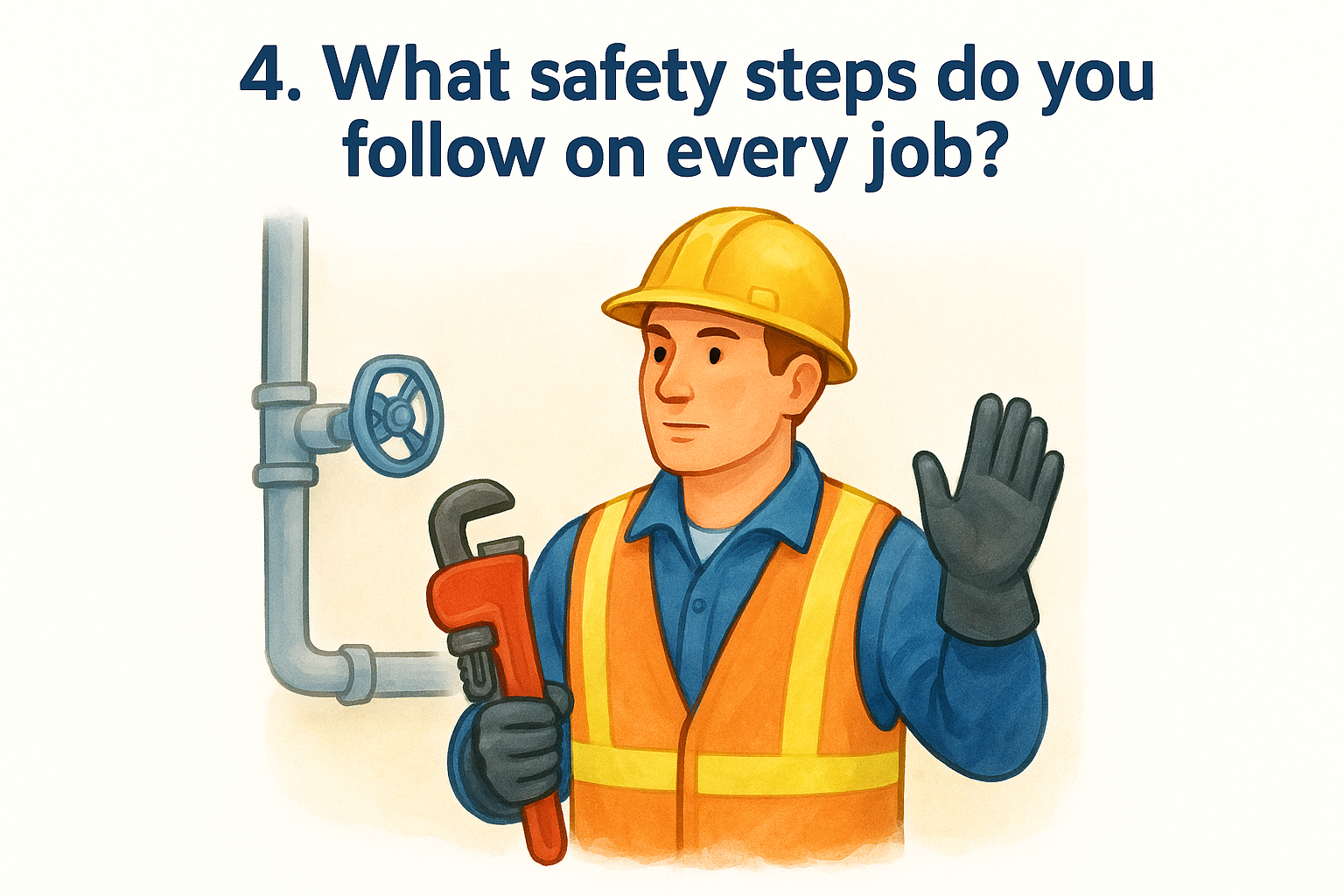
4. What safety steps do you follow on every job?
Safety questions show up in nearly every list of plumbing job interview questions because a single overlooked hazard can shut down a job site, injure a crew member, or expose the company to serious liability. Your answer here carries real weight with hiring managers.
What the interviewer wants to learn
The interviewer wants to know that safety is a habit for you, not something you think about only when a supervisor is watching. They’re also checking whether you understand the specific hazards of plumbing work, including exposure to sewage, hot water systems, confined spaces, and pressurized lines.
How to answer in a way that stands out
Walk through your actual pre-job routine rather than reciting a generic list of safety rules. Mention the specific PPE you use, how you communicate hazards to others on site, and how you handle situations where safety shortcuts are being pressured.
Employers want to hire people who protect their crew and their company without needing to be reminded to do it.
Sample answer
“Before I start any job, I check for gas lines and water shutoffs, confirm proper PPE is on hand, and make sure I understand the scope of the work. On confined space jobs, I follow lockout/tagout procedures and confirm ventilation before entering.”
Common mistakes to avoid
Don’t give a vague answer like “I follow all safety protocols.” That tells the interviewer nothing. Also avoid leaving out specific examples, since general statements without details come across as rehearsed and hollow.
Good questions to ask them back
Ask: “How does your team handle safety reporting when someone spots a hazard mid-job?” This shows you already think about safety as a shared responsibility.
5. A customer complains about low water pressure. What do you do?
Scenario-based questions like this are a staple of plumbing job interview questions because they reveal how you think through a problem in real time. The hiring manager isn’t looking for a perfect textbook answer; they want to see your diagnostic process in action.
What the interviewer wants to learn
This question tests whether you can isolate a problem systematically rather than jumping straight to a fix. Employers want to know you understand that low water pressure has multiple causes, from clogged aerators to a failing pressure regulator, and that you ask the right questions before picking up a wrench.
How to answer in a way that stands out
Walk the interviewer through your step-by-step diagnostic process. Start with what you’d ask the customer, then explain how you narrow down the cause. Show that you distinguish between a single-fixture issue and a whole-house problem before you touch anything.
Employers hire plumbers who solve the right problem, not just the first one they find.
Sample answer
“First, I’d ask the customer whether the low pressure is isolated to one fixture or affecting the whole house. If it’s one fixture, I’d check the aerator or shutoff valve. If it’s whole-house, I’d check the pressure regulator and main shutoff, then test at the meter.”
Common mistakes to avoid
Don’t skip the diagnostic questions and jump straight to a solution. Guessing without gathering information first signals poor judgment and can lead to unnecessary repairs that damage your credibility with the customer.
Good questions to ask them back
Ask: “What pressure-related issues does your crew run into most often?” This shows you’re already thinking about the specific challenges of the role before you’ve even started.
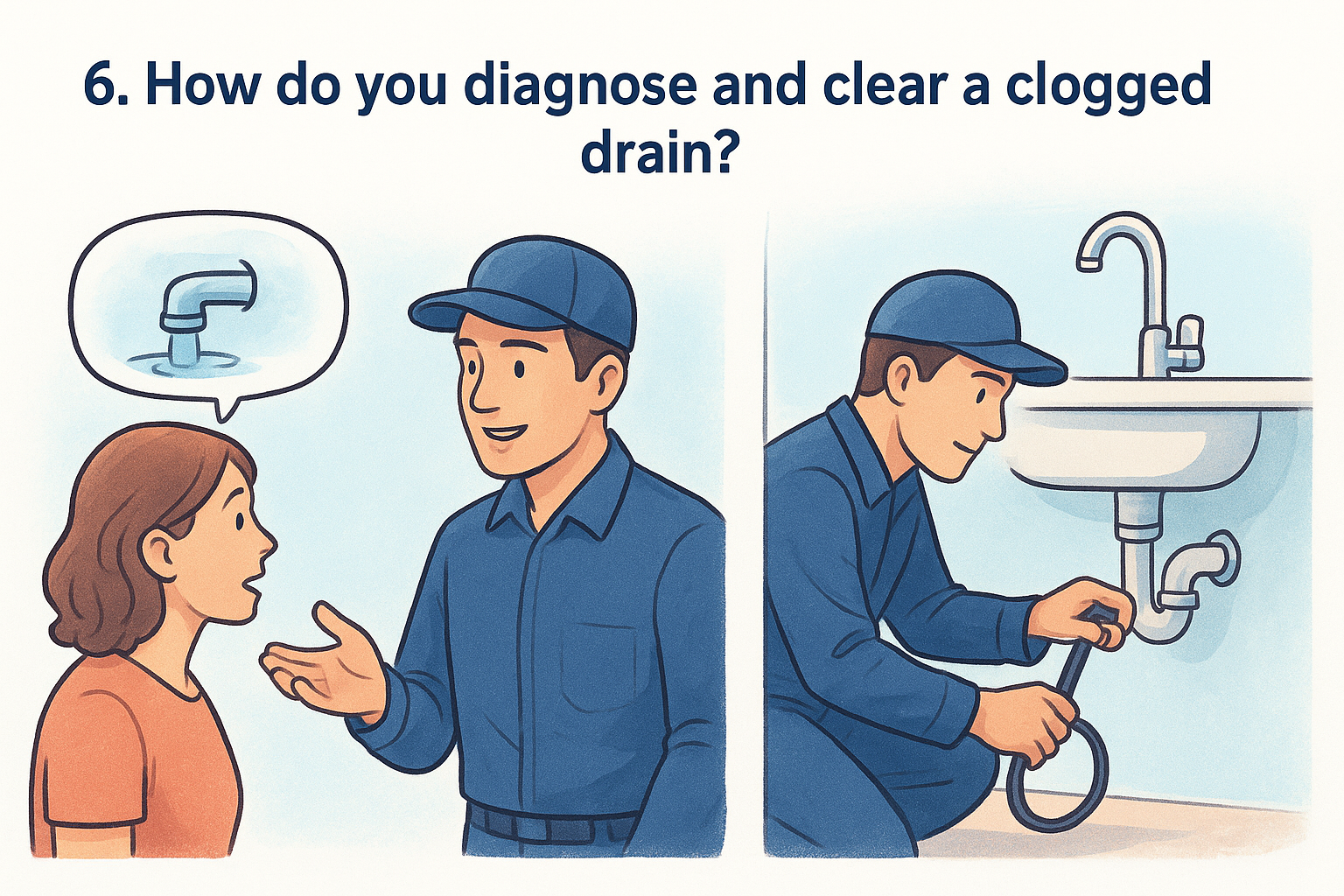
6. How do you diagnose and clear a clogged drain?
Drain clogs are one of the most common service calls in the trade, which is why this question appears on so many plumbing job interview questions lists. Interviewers use it to test both your technical knowledge and your systematic approach before you commit to a method.
What the interviewer wants to learn
The interviewer wants to see that you assess the situation before you act. They’re checking whether you understand the difference between a localized clog and a main line blockage, and whether you select your tools based on what the job actually requires rather than habit.
How to answer in a way that stands out
Walk through your process from the customer conversation to the fix. Start by asking what’s draining slowly and where, then explain how you determine the location and severity of the blockage before choosing a tool.
Describing a clear sequence shows the interviewer you bring discipline to a job that can quickly get complicated.
Sample answer
“I ask the customer which drains are affected to rule out a main line issue. Then I do a visual inspection, check the cleanout, and decide whether a hand auger or a drum machine is the right tool. If I suspect a deeper blockage, I’ll run a camera before I snake it.”
Common mistakes to avoid
Don’t jump straight to using a snake on every clog without assessing the situation first. Skipping that diagnostic step can damage older pipes or miss a bigger underlying problem entirely.
Good questions to ask them back
Ask: “What equipment does your crew typically use for drain work, and do you use cameras regularly?” This shows you care about working with the right tools rather than just getting through the call.
7. How do you test a plumbing system for leaks?
Leak testing is a core competency that comes up in plumbing job interview questions for good reason. A missed leak can cause thousands of dollars in water damage, which means hiring managers want to confirm you have a reliable, systematic approach before you sign off on any job.
What the interviewer wants to learn
The interviewer wants to know whether you understand the different testing methods available and when to apply each one. They’re checking that you can identify leaks through pressure testing, visual inspection, and dye testing rather than relying on guesswork or waiting for a callback from a frustrated customer.
How to answer in a way that stands out
Walk through the specific methods you use and explain your reasoning for choosing one over another. Mention how you document your results and communicate findings to the customer or general contractor before closing out the job.
Showing that you verify your work before you leave a job site tells employers you take full ownership of your results.
Sample answer
“I start with a pressure test on new installations, typically holding the system at 150 PSI for at least 15 minutes while I monitor gauges and inspect fittings. On existing systems, I use a combination of visual inspection and dye tablets when I suspect a slow or hidden leak.”
Common mistakes to avoid
Don’t say you rely solely on visual checks. Skipping pressure tests on new or repaired systems leaves real risk on the table and reflects poorly on your overall attention to detail.
Good questions to ask them back
Ask: “What does your sign-off process look like before a technician closes out a job?” This signals you take quality control seriously from the start.
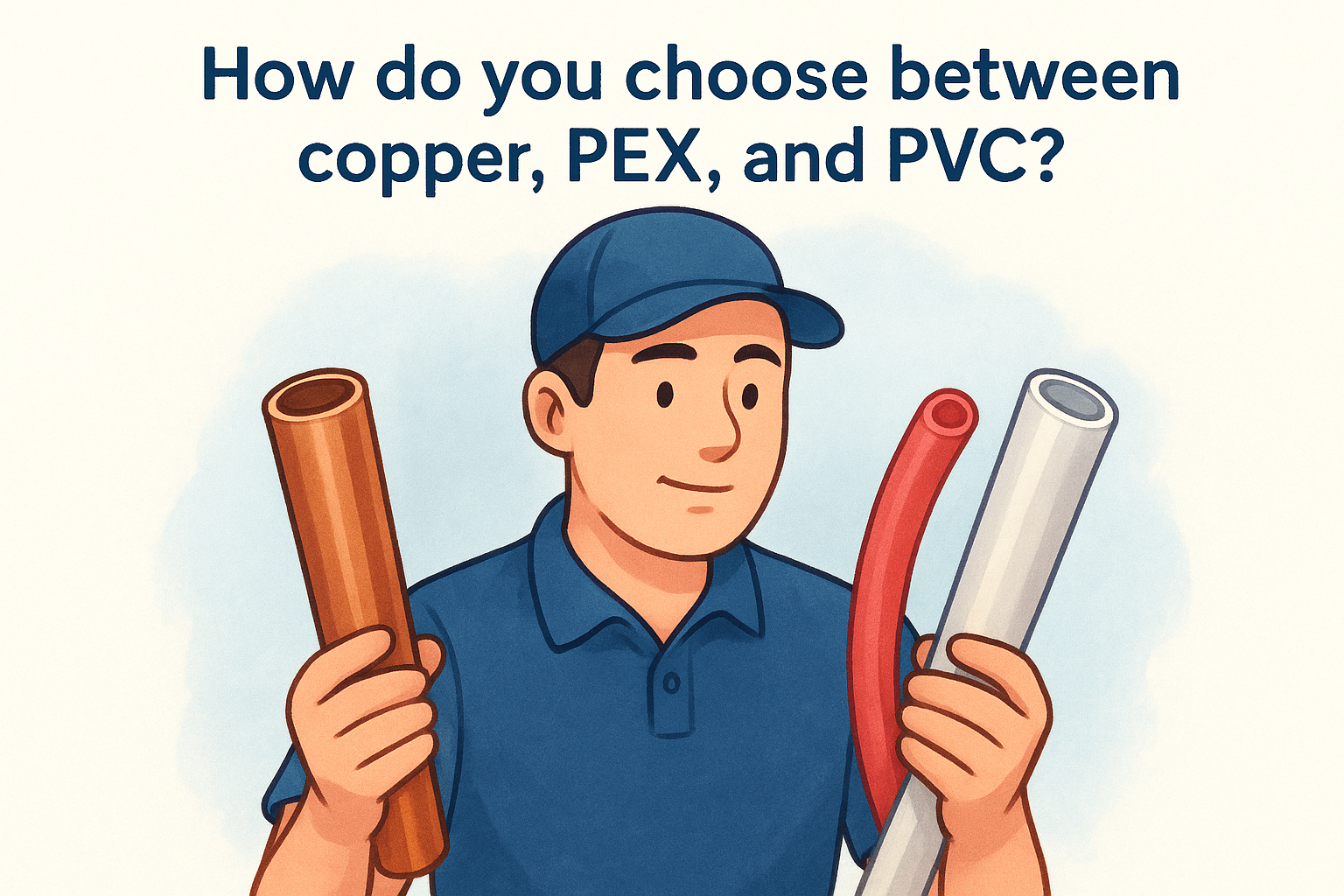
8. How do you choose between copper, PEX, and PVC?
Material selection questions are a reliable fixture in plumbing job interview questions because they test whether you understand the trade-offs between cost, durability, and application before you start a job. The right answer depends on the situation, and that’s exactly what the interviewer wants to hear.
What the interviewer wants to learn
The hiring manager wants to know you can make informed material decisions without needing someone to tell you which pipe to grab. They’re checking whether you understand the strengths and limitations of each material across different environments, budgets, and local code requirements.
How to answer in a way that stands out
Walk through the key factors you weigh when choosing a material: the application type, local code requirements, the environment the pipe will run through, and budget constraints. Showing that your choice is always driven by the job’s specific conditions rather than personal habit tells the interviewer you think like a professional.
The best plumbers pick the right material for the job, not the one they’re most comfortable with.
Sample answer
“I default to copper for high-heat applications and where long-term durability is the priority. I use PEX in residential remodels where flexibility and freeze resistance matter. PVC is my go-to for drain lines and low-pressure cold water runs where cost efficiency makes sense.”
Common mistakes to avoid
Don’t say you always use one material regardless of the situation. That answer signals you’re not adapting to job conditions, which raises real concerns about your judgment on site.
Good questions to ask them back
Ask: “Does your company have preferred materials for standard installs, or do you let technicians make those calls based on the job?” This shows you’re ready to work within their established workflow from day one.
9. Tell me about a time you handled an upset customer
Behavioral questions like this are common in plumbing job interview questions because customer service is part of the job whether you like it or not. How you respond tells the hiring manager whether you can keep a situation from escalating while still getting the work done.
What the interviewer wants to learn
The interviewer wants evidence that you can manage conflict professionally without making the company look bad. They’re listening for how you stayed calm, what steps you took to resolve the issue, and whether the customer left satisfied.
How to answer in a way that stands out
Use a specific real example and walk through it using a simple structure: what happened, what you did, and what the outcome was. Focus on your actions, not the customer’s behavior. Showing that you took ownership of the situation without pointing fingers tells the interviewer exactly what they need to hear.
Employers want technicians who protect the company’s reputation on every job, not just the easy ones.
Sample answer
“A customer called upset because a repair I completed the day before had started leaking overnight. I went back the same day, found a fitting I hadn’t fully seated, fixed it at no charge, and walked her through what caused it. She called the office afterward to say she appreciated how I handled it.”
Common mistakes to avoid
Don’t say you’ve never dealt with an upset customer or that you always hand difficult customers off to a manager. Both answers suggest you avoid accountability rather than face it.
Good questions to ask them back
Ask: “How does your team typically handle customer callbacks when something needs a second visit?” This shows you already think about follow-through as part of the job.
10. What do you do when you get incomplete instructions?
This question comes up in plumbing job interview questions because job sites rarely run on perfect information. Hiring managers use it to find out whether you freeze up when details are missing or whether you take initiative in a way that still keeps the job moving forward without creating new problems.
What the interviewer wants to learn
The interviewer wants to know you can handle ambiguity without guessing blindly. They’re checking whether you ask the right people the right questions, or whether you make assumptions that end up costing the company time and rework.
How to answer in a way that stands out
Explain your specific process for closing information gaps before you start work. Walk through who you contact first, what you ask, and how you document the clarification. Showing that you stop and communicate rather than improvise tells the interviewer you protect the job and the company from preventable mistakes.
The plumber who asks one clarifying question upfront saves the whole crew from a costly fix later.
Sample answer
“If I get to a job and the scope is unclear, I call my supervisor before I touch anything. I’d rather spend two minutes confirming the plan than spend two hours undoing work that wasn’t done right.”
Common mistakes to avoid
Don’t say you just figure it out on the fly. That answer signals you’re comfortable guessing with someone else’s property. Interviewers hear that as a liability, not confidence.
Good questions to ask them back
Ask: “How do your technicians typically communicate with the office when they run into surprises on a job?” This shows you value clear communication as a standard part of how you work.
11. What pay rate, benefits, and schedule do you expect?
Compensation questions close out many plumbing job interview questions lists, but candidates consistently under-prepare for them. Your answer here sets the baseline for your entire employment negotiation, so walking in without a number in mind puts you at a real disadvantage.
What the interviewer wants to learn
The hiring manager wants to know whether your expectations align with the budget for the role and whether you’ve done enough research to have a realistic number ready. They’re also listening for how you handle a slightly uncomfortable conversation, since that tells them how you’ll handle difficult discussions with customers or contractors on the job.
How to answer in a way that stands out
Research the going rate for your license level and experience in your specific state before the interview. Come in with a clear range and be ready to explain what informs it.
Knowing your market value before the interview tells the employer you treat your career with the same professionalism you bring to a job site.
Sample answer
“Based on my journeyman license and five years of commercial experience, I’m looking for something in the $32 to $36 per hour range. I’m also interested in understanding the benefits package and overtime availability before settling on a final number.”
Common mistakes to avoid
Don’t say “whatever you think is fair.” That answer hands all the negotiating power to the employer and signals you don’t know your own worth.
Good questions to ask them back
Ask: “How does your pay structure work for overtime and on-call shifts?” This shows you’re thinking about the full picture from the start.
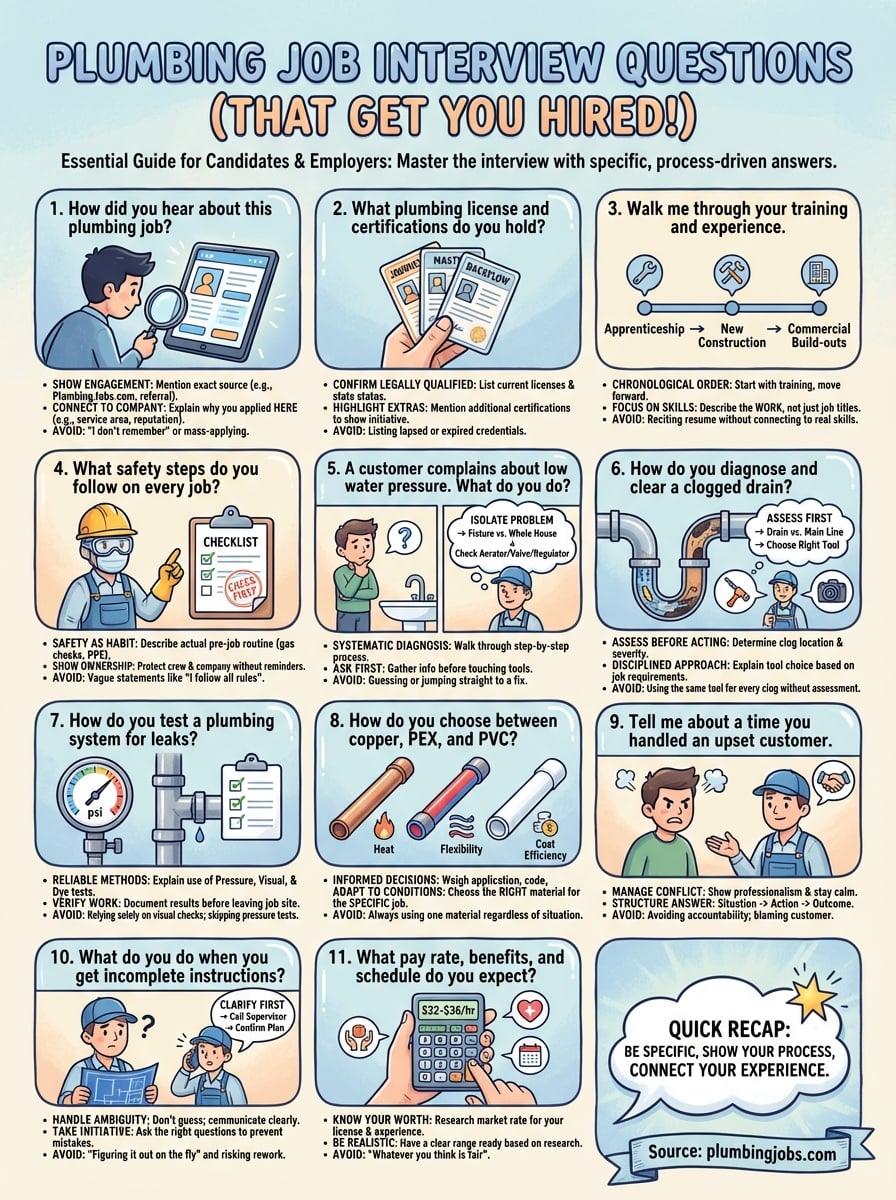
Quick recap and next steps
These 11 plumbing job interview questions cover the full range of what you’ll face on either side of the table, from licensing and technical diagnostics to compensation and customer conflict. The pattern across every answer is the same: be specific, show your process, and connect your experience directly to what the role requires. Generic answers get forgotten; detailed, experience-backed answers get you hired.
Preparation is what separates candidates who get offers from those who leave wondering what went wrong. Review these questions before your next interview, write out your own sample answers based on your real experience, and practice saying them out loud so they sound natural rather than rehearsed. The more specific your examples, the stronger your impression.
Ready to put that preparation to work? Whether you’re searching for your next position or looking to hire a qualified plumber, browse plumbing jobs across the US on PlumbingJobs.com and find your next opportunity today.
Want plumbing jobs delivered to your inbox?
Want plumbing jobs delivered to your inbox?
Partner Site

