

Commercial Plumber Salary: Pay Rates, States, Experience
Commercial plumbers handle complex systems in office buildings, hospitals, factories, and other large-scale facilities, work that demands specialized skills and comes with compensation to match. If you’re considering a move into commercial plumbing or trying to benchmark your current earnings, understanding commercial plumber salary ranges gives you a clearer picture of what’s realistic in this trade.
Hourly rates and annual pay vary significantly based on where you work, how long you’ve been in the field, and the type of projects you take on. A commercial plumber in California won’t earn the same as one in Texas, and a journeyman’s paycheck looks different from a master plumber’s. This article breaks down the numbers, national averages, state-by-state comparisons, and how experience shapes your earning potential.
At PlumbingJobs.com, we connect plumbing professionals with employers across the United States. We’ve compiled this salary data to help you make informed career decisions, whether you’re negotiating a raise, relocating for better opportunities, or just starting out in the commercial plumbing sector.
Current commercial plumber pay in the US
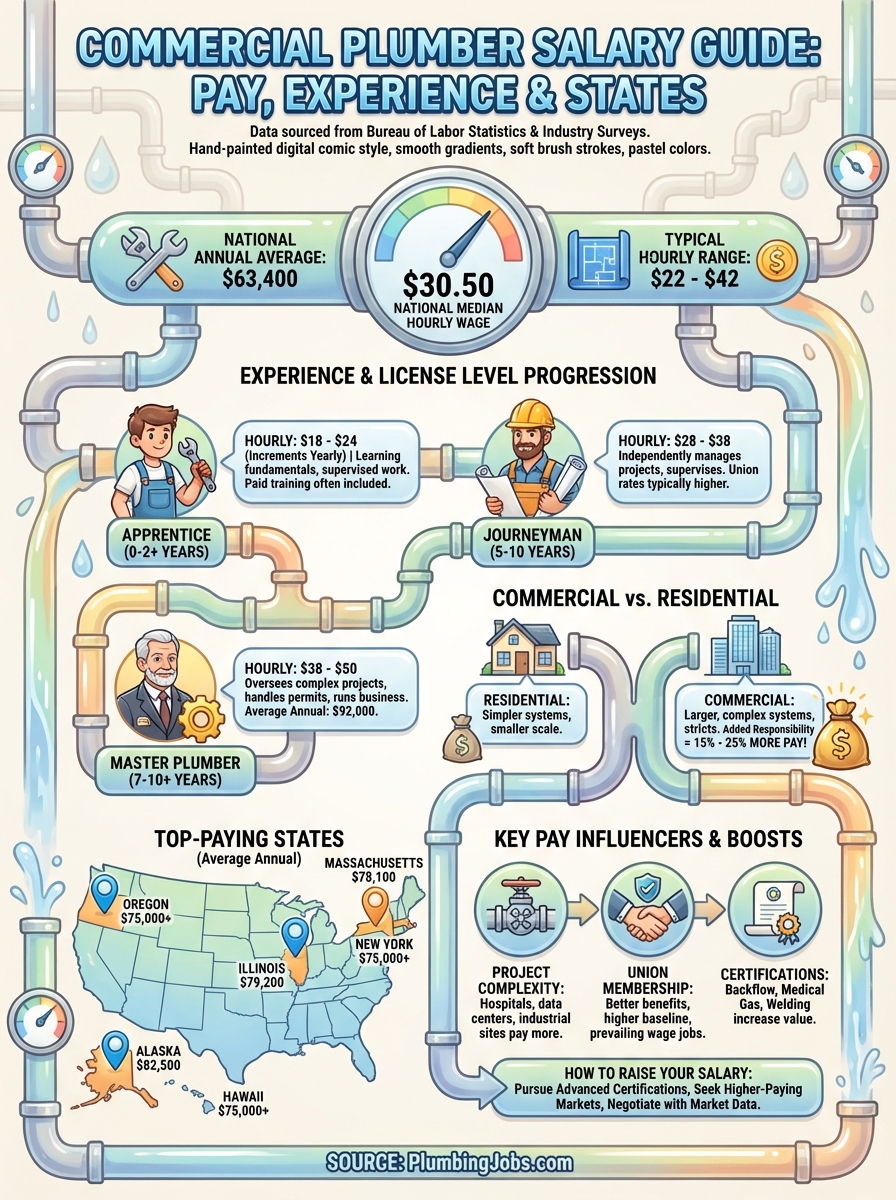
Commercial plumbers in the United States earn a median hourly wage of approximately $30.50, translating to an annual salary near $63,400 for full-time work. These figures reflect data from the Bureau of Labor Statistics and industry surveys that track compensation across the plumbing trade, though your actual earnings will depend on your location, credentials, and the complexity of systems you install or maintain. The $30.50 hourly baseline serves as a useful reference point when evaluating job offers or negotiating with employers.
National hourly and annual averages
Hourly pay for commercial plumbers typically falls between $22 and $42 depending on your skill level and regional market conditions. Entry-level positions with basic certifications start closer to the lower end of that range, while experienced plumbers working on high-stakes projects like hospital water systems or manufacturing facilities command rates at the upper threshold. You’ll find that annual earnings between $46,000 and $87,000 cover most commercial plumbers nationwide, with the middle 50% clustering around $55,000 to $72,000.
Full-time commercial plumbers usually log 2,080 hours per year, which assumes a standard 40-hour workweek without accounting for overtime. Many commercial jobs involve weekend or emergency callouts that push your hours higher, directly increasing your take-home pay through time-and-a-half or double-time rates. Overtime can add $10,000 to $20,000 to your base salary in busy markets where commercial construction or facility maintenance schedules demand round-the-clock availability.
How these numbers compare to residential work
Commercial plumbing work generally pays 15% to 25% more than residential positions because the systems you handle are larger, more intricate, and carry stricter code requirements. A residential plumber might install a single-family water heater, while you’re managing multi-floor supply lines, fire suppression networks, or medical gas systems that require specialized knowledge and liability insurance. Employers recognize this added responsibility and adjust commercial plumber salary offers accordingly.
Commercial projects demand more certifications and carry higher stakes, which translates directly into higher compensation for plumbers who can manage the complexity.
The gap widens further when you factor in union representation, which is more common in commercial settings. Union contracts often secure better health benefits, retirement contributions, and standardized wage increases that residential plumbers working for small shops may not receive. Your total compensation package in commercial work typically includes these extras on top of base pay, making the real earnings difference even more pronounced than hourly rate comparisons suggest.
Pay by experience and license level
Your earning potential as a commercial plumber climbs steadily as you progress through licensing tiers and accumulate field experience. An apprentice just starting out won’t match the commercial plumber salary of a master plumber who’s spent fifteen years troubleshooting complex building systems, and that gap reflects both your technical capabilities and the value employers place on proven expertise. Understanding where you stand in this progression helps you set realistic income goals and plan the certification steps that unlock higher pay brackets.
Entry-level and apprentice rates
Apprentices in commercial settings typically earn between $18 and $24 per hour during their first two years on the job. You’re learning to read blueprints, install large-scale pipe networks, and handle tools under the supervision of licensed plumbers who train you on everything from threading steel pipe to testing backflow prevention devices. Your pay increases incrementally as you complete each year of your apprenticeship program, with third- and fourth-year apprentices often reaching $24 to $30 hourly once they demonstrate competence in tasks like rough-ins or drain testing.
Most apprentices work full-time while attending evening classes or weekend training sessions required for state licensure. Employers who sponsor your apprenticeship may cover tuition costs or provide paid time for coursework, adding indirect value to your total compensation package even when your base hourly rate sits below fully licensed plumbers.
Journeyman commercial plumber earnings
Journeyman plumbers with valid state licenses command $28 to $38 per hour in most commercial markets. You’ve passed your licensing exam, logged the required supervised hours, and can now work independently on projects like installing water heaters in apartment complexes or maintaining HVAC systems in office towers. Your five to ten years of experience at this level lets you bid on jobs, supervise apprentices, and take on specialized roles that push your earnings toward the higher end of the range.
Journeyman status marks the point where your career shifts from learning fundamentals to mastering complex installations and building a reputation that drives repeat business.
Union journeymen often secure hourly rates closer to $38 through collective bargaining agreements that standardize wages across contractors. Non-union journeymen may negotiate individually, which creates wider pay variation but also gives you flexibility to leverage strong performance reviews or niche certifications into faster raises.
Master plumber compensation
Master plumbers certified to oversee commercial projects earn $38 to $50 per hour, with top earners in high-demand specialties breaking $55 when they manage large teams or handle critical infrastructure like hospital water systems. You’ve met the strictest licensing requirements, typically including seven to ten years of documented experience and passing rigorous exams on code compliance, system design, and safety protocols. Employers hire you to approve permits, train junior staff, and guarantee that installations meet regulatory standards, responsibilities that justify the premium pay.

Your master license opens doors to project management roles, consulting work, or starting your own contracting business where you control billing rates and profit margins. Salary data shows master plumbers in commercial settings average around $92,000 annually when they work full-time, though overtime and bonuses can push total compensation past six figures in busy metropolitan areas.
Salary by state and high-paying metros
Geographic location shapes your commercial plumber salary more than almost any other factor, with coastal states and major metro areas offering wages that can exceed national averages by $15,000 to $30,000 annually. You’ll find that cost of living doesn’t always move in lockstep with pay scales, which means some regions offer better purchasing power despite lower nominal wages. Researching state-specific rates before you relocate or negotiate a job offer gives you leverage to maximize your earning potential while accounting for housing costs, taxes, and local demand for commercial plumbing expertise.
Top-paying states for commercial plumbers
Alaska leads the nation with commercial plumbers averaging $82,500 per year, driven by extreme weather conditions that require constant system maintenance and a limited workforce willing to handle the climate. Illinois follows at $79,200, bolstered by Chicago’s dense commercial real estate market and strong union presence that negotiates higher baseline wages. Massachusetts rounds out the top three at $78,100, where strict building codes and a concentration of hospitals, universities, and tech campuses create steady demand for skilled plumbers who can handle specialized installations.

States with harsh climates or dense commercial construction activity consistently pay premium rates because the work is more demanding and qualified plumbers are harder to recruit.
New York, Hawaii, and Oregon also break the $75,000 threshold, though you’ll need to weigh those figures against each state’s cost of living. Your take-home purchasing power in Oregon might stretch further than an equivalent salary in Manhattan, even when the nominal difference seems small on paper.
High-wage metropolitan areas
The San Francisco Bay Area tops metropolitan rankings at $95,200 annually for commercial plumbers, reflecting California’s high construction costs and tech-driven commercial expansion. New York City follows at $88,700, where union contracts and 24-hour building operations push both base wages and overtime opportunities higher. Chicago commercial plumbers earn around $84,300, benefiting from a robust industrial sector that requires specialized pipe fitting and process plumbing expertise.
Smaller metros like Fairbanks, Alaska and Trenton, New Jersey also deliver above-average wages without the intense competition or living expenses you’d face in larger cities.
What moves commercial plumber pay up or down
Several market forces and individual factors determine whether your commercial plumber salary lands at the higher or lower end of the pay spectrum. Understanding these variables helps you identify which elements you control directly and which reflect broader economic conditions in your region. Employers adjust compensation based on project demands, labor shortages, and the specialized skills you bring to each job site, creating pay differences that can shift your annual earnings by $10,000 to $25,000 depending on how many of these factors align in your favor.
Project type and complexity
You’ll earn more working on high-stakes projects like hospital mechanical systems, data centers, or industrial facilities where mistakes carry serious consequences and installations require meticulous attention to code compliance. Employers pay premium rates for plumbers who can handle medical gas piping, cleanroom water systems, or process piping in manufacturing plants because these jobs demand specialized knowledge beyond standard commercial installations. Routine office building work or retail space plumbing pays closer to baseline rates since the systems are simpler and risk levels lower.
Union membership and prevailing wages
Union plumbers consistently earn 15% to 30% more than non-union counterparts because collective bargaining agreements set minimum wage scales, guarantee annual raises, and secure better benefits packages. Your union membership also qualifies you for prevailing wage projects on government-funded construction, which legally mandates higher hourly rates that can exceed $45 to $55 in some metro areas. Non-union plumbers negotiate individually, which creates more pay variation but lacks the standardized protections and automatic increases union contracts provide.
Union representation and prevailing wage laws create a floor under your earnings that protects against downward pressure during economic slowdowns or periods of high competition.
Certifications and specialized skills
Additional credentials like backflow prevention certification, medical gas installer licenses, or welding certifications increase your value to employers who need those specific skills on complex projects. You command higher rates when you can test fire suppression systems, install grease interceptors, or work with exotic materials like stainless steel or copper that require specialized joining techniques.
How to raise your commercial plumber salary
Boosting your earnings requires deliberate career moves that position you as a more valuable asset to employers or create opportunities to work on higher-paying projects. You control several factors that directly influence your commercial plumber salary, from the credentials you hold to where you choose to work and how aggressively you negotiate compensation packages. Taking action on these strategic levers can add $8,000 to $20,000 to your annual income within one to three years, depending on your current situation and which improvements you prioritize first.
Pursue advanced certifications
Additional credentials immediately justify higher pay because they qualify you for specialized work that fewer plumbers can handle. Target certifications like backflow prevention, medical gas installation, or welding that open doors to hospital projects, pharmaceutical facilities, or industrial sites where employers pay premium rates for expertise. You can complete most specialized courses in three to six months while working full-time, and the investment typically pays for itself within the first year through increased billing rates or eligibility for better-paying positions.
Employers pay more for skills that solve specific problems on high-value projects, making targeted certifications one of the fastest paths to a salary increase.
Seek higher-paying markets
Relocating to states or metro areas with stronger commercial construction activity and higher wage scales can boost your earnings more dramatically than years of incremental raises in a low-wage region. Research markets like Alaska, Illinois, or the San Francisco Bay Area where commercial plumbers earn $75,000 to $95,000 annually, then factor in cost of living to determine if the move makes financial sense. Union membership in your new location often provides immediate access to prevailing wage projects that guarantee higher hourly rates than non-union work.
Negotiate based on market data
Armed with salary information from resources like the Bureau of Labor Statistics, you can make data-driven cases for raises that match your experience level and regional benchmarks. Present specific figures showing what journeyman or master plumbers earn in your metro area when you request pay increases, and highlight any specialized skills or certifications that justify rates above the median. Employers who want to retain skilled workers will respond to well-researched requests backed by objective market data rather than vague appeals for more money.
Next steps to find a better-paying job
Armed with comprehensive commercial plumber salary data, you can evaluate job offers more objectively and negotiate from a position of knowledge rather than guesswork. Compare your current compensation against the state-by-state figures and experience-level benchmarks we’ve outlined, then identify concrete steps like relocating to higher-paying markets, pursuing specialized certifications, or joining a union that secures better wage scales. Your next career move should target positions that match both your skill level and the market rates specific to your chosen geographic region.
PlumbingJobs.com connects you with employers across the United States who are actively hiring commercial plumbers at competitive rates in every major metro area. Browse our job listings to see real-time salary offers in your target markets, set up email alerts for new opportunities that match your qualifications and desired pay range, and visit our blog regularly for updates on industry trends, licensing requirements, and emerging high-demand specialties that command premium compensation in commercial plumbing.
Want plumbing jobs delivered to your inbox?
Want plumbing jobs delivered to your inbox?
Partner Site

